
CARICOM | Sir Kenneth Hall Gives P.J. Patterson’s Caribbean Vision a Name and a Permanent Place in Regional Thought: “The Patterson Doctrine”
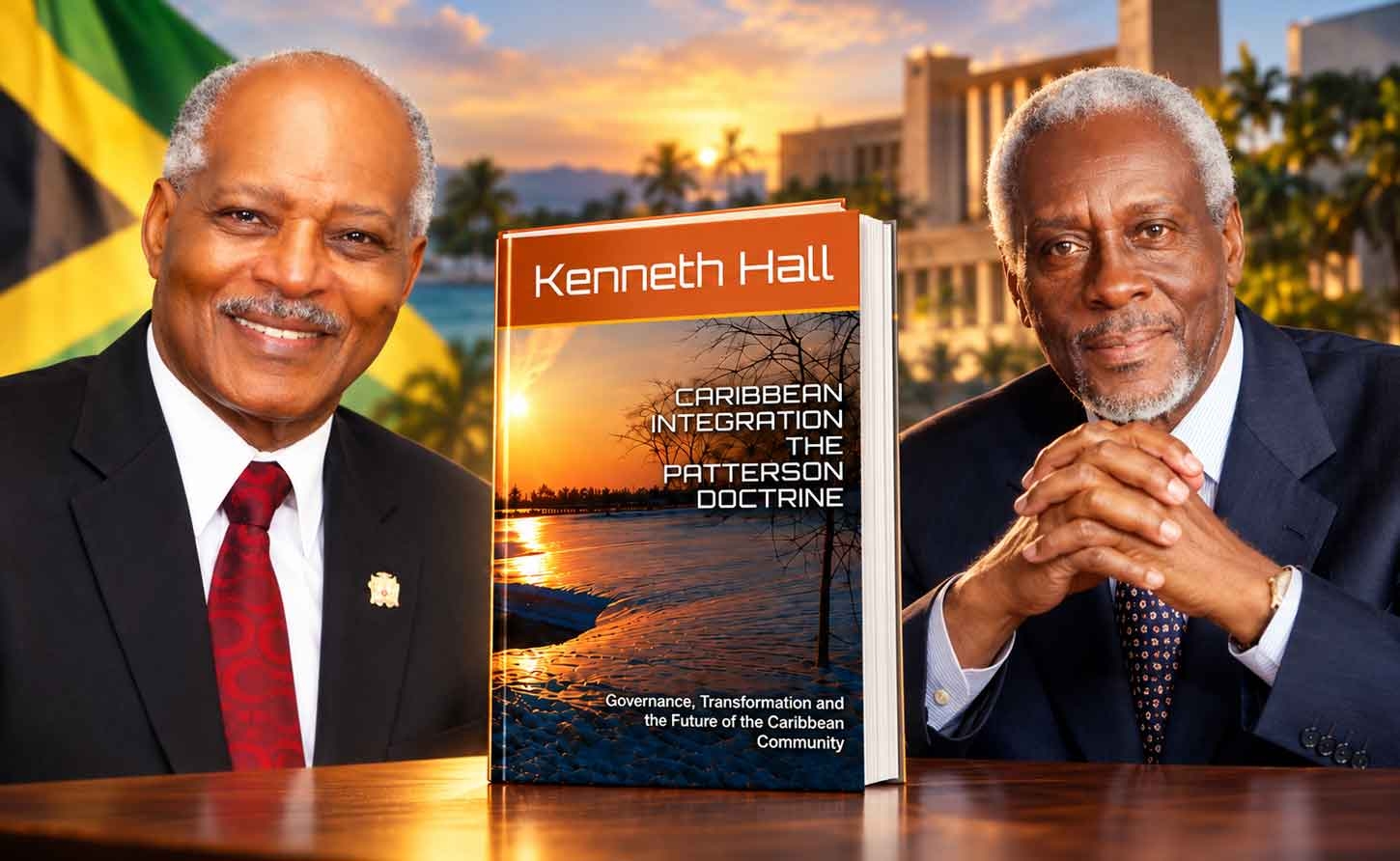
From Left: Sir Kenneth O. Hall, former Governor General of Jamaica and the Most Hon. PJ Patterson, former Prime Minister of Jamaica.
Caribbean Integration — The Patterson Doctrine: Governance, Transformation and the Future of the Caribbean Community By Sir Kenneth O. Hall | The Integrationist, 2026 | 13 chapters, epilogue, bibliography, documentary appendices and index. The former Governor-General's sweeping new study argues that Jamaica's longest-serving Prime Minister did more than steer CARICOM — he gave it a philosophy.
MONTEGO BAY, Jamaica, November 8, 2026 - Calvin G. Brown | Every political tradition eventually needs someone to write it down properly. For the Caribbean integration movement in the age of globalisation, that someone is Sir Kenneth Hall. His new book does something no earlier study has done: it argues that the long public life of the Most Honourable P.J. Patterson amounts to a coherent, teachable philosophy of regional governance, and it gives that philosophy a name that is likely to last — the Patterson Doctrine.
The book will be launched on Sunday, November 15, at the University of the West Indies, with Barbados Prime Minister Mia Amor Mottley as guest speaker. The setting fits. Hall served as Principal of UWI's Mona Campus before becoming Jamaica's Governor-General. And in 2006 it was at Mona that Patterson chose to stage the ceremony marking the CARICOM Single Market, calling the university a regional centre of learning and of regional consciousness. Hall's book is in many ways a return to that hall of ideas.
A doctrine, not a résumé
Hall's central claim is set out early and pursued without wavering. Patterson's achievements as Jamaica's sixth Prime Minister and its longest-serving Head of Government are widely known. What has been missing, Hall writes, is serious attention to "the conceptual coherence of his regional vision." The book exists to supply it.
Hall draws the line sharply. The founding generation — Norman Manley, Sir Grantley Adams, Eric Williams, Errol Barrow, Forbes Burnham, Sir Arthur Lewis, William Demas, Alister McIntyre and Shridath Ramphal — built the house. Patterson's contribution, as Hall tells it, was to make that house work in a harsher century.
"Whereas the founders concentrated primarily upon creating regional institutions," Hall writes, "Patterson concentrated upon transforming those institutions into dynamic instruments of implementation." The shift, in his words, was "from aspiration to delivery; from regional symbolism to measurable outcomes."
From there Hall sets out the doctrine's six pillars with the clarity of a constitutional draftsman:
- integration is irreversible, because fragmentation weakens sovereignty and collective action strengthens it;
- regional institutions must adapt continuously;
- development must be people-centred;
- Caribbean diplomacy must become truly global, reaching Africa, Latin America, Asia and the wider Global South;
- knowledge, innovation and technology are the foundations of Caribbean competitiveness;
- regional leadership requires moral purpose.
Running through all six is the idea the book makes its own: "effective sovereignty." For small states, Hall argues, sovereignty cannot be measured by flags and constitutions alone. It is the practical capacity to shape the outcomes that decide a nation's development, and regional cooperation enlarges that capacity rather than surrendering it.
It is a bracing answer to the old fear that CARICOM costs its members their independence. For a region still arguing over free movement, a single economy and a common court, it could hardly be more timely.
Patterson at the centre
Hall leaves no doubt about who stands at the centre of this story. In his telling, Patterson is the statesman who carried the Caribbean project from the closing of the Cold War into a world of globalisation, climate vulnerability and shifting power. "Patterson did not simply preserve the integration movement inherited from Norman Manley, Eric Williams, Errol Barrow, Forbes Burnham, and Michael Manley," Hall argues. "He transformed it into a new paradigm of regional governance."
What makes the portrait convincing rather than merely admiring is the evidence. The book is built on Patterson's own words — his addresses to the Conference of Heads of Government, his statements on the Single Market, his speeches on Haiti and on the Community's duty to its people — and on the official record of CARICOM.
Its documentary centrepiece will make readers in western Jamaica sit up. That is the 2003 Rose Hall Declaration on Regional Governance and Integrated Development, adopted right here in Montego Bay at the 24th Meeting of Heads of Government under Patterson's chairmanship. Hall calls it "the pivotal institutional document" of the doctrine.
It reaffirmed CARICOM as a community of sovereign states while calling for "mature regionalism," an executive mechanism to drive implementation, a faster path to the Single Market and Economy, and stronger ties with Africa, Latin America, Asia and the Pacific. In a single text, Hall shows, almost every pillar of the Patterson Doctrine appears together.
The book is equally careful about what it does not claim. Hall is precise that the Single Market began with the 1989 Grand Anse Declaration, before Patterson's premiership. Patterson's achievement was to advance it, sustain it politically and see it through to implementation — "sixteen years," as Patterson himself put it at the 2006 launch, from commitment to reality.
That discipline is the book's quiet strength. Hall describes his aim as "neither hagiography nor political advocacy but rigorous scholarly interpretation grounded in historical evidence," and the result is a tribute that will stand up to scrutiny.
Built to be read
At close to 400 pages, this is a substantial work of scholarship, and it reads like one: formal, measured, written in the stately prose of the Caribbean intellectual tradition. But it is not a hard book to use. Every major section closes with a short "Reflections" passage that distils the argument and an "Observation" that points ahead to what comes next — more than 160 of these signposts in all. A student, a diplomat or a busy policymaker can follow the whole argument through them, or go straight to the chapters that matter most to them.
And the range is impressive. Chapters cover the colonial inheritance and the search for community, the architecture of CARICOM governance, the Single Market and Economy, the Caribbean Court of Justice and the "constitutionalisation" of integration, functional cooperation, collective diplomacy in a multipolar world, and a striking chapter on the University of the West Indies as the intellectual engine of "Caribbean civilisation."
The Patterson Doctrine chapter then draws the threads together. It extends the argument to reparatory justice, Africa–Caribbean partnership, climate resilience as national security, and youth and citizenship as the ultimate test of whether integration succeeds. Appendices reproduce the key documents with commentary, so readers can check the foundations for themselves.
Why it matters now
The book's closing pages are its most stirring, and its most relevant. Hall writes that Patterson treated history as a source of strength, not a chain: "Memory becomes the foundation of confidence rather than grievance; justice becomes the pathway to reconciliation; identity becomes the source of creativity rather than exclusion."
In an era of artificial intelligence, geopolitical rivalry and climate emergency, he argues, the doctrine still offers fixed points: knowledge as the primary strategic resource, ethical leadership as indispensable, and human dignity as "the ultimate measure of public policy."
"Small states need not accept marginality as their destiny," Hall writes. That sentence alone is worth the price of the book. It is also why it is fitting that Mia Mottley — who has carried the cause of small states, climate justice and reparations onto the world stage — should be the one to send it into the world.
The verdict
Caribbean Integration — The Patterson Doctrine is an important book by one of the few people with the standing to write it: a scholar of integration, a former head of UWI Mona and a former Governor-General. It gives Caribbean scholarship a framework it has lacked.
It gives policymakers a language for the next stage of CARICOM. And it gives P.J. Patterson what statesmen rarely receive while they are still with us — a rigorous, evidence-based account of the ideas that drove him, and a doctrine that will carry his name.
It belongs on the shelf of every student of Caribbean politics, every public servant in the region, and every citizen who still believes that small nations, acting together, can shape their own destiny. Sir Kenneth Hall has named the doctrine. History, one suspects, will keep it.
Caribbean Integration — The Patterson Doctrine: Governance, Transformation and the Future of the Caribbean Community will be launched on Sunday, November 15, 2026, at the University of the West Indies. The guest speaker is the Honourable Mia Amor Mottley, Prime Minister of Barbados.
-30-
