
JAMAICA | 194 Years On, the Scaffold Cannot Silence Daddy Sharpe
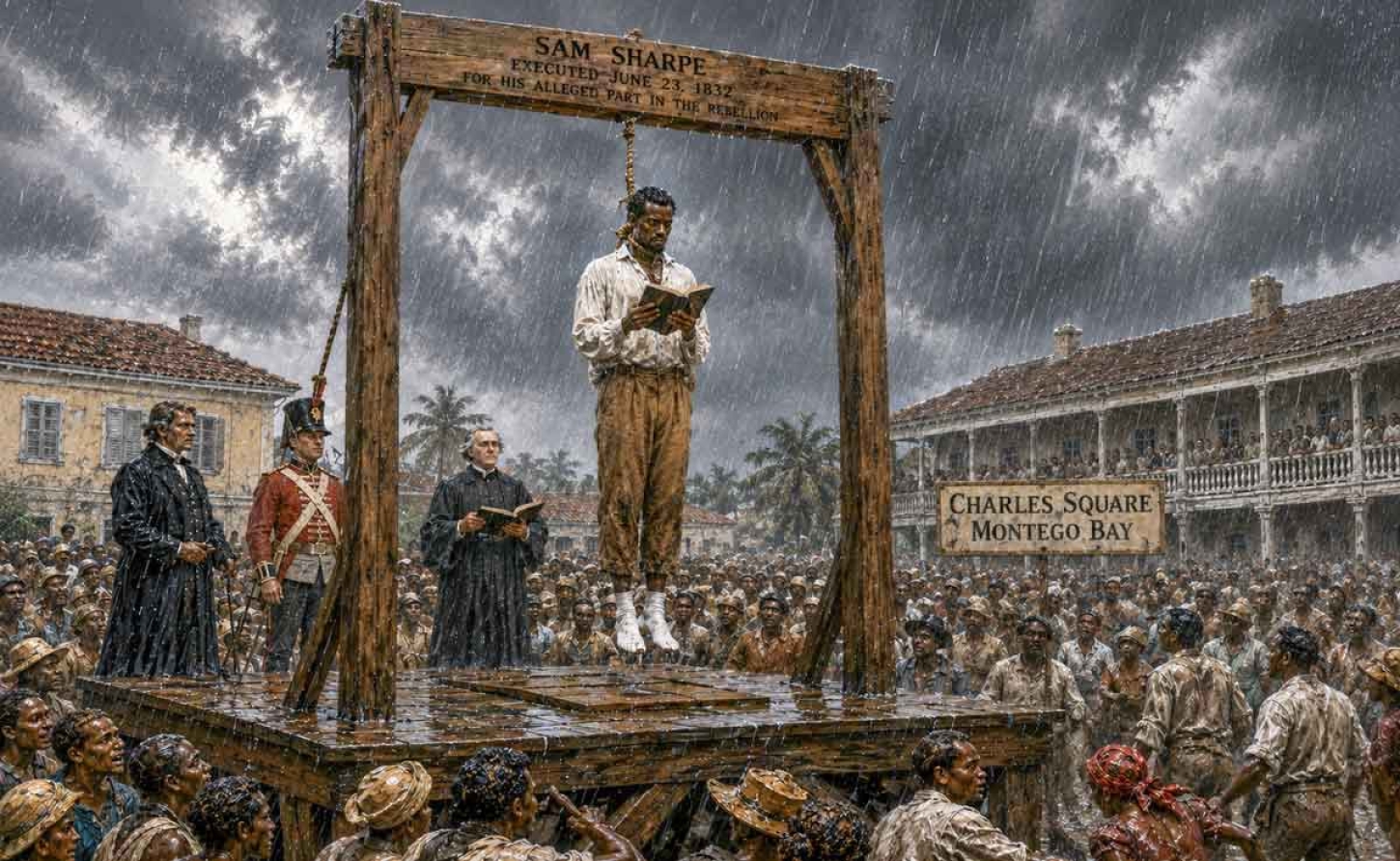
Created image of Sam Sharpe being hung in Charles Square on the 23rd of May 1832
On May 23, 1832, Jamaica — and the entire British Empire — hanged a man they feared more than any army. They were right to fear him.
CALVIN G. BROWN | HISTORY & HERITAGE | WIREDJA — MAY 20, 2026 - On May 23, 1832 — one hundred and ninety-four years ago this Friday — in the sun-baked square at the heart of Montego Bay, a man stood beneath the gallows and refused to flinch.
Samuel Sharpe — schoolteacher, Baptist deacon, organiser of the largest and most consequential slave rebellion in British colonial history — was publicly hanged on the charge of insurrection. They put a rope around his neck. They could not put one around his legacy.
Today, that square bears his name. His face graces Jamaica's fifty-dollar note. His name is etched among the nation's pantheon of National Heroes. But the full weight of what Daddy Sharpe did — and what it cost him — deserves more than the quiet reverence of a public holiday. It demands a reckoning with the audacity, the brilliance, and the deliberate moral courage of a man who chose death over degradation.
THE PLAN THAT SHOOK AN EMPIRE
Sharpe's genius was not the rage of a desperate man but the cool strategic mind of a revolutionary who understood power. In the weeks before Christmas 1831, he moved quietly through the enslaved communities of western Jamaica — in the great houses, the mission chapels, the cane fields — organising what was, in its original conception, an act of industrial action.
The plan was disciplined and deliberate: after December 27, the enslaved would lay down their tools and refuse to work until plantation owners committed to paying them wages. It was a strike — arguably the first organised industrial action in Jamaica's history.
The plantation class, drunk on centuries of absolute dominion, refused. They could not conceive of the people they had brutalised and commodified as having the moral authority to make demands. That miscalculation proved catastrophic for the colonial order.
“I would rather die on yonder gallows than live one more day of slavery.”— Samuel Sharpe, 1832
On the night of December 27, 1831, as it became clear that the planters would not yield, fire was set to the Kensington Estate. The signal blazed into the night sky, and across western Jamaica, the response was swift and searing. Palmyra answered. Falmouth responded. The emancipation war had begun. By the time it ended, fewer than fifteen of the nine hundred great houses that had stood across Jamaica remained intact.
The rebellion that historians would later call the Baptist War — and that we must claim as the Sam Sharpe War — had torn through the colonial fabric like a judgment long overdue.
THE TRIAL AND THE SENTENCE
The colonial courts were not interested in justice. They were interested in restoration — of order, of profit, of the fiction that enslaved Africans were content in their chains. On April 19, 1832, the verdict was formalised in language that dripped with the mundane cruelty of bureaucratic violence:
“The King against Samuel Sharpe — Tried and found guilty the 19th day of April 1832. Sentence: That the said Negro man slave named Samuel Sharpe be taken from hence to the place from whence he came and from thence to the place of Execution… and there to be hanged by the neck until he be dead.”
Signed by three men — John Coates, Robert Thomas Downer, and H.A. Plummer — the document reduced a towering human being to a legal formality. On May 23, 1832, the sentence was carried out in the public square. Sharpe walked to that gallows knowing exactly what he had done and why. His words, defiant and luminous, have outlasted every one of his executioners.
THE LIE THEY NEEDED TO KILL
To understand the full significance of what Sharpe did, one must understand the lie it demolished. The West India Lobby — a powerful coalition of absentee plantation owners and London merchants with enormous influence in Parliament — had spent years insisting that enslaved Africans in Jamaica were, in fact, content.
That they did not want to be free. That abolition would be a cruelty imposed on people who neither desired nor deserved liberty.
Sharpe's rebellion was the empirical refutation of that lie, written in fire across the Jamaican hillside. Nine hundred great houses reduced to fifteen ruins was not the action of a people satisfied with their condition. It was the declaration of a people who had decided, collectively and at enormous personal cost, that enough was enough.
The planters' own petition to the Jamaica House of Assembly inadvertently provided the most damning testimony of the rebellion's scale, describing it as a war “unparalleled in the history of the colony, whether for depth of design or the extent of misery and ruin which it has entailed on the inhabitants.”
Those “inhabitants,” of course, were the enslaved. The misery they referenced was the loss of property. They could not bring themselves to name what was actually being destroyed: the moral and economic architecture of chattel slavery itself.
THE RIPPLE THAT BECAME A WAVE
Within two years of Sharpe's execution, the Slavery Abolition Act of 1833 was passed by the British Parliament. The connection is not coincidental. The rebellion had made the cost of maintaining slavery — in blood, in treasure, and in the increasing difficulty of pretending to the world that the empire was a civilising force — simply too high to sustain.
Daddy Sharpe did not live to see emancipation proclaimed. But no honest accounting of abolition omits his name.
The freedom that spread across the British Caribbean — from Jamaica to Barbados, from Trinidad to British Guiana — was purchased, in no small part, by the courage of the men and women who followed Sharpe into that war. They were not collateral in someone else's political debate. They were the agents of their own liberation.
THE CRIME THE WORLD FINALLY NAMED
For 194 years, the world spoke of what was done to Samuel Sharpe's people in the language of history — distant, clinical, stripped of its full moral horror. That began to change on March 25, 2026, when the United Nations General Assembly voted 123 to 3 to formally declare the transatlantic slave trade “the gravest crime against humanity.”
The resolution, championed by Ghana’s President John Dramani Mahama on behalf of the 54-member African Group, broke the silence of institutions that had for too long treated the systematic abduction, commodification, and brutalisation of more than 12.5 million African men, women, and children as a matter of historical record rather than ongoing injustice.
The vote was not unanimous. The United States, Israel, and Argentina voted against. The United Kingdom and the entire European Union — whose nations built their modern wealth on the plantation system that hanged Samuel Sharpe — chose to abstain.
Their reticence speaks its own language. The Netherlands stands alone among European nations in having issued a formal apology for its role in the slave trade. The rest prefer the comfort of history’s passive tense.
Critically, it was CARICOM — the Caribbean Community that Samuel Sharpe’s descendants built — that co-sponsored the resolution alongside the African Union, affirming that the Caribbean has not forgotten what was done, nor forgiven it in silence.
The resolution calls on member states to engage in dialogue on reparations: formal apologies, financial compensation, the return of stolen cultural artefacts, and guarantees that the architecture of racial oppression will not be reconstructed.
It is non-binding. But as Ghana’s Foreign Minister Samuel Ablakwa declared in that chamber: “History does not disappear when ignored, truth does not weaken when delayed, crime does not rot… and justice does not expire with time.”
“History does not disappear when ignored, truth does not weaken when delayed, crime does not rot… and justice does not expire with time.”— Samuel Ablakwa, Ghana’s Foreign Minister, UN General Assembly, March 25, 2026
In Jamaica and across the West Indies in particular, no monument to slavery yet stands. No national memorial and no physical acknowledgment proportionate to the crime as if these horrors must continue to be hidden. The UN resolution, therefore, lands as both rebuke and challenge.
If 123 nations can vote to name this crime before the world, what is stopping the Caribbean from building the monument this crime demands? The absence of such a memorial is not an oversight. It is a choice — and on the 194th anniversary of the hanging of the man who made emancipation inevitable, it is a choice that demands an answer.
194 YEARS LATER: THE UNFINISHED BUSINESS
We do Sharpe a disservice if we reduce him to a statue and a square. Professor Verene Shepherd has warned that calls for Caribbean republicanism risk becoming mere symbolism rather than the final act of emancipation.
Professor Hilary Beckles has challenged the region to shed its “intellectual timidity” and complete the mission that Sharpe and his generation began. Those are not abstract academic provocations — they are invitations to interrogate what freedom actually means in 2026, when so many of the structural legacies of plantation capitalism remain stubbornly, deliberately intact.
194 years after a rope was placed around Samuel Sharpe's neck in the square that now bears his name, the Caribbean still wrestles with the inheritance of that system — in economic dependency, in the casualisation of labour, and in the ongoing extraction of regional wealth by former colonial powers. We are still enslaved.
Daddy Sharpe did not die so that his descendants could inhabit a more comfortable version of the same arrangement. He died so that they would be free — genuinely, structurally, unapologetically free.
That work is not finished. And on this day of all days, it is worth asking whether we are equal to the task he left us.
— 30 —
