
BRAZIL | Lula's Last Stand: Brazil's Old Lion Beats Back the Bolsonaro Dynasty
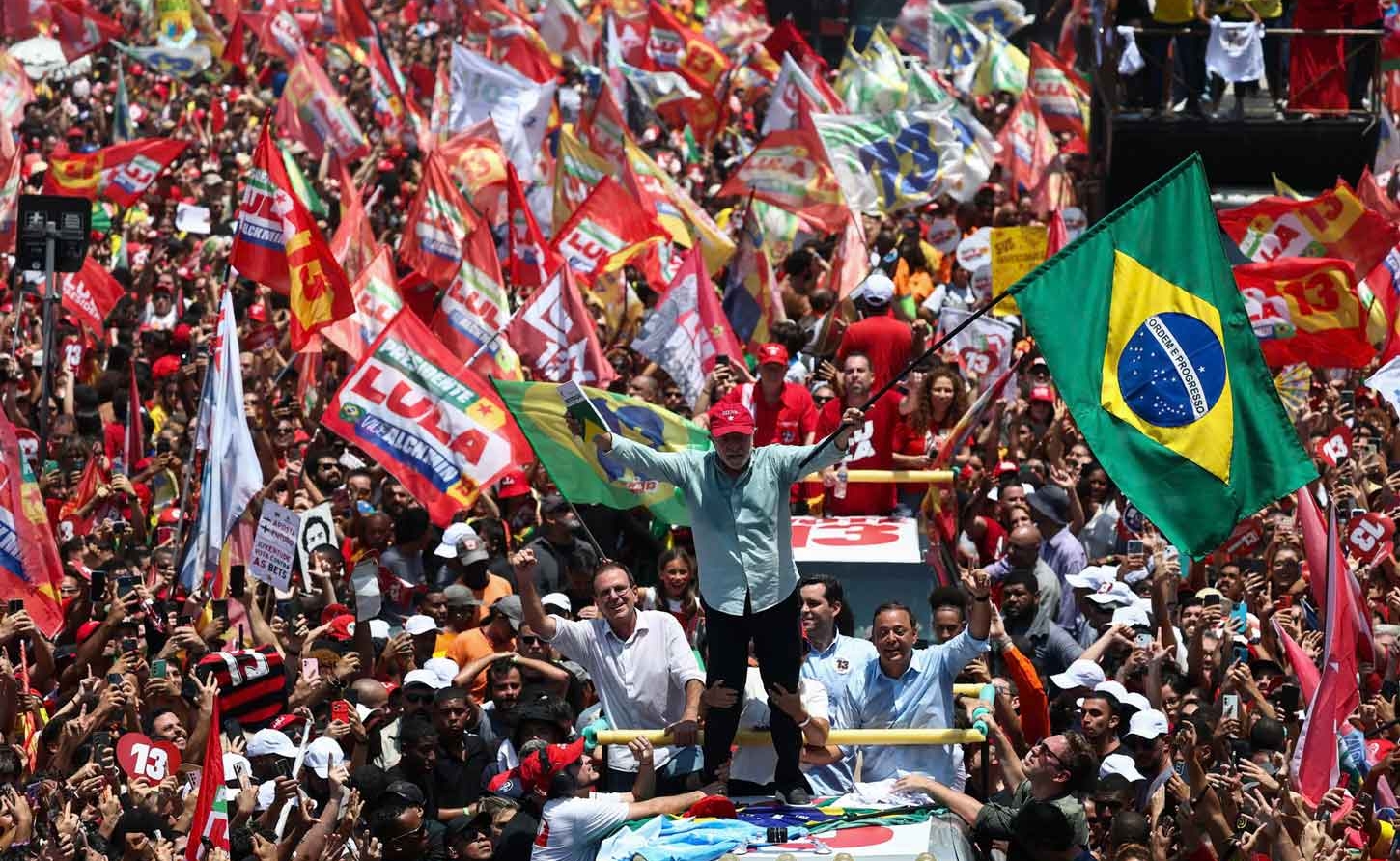
Lula attends a closing campaign rally ahead of the presidential runoff, at Copacabana beach in Rio de Janeiro, Brazil, on Saturday. Photograph: Agustín Marcarian/Reuters.
Written off after a first-round defeat, the 80-year-old president turned a 2.2 million-vote deficit into a 4.3 million-vote victory in three weeks — and handed Donald Trump's Latin American project its most painful setback yet.
MONTEGO BAY, Jamaica, October 25, 2026 |Calvin G. Brown | World | WiredJa — Three weeks ago, they were writing his political obituary. On Sunday night, Luiz Inácio Lula da Silva wrote the ending himself.
The Brazilian president, who turns 81 on Tuesday, stormed back from a first-round loss to defeat Flávio Bolsonaro in the run-off, taking 51.75 per cent of the vote to his far-right rival's 48.25 per cent with nearly 99 per cent of ballots counted. The result delivers Lula a historic fourth term and achieves something no candidate has managed since Brazil restored democracy in the 1980s: winning the second round after losing the first.
The arithmetic of the comeback is brutal in its clarity. Lula trailed by 2.2 million votes in early October. He won on Sunday by 4.3 million — a swing of more than six million ballots in 21 days. Not a drift, but a stampede.
The voters who stayed home, then didn't
Lula's allies had identified the problem early and named it plainly: his supporters were not turning up. The first round recorded an abstention rate of 21.08 per cent, the highest on record, and it fell hardest on the president's base — poorer Brazilians who live farther from polling stations and pay a higher price, in time and money, to cast a ballot.
A swing of more than six million ballots in 21 days — not a drift, but a stampede.
In the run-off, abstention dropped to 19.21 per cent. That two-point shift, concentrated in the neighbourhoods that bleed red for the Workers' Party, is the difference between a Lula retirement and a Lula fourth term.
The mobilisation was visible on the streets before it showed in the count. On Saturday, more than a million people packed Rio's Copacabana beach, and an even larger crowd filled Paulista Avenue in São Paulo, after weeks of student-led protests. Caio Marques, a 40-year-old photographer from Franca, told The Guardian without flinching: in the first round the left failed; in the second it woke up.
Sabotage on the buses
The victory came despite what many on the streets of São Paulo described as an attempt to rig the outcome by other means. The Guardian reported widespread anger over an apparent effort by pro-Bolsonaro politicians to disrupt public transport in Lula-leaning voting areas across the country on election day — a tactic aimed squarely at the voters who most need a bus to reach a ballot box.
Lucas Lopes, a 32-year-old public relations worker, called it another coup attempt by the extreme right. The allegation is untested and no official body has assigned responsibility. But in a country where the previous president is serving 27 years for plotting to overturn an election, the charge did not sound far-fetched to those making it.
A dynasty denied
That previous president is Jair Bolsonaro, Flávio's father, now living under house arrest in Brasília after his conviction for the botched power grab that followed his 2022 defeat to Lula. A Flávio victory was widely expected to open the door to his father's release and a role in government. That door is now shut, and the Guardian described the mood in the capital as one of anger and bewilderment.
The 45-year-old senator ran as heir to a movement, not merely a candidate. His defeat leaves Bolsonarismo without the prize it was built to win, though it would be reckless to pronounce it dead: more than 48 per cent of Brazilians voted for it on Sunday. Lula will govern a country split down the middle as the oldest president in its history, with no obvious successor and a constitution that bars him from running again.
Why the Caribbean should care
From Kingston to Georgetown, this is not a distant result. Brazil is the largest economy in Latin America, shares land borders with CARICOM members Guyana and Suriname, and for 13 years led the UN stabilisation mission in Haiti. Under Lula it has become the loudest voice of the Global South, a founding pillar of BRICS, and a counterweight to Washington's instincts in the hemisphere.
A Bolsonaro presidency would have placed a Trump-aligned government on the region's southern flank, joining Javier Milei in Argentina, José Antonio Kast in Chile, Daniel Noboa in Ecuador and Abelardo de la Espriella in Colombia in a bloc the Trump regime openly hoped to complete. The Bolsonaro clan was the US president's most important ally in the hemisphere's largest country. That ally has lost, and the map of the Americas looks different because of it.
Reginaldo Lopes, a senior Lula ally, told The Guardian the result was Brazil telling the world that the extreme right is fascist and stands against Black people, the poor and the state itself. Strip away the campaign heat and the point stands: a majority of the Afro-descendant nation with the largest Black population outside Africa chose a former factory worker over a dynasty.
The last chapter
Lula was born in rural poverty, rose as a union leader in São Paulo's industrial belt in the late 1970s, lost three presidential elections before winning in 2002, served two terms, went to prison, walked out, beat the elder Bolsonaro in 2022 and has now beaten the younger. There is no fifth act. The constitution forbids it, and so, eventually, will time.
Which is why Sunday matters beyond the margin. Lula showed that a right-wing surge built on voter demobilisation can be reversed by the simple, exhausting work of getting people to the polls. For a region watching its own democracies strain under polarisation and foreign pressure, that lesson is worth more than any single result.
The old lion has one more term. Brazil, and its neighbours, will find out what he does with it.
— 30 —
