
CARIBBEAN | From Hopewell to the World: Hope Markes Takes the Helm of Kiwanis International
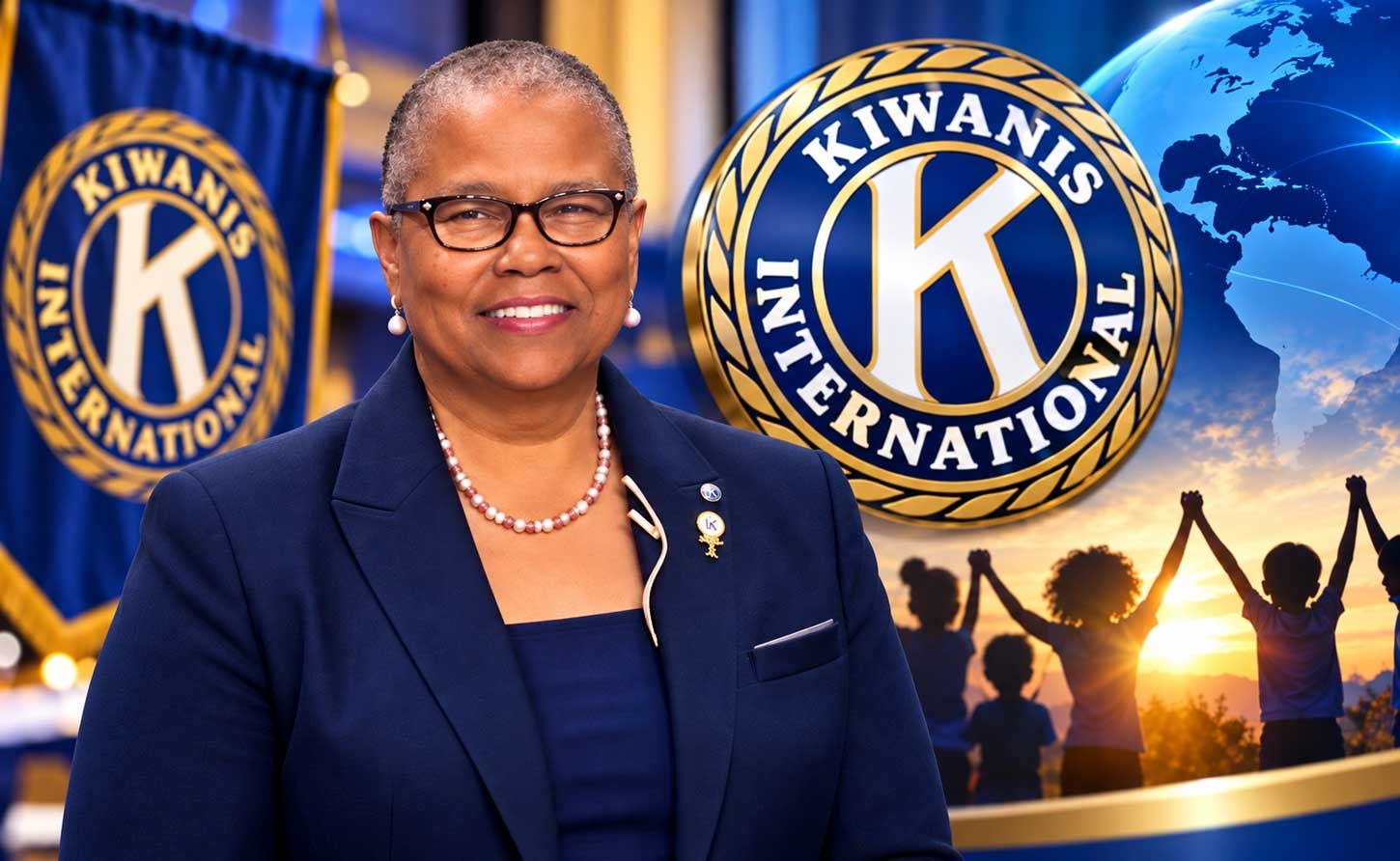
Newly installed president of Kiwanis International, Hope Markes
A charter member of a small Hanover service club now leads one of the world’s largest volunteer organisations. She is the first Black woman and the first Caribbean national to do so in its long history.
MONTEGO BAY, Jamaica, Calvin G Brown | October 10, 2026 | Some journeys to the top of the world begin in its capitals. Hope Markes’ began in Hopewell, a Hanover community better known for sea breeze and fishing canoes than for global boardrooms.
On October 1, 2026, Markes assumed office as president of Kiwanis International. She was elected in Manila, Philippines, at the House of Delegates session of the organisation’s 2026 convention, with a term that began on October 1. From her Jamaican base, she now leads a membership that spans 84 countries and 53 districts.
The title alone would be remarkable. The history attached to it is more remarkable still. The Jamaica Gleaner records that Markes is the first Black woman and the first Caribbean national to head the organisation in its more than 110 years. For a region more used to sending members to the convention floor than presidents to the podium, this is a seat at the head of the table.
A glass ceiling, raised slowly
 Kiwanis was founded in 1915. For most of the century that followed, its presidency was a men’s preserve. The organisation did not elect its first woman president until 2016, when a district newsletter of the time celebrated the glass ceiling finally breaking.
The decade since has been brisk by comparison. Roy Hedeen spent 38 years in Kiwanis, including as a senior staffer at its Indianapolis headquarters. He told the Gleaner that in more than a century, the organisation has had only three other women presidents, all of them within the last ten years. Markes is the fourth. She is also the first to arrive by way of the Caribbean.
Hedeen sees the moment as one of identity, not only arithmetic. He told the Gleaner that her rise “really reflects the diversity of our membership worldwide.”
That diversity has long been the Caribbean’s quiet contribution. Jamaica’s clubs sit within the Eastern Canada and Caribbean District. Hedeen describes it as a jurisdiction spanning 17 countries, including Canada, and several languages. Caribbean Kiwanians have spent decades holding fund-raisers, staffing basic-school projects and filling convention halls. What the region had rarely done was set the agenda from the top.
Markes first breached that wall in 2021, when she became the first Black woman elected to the Kiwanis International Board. Her presidency completes the climb.
The long climb
Markes did not arrive at the summit by helicopter. She walked up, one office at a time.
The path began about a quarter-century ago, when she was among the founders of the Kiwanis Club of Hopewell. She went on to serve as its president twice, from 2001 to 2003 and again from 2015 to 2017. Under her leadership as president and secretary, the club earned Kiwanis International’s Distinguished Award. Her ambition showed early. She won election as lieutenant governor while still a sitting club president, three months before her presidential term ended.
The district beckoned next. Markes served as lieutenant governor for Division 25 and then rose to governor of the Eastern Canada and Caribbean District for 2013-14. Hedeen, who worked with her in that period, called her “the hardest worker I’ve ever seen, always with a smile,” according to the Gleaner.
The international stage followed. As a trustee from 2021, Markes chaired the Leadership and Education Committee. She also sat on the Executive, Risk Management, and Audit and Finance committees. The real test came in Denver in July 2024. There she contested the vice presidency against two men, from Louisiana and North Dakota, and won.
From then on, the Kiwanis ladder did the rest. In Pittsburgh in 2025, delegates elected her president-elect, which positioned her for the 2026-27 presidency. Manila made it official.
Along the way she gathered honours. They include the George F. Hixson and Walter Zeller fellowships, recognition as a Mel Osborne Fellow and Champion for Children, and the Godfrey Dyer Medallion from the Kiwanis Foundation of Jamaica.
Rooted in Hopewell
Kingston can claim her birth. She was born in the capital, attended Alpha High School and Alpha College, and graduated from St Joseph’s Teachers’ College. But Hanover claims her heart.
Markes' journey with Kiwanis began after she relocated from Kingston to Western Jamaica, drawn by opportunities in the burgeoning hospitality sector.
The move from Vineyard Town to Hopewell, Hanover wasn't just a change of address; it was a transformation that would expand her understanding of service from the urban activism of her Kingston roots to the community-building imperatives of Jamaica's tourism heartland.
In Hopewell, she found a community ready for her leadership. As a charter member of the Kiwanis Club of Hopewell, she didn't just join; she built. She served as club president twice, taking on the foundational work of fundraising, membership growth, and public relations.
"Whatever I've accomplished," Markes often says, "I attribute it mainly to being nurtured and loved by my parents and my family. They believed in putting children first." It's a philosophy that carried her from the streets of Vineyard Town to Western Jamaica's tourism corridor, and ultimately from the Kiwanis Club of Hopewell to the precipice of history.
Her mother saw the vocation first. “My calling for children was always there,” Markes told the Gleaner. She added that her mother “recognised it early.” She trained in early childhood education, and that calling has guided her ever since. Today she runs a resort-property management business in western Jamaica.
Over the years she has served on the boards of the Sandy Bay Primary and Junior High School, the Parish Hospital and the Hanover Community Development Commission, and as vice chair of the Bethel Infant School. Last year she helped deliver a water tank to Haddington Basic School, a joint effort with Kiwanians from Toronto.
Back at the Hopewell clubhouse, the news landed like a family wedding announcement. “One member broke down in tears right away,” Nicolette Wilson of the Kiwanis Club of Hopewell told the Gleaner. She describes the club as a “little big club”, modest in numbers but large in impact. She credits Markes with a leadership style that “gives you the space to make your own mark.”
The global itinerary has not changed her address. “My base is Jamaica,” Markes says.
The job ahead
The presidency brings prestige but no pay. “It is not a paying job,” Markes told the Gleaner plainly. “It’s volunteer work, and you give of your time selflessly.”
The work itself is considerable. Kiwanis has about 155,000 members worldwide. Jamaica alone has roughly 3,000 members in nearly 100 clubs, which makes the island one of the movement’s more fertile grounds. Markes is clear about her priority. “Growth is about legacy,” she has said. “If we don’t grow, that legacy fades.”
“I want people to say, ‘Hope tried it, let me try, too.’” — Hope Markes
Her presidency also opens at a tender moment for her home. In a few weeks Jamaica will mark one year since Hurricane Melissa. The Category 5 storm made landfall on the island’s south-western coast on October 28, 2025, and the government estimated that some 400,000 people were affected. For an organisation built on serving children, a Jamaican at the helm during the island’s recovery year is no small thing. She will know, from the ground up, what rebuilding a basic school or a community actually costs.
Still, the most lasting part of her presidency may be the example it sets. “I want people to say, ‘Hope tried it, let me try, too,’” Markes says. “If you believe in something and go for it, even if you don’t achieve it, you haven’t lost.”
From Hopewell, someone tried. The world said yes.
— 30 —
