
DIASPORA | Nowhere to Hide: Inside the Quota-Driven Immigration Dragnet Engulfing Caribbean Communities in America
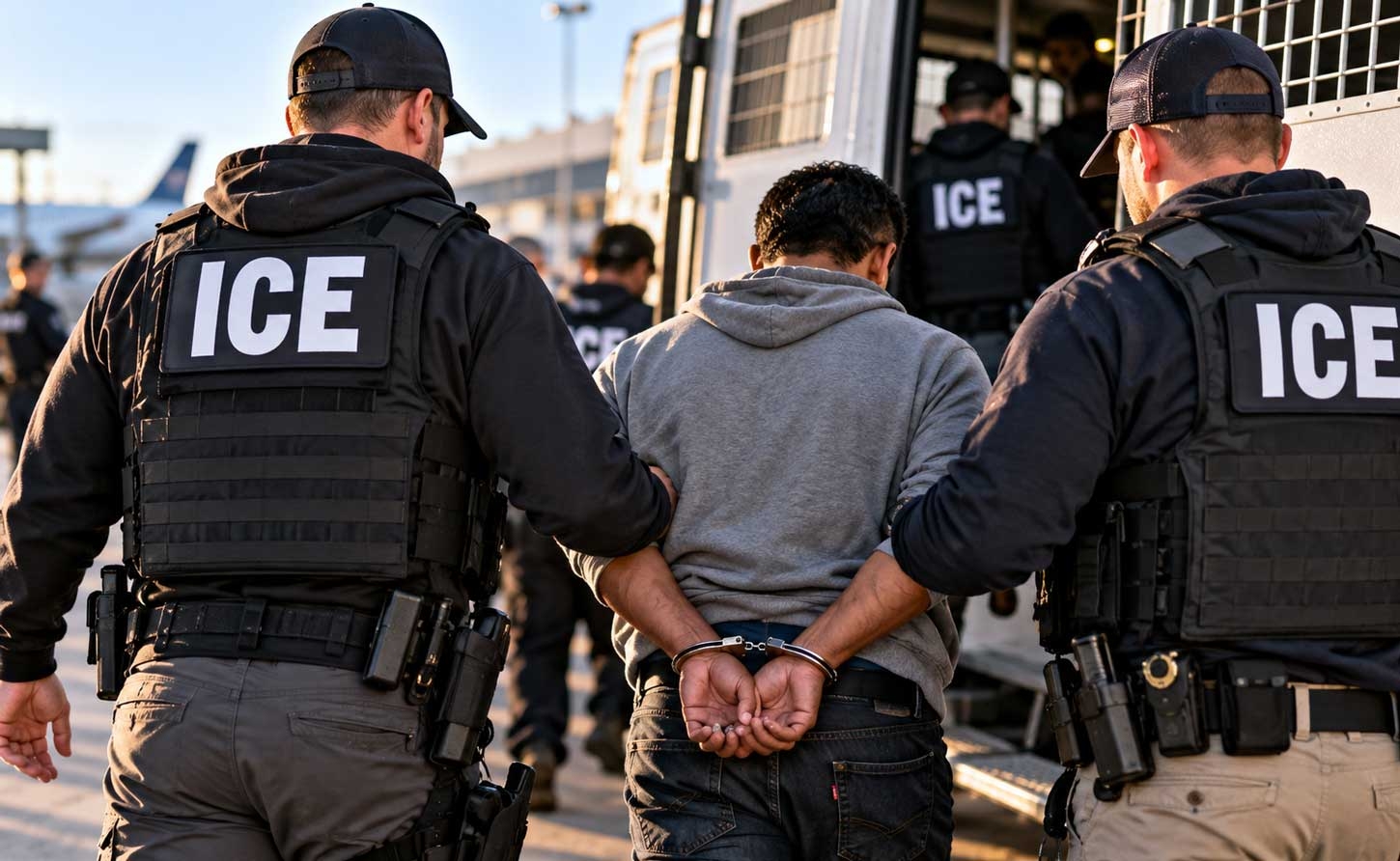
ICE agents began appearing at major US airports in force from March 2026, targeting foreign nationals with expired visas — a dramatic expansion from the previous practice of only detaining those with existing removal orders.
As the Trump regime pushes ICE toward 3,000 arrests per day, the Caribbean diaspora finds itself caught in an enforcement machine that has abolished every safe space — from churches and hospitals to school gates and asylum interviews
MONTEGO BAY, JAMAICA, October 09, 2026 - There was a time — measured not in decades but in months — when a Jamaican mother dropping her child at school in Brooklyn could do so without scanning the street for unmarked federal vehicles. When a Trinidadian grandmother attending Mass at her parish church in Miami could worship without wondering whether the men in the back pew carried badges. When a Guyanese father driving to his construction job in Houston could be pulled over for a broken taillight without being detained, cuffed, and entered into a deportation pipeline. That time is over.
The Trump regime's Immigration and Customs Enforcement apparatus has, through a systematic dismantling of longstanding protections and a relentless escalation of arrest quotas, transformed virtually every space in American public life into a potential enforcement zone. For Caribbean nationals — whether undocumented, holding expired visas, awaiting asylum decisions, or in some documented cases holding valid work permits — there is now, quite literally, nowhere in America that is safe from detention.
The quota machine
The numbers tell a story of escalation that has accelerated with each passing month. In January 2025, the White House directed ICE field offices to meet a quota of 75 arrests per day each — roughly 1,200 to 1,500 nationally. By May 2025, White House Deputy Chief of Staff Stephen Miller and then-Homeland Security Secretary Kristi Noem delivered a new directive in a meeting so aggressive that senior ICE officials feared being fired: 3,000 arrests per day, or more than one million per year.
Miller subsequently confirmed the figure on Fox News. The Department of Justice later told a federal court that no such quota exists and that enforcement is based on "individualized assessments" — a direct contradiction of Miller's own public statements.
The reality on the ground has fallen somewhere between the rhetoric and the denial. ICE recorded more than 43,000 arrests in June 2026 alone — an average of 1,438 per day, the highest monthly total since Trump's return to office. In late June, more than 10,000 people were detained in a five-day period, roughly 2,000 per day, with the White House pushing for that pace to become the new operational baseline.
More recently, ICE agents have been called into mandatory seven-day work weeks under a "100% manpower surge effort" pushed, according to agency sources, at the last minute. The regime's appetite for higher numbers shows no sign of diminishing.
The abolition of safe spaces
What makes the current enforcement regime qualitatively different from any previous administration — including Trump's first term — is the systematic elimination of every location that was once considered off-limits.
On January 21, 2025, the Department of Homeland Security revoked the Biden-era sensitive locations policy, a directive first enacted in 2011 that prohibited ICE and Customs and Border Protection officers from making arrests at schools, houses of worship, hospitals, shelters, funerals, weddings, and public demonstrations. DHS declared that "criminals will no longer be able to hide in America's schools and churches."
The consequences have radiated across every dimension of daily life. Caribbean nationals in the United States can now be targeted for enforcement and detention at their homes; during vehicle stops on their way to work; at their workplaces, including construction sites; at USCIS field offices during immigration interviews, including asylum interviews; at routine ICE check-ins; at airports and other transportation hubs; on university campuses; during school drop-offs and pick-ups; in hospitals; and at houses of worship.
This is not theoretical. The American Immigration Lawyers Association has documented ICE arrests at USCIS field offices in multiple cities, where people attending required immigration interviews — a mandatory part of the legal process — have been detained on the spot. Internal ICE documents obtained by the Washington Post showed officers instructed to arrest people at courthouses immediately after judges dismissed their cases.
ICE agents began appearing at major US airports in force from March 2026, targeting foreign nationals with expired visas — a dramatic expansion from the previous practice of only detaining those with existing removal orders. Immigration attorneys report that the airport sweeps have caught tech professionals, asylum applicants, and spouses of US citizens with pending green card applications.
The vehicle stop programme became so aggressive — and so deadly — that it generated its own crisis. Since January 2025, federal immigration agents have shot and killed at least eleven people, with nineteen of twenty-two shooting incidents involving officers firing at people in vehicles during traffic stops.
In a single week in July 2026, ICE agents killed two men during traffic stops — Lorenzo Salgado Araujo in Houston and a Colombian national in Biddeford, Maine — prompting DHS Secretary Markwayne Mullin to temporarily suspend most vehicle stops. President Trump overruled the suspension within twenty-four hours, declaring on Truth Social that the traffic stop is "one of I.C.E.'s most important and effective Crime Fighting tools."
The Caribbean in the crosshairs
For the Caribbean diaspora, these enforcement patterns carry a particular sting. Jamaicans have been specifically named in multiple ICE enforcement announcements. In January 2026, DHS identified Jamaican nationals among those detained in operations that the agency characterised as targeting "the worst of the worst."
In June 2026, Caribbean nationals from Jamaica, Trinidad and Tobago, Guyana, the Dominican Republic, Belize, and St. Vincent and the Grenadines were among fifty-eight people arrested in a single New York metropolitan area operation.
But the data tells a more troubling story than the administration's rhetoric suggests. In June 2025, less than one-third of ICE arrests involved individuals with criminal convictions. The largest single category of arrests has consistently been immigrants with no criminal history whatsoever — a pattern that immigration scholars at Syracuse University's Deportation Data Project have documented month after month.
ICE insiders have told the New York Post that the quota system is "killing morale" and forcing agents to deprioritise dangerous criminals in favour of easier targets — precisely the outcome that immigration enforcement professionals warned about from the beginning.
For Caribbean communities in the United States, this means that the net has widened far beyond the convicted criminals that dominate DHS press releases. Overstayed visas, pending asylum cases, lapsed Temporary Protected Status, even attendance at a mandatory immigration interview — any of these can now trigger detention.
Immigration attorneys who serve Caribbean clients in Florida and New York report that families are avoiding medical care, pulling children from school, and skipping required court appearances rather than risk encounters with an enforcement apparatus that has declared every public space fair game.
A question for Caribbean governments
The silence from Caribbean capitals on the scale and nature of this enforcement regime is itself a story. CARICOM governments, which maintain diplomatic channels with Washington and depend heavily on diaspora remittances, have offered little public comment on the abolition of sensitive location protections or the quota-driven enforcement that has swept up their nationals regardless of criminal history.
Jamaica's government was advised as early as January 2025 to "brace itself for a flood of returnees." Whether it has done so — whether reception infrastructure, reintegration programmes, and diplomatic representations are commensurate with the scale of what is unfolding — remains an open and urgent question.
What is not in question is this: for Caribbean nationals in the United States, the enforcement architecture of 2026 has made every space — sacred, medical, educational, judicial — into a potential point of capture. The quota demands it. The policy permits it. And the silence from home enables it.
-30-
