
DIASPORA | Supreme Court Crushes Trump’s Birthright Citizenship Gambit — Caribbean Diaspora Claims a Rare Win
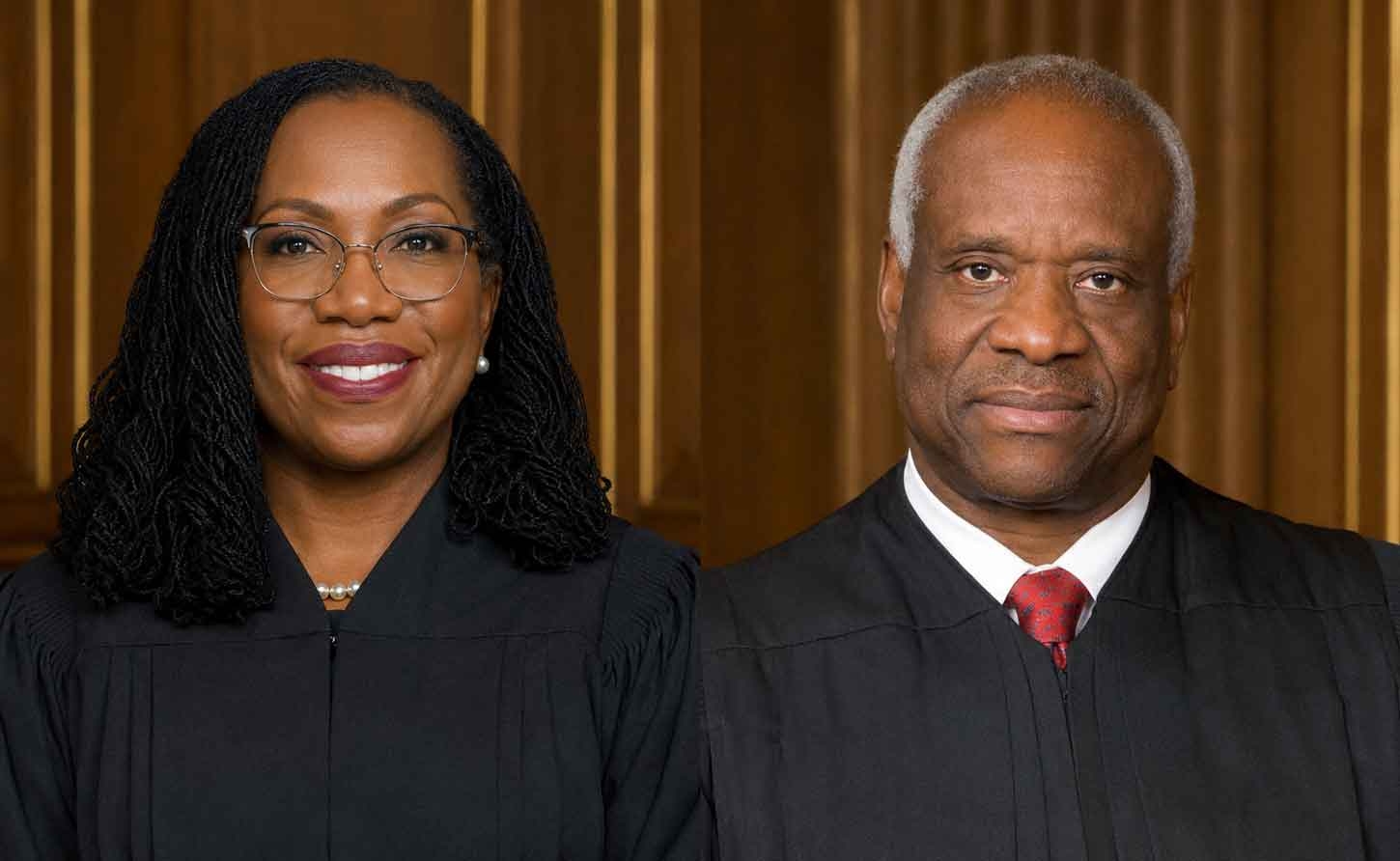
Supreme Court Justices Clarence Thomas and Ketanji Brown Jackson. The majority, which included Justice Jackson, determined that birth on U.S. soil plus being subject to U.S. law is enough for citizenship. Dissenters like Justice Thomas argued that the parents must have a deeper allegiance to the U.S.
In a fractured 6-3 ruling, America’s highest court reaffirmed that soil, not bloodline, determines who is American — exposing a bitter constitutional rift between the bench’s two Black justices and handing Caribbean immigrant families a hard-fought victory.
WASHINGTON DC, July 1, 2026 | By Calvin G. Brown | The United States Supreme Court delivered a stinging constitutional rebuke to President Donald Trump on Tuesday, ruling 6-3 that his executive order stripping automatic citizenship from children born on American soil to undocumented or temporarily present parents cannot stand. The decision, Trump v. Barbara, closes out an eighteen-month legal siege on one of the republic’s oldest constitutional guarantees — and it did not go quietly.
Trump signed Executive Order 14160 on his very first day back in the White House, January 20, 2025, ordering federal agencies to stop recognising as citizens any baby born to a parent who was in the country illegally or on a temporary visa. Every court to examine the order called it unconstitutional. It never once took effect. Tuesday’s ruling makes that failure permanent.
Writing for the majority, Chief Justice John Roberts anchored the decision in the plain text of the Fourteenth Amendment’s Citizenship Clause, which declares that all persons “born or naturalised” on US soil and subject to its laws are citizens.
Roberts leaned on the Court’s 1898 precedent in United States v. Wong Kim Ark, insisting the Court had “repeatedly understood” that ruling to guarantee citizenship to nearly all children born within American borders. Citizenship, he wrote, has always meant the right to have rights.
A Fractured Bench, A Deeper Wound
The victory was not clean. Five justices — Roberts, Sonia Sotomayor, Elena Kagan, Amy Coney Barrett and Ketanji Brown Jackson — found the order unconstitutional outright. Justice Brett Kavanaugh reached the same result on narrower statutory grounds, giving the ruling its 6-3 shape. Justices Clarence Thomas, Samuel Alito and Neil Gorsuch dissented.
It is the exchange between the Court’s two Black justices that has drawn the sharpest attention. Thomas, in a sprawling dissent joined by Gorsuch, argued the Citizenship Clause was written narrowly for freed slaves and their descendants, and that children of temporary visitors or undocumented parents lack the “domicile” required for citizenship.
Jackson answered directly, accusing Thomas of abandoning his own long professed colour-blind philosophy to suddenly read the amendment as a race-specific remedy. The Reconstruction Amendments, she wrote, were an anti-caste reset for the nation, not a narrow fix for one group’s exclusion. Alito, dissenting separately, warned the ruling preserves a powerful incentive to enter the country unlawfully.
Few exchanges this term have exposed such a raw disagreement over how America’s post-slavery constitutional settlement should be read today — and the fact that it split along these particular lines, pitting one Black justice’s reading of Reconstruction against another’s, only sharpens the discomfort.
“Citizenship, then and now, was the right to have rights.” — Chief Justice John Roberts
The stakes behind the legal theory are not small. Government estimates put the number of US births each year to parents without lawful permanent status in the hundreds of thousands. Had Trump’s order survived, those children would have grown up in a permanent legal grey zone: born on American soil, yet excluded from the citizenship every other child born there automatically receives.
It was precisely that prospect that drove the ACLU, the NAACP Legal Defense Fund and several state attorneys general to fight the order through three federal court tiers before it ever reached the Supreme Court’s docket.
The Diaspora’s Stake
For Caribbean nationals in the United States — many of them undocumented, many more holding temporary status while navigating an increasingly hostile immigration system — this ruling was never an abstract constitutional debate. Congresswoman Yvette Clarke of Brooklyn, whose district holds one of the densest concentrations of Caribbean-American families in the country, joined fellow Democratic lawmakers in praising the decision as a defence of a 150-year-old constitutional promise.
For thousands of Jamaican, Haitian, Trinidadian and other Caribbean households living in legal limbo, the ruling means their US-born children keep the citizenship the Constitution has always promised them, regardless of what happens to their parents’ immigration status. That certainty matters enormously in diaspora hubs such as South Florida, New York City and parts of Connecticut, where mixed-status households have spent eighteen months bracing for the worst.
What Comes Next
Trump wasted no time reacting, posting on Truth Social that Congress should move immediately to legislate around the ruling, promising his full support. But the path he is describing is far steeper than he suggests. Undoing a constitutional guarantee requires a constitutional amendment — two-thirds of both congressional chambers and ratification by three-quarters of the states — not an ordinary bill.
Kavanaugh and Alito each noted, in narrower asides, that Congress might legislate limited statutory exceptions to birthright citizenship, but even that path remains untested and would almost certainly draw immediate legal challenge.
This marks the third major Supreme Court defeat for Trump’s second-term agenda, following February’s tariff ruling and this week’s rejection of his citizenship order.
For the Caribbean diaspora, it is a rare moment of constitutional certainty in an otherwise turbulent immigration landscape — proof that even a president determined to redraw the boundaries of American belonging cannot simply order the Constitution to mean something it does not.
But with Trump already pushing Congress to act and his conservative allies signalling they are not finished with the argument, the fight over who gets to belong in America is far from settled.
— 30 —
