
GUYANA | GECOM Has Not Met in over a Year. But Singh, Its Chair, Just Briefed Western Diplomats on Elections
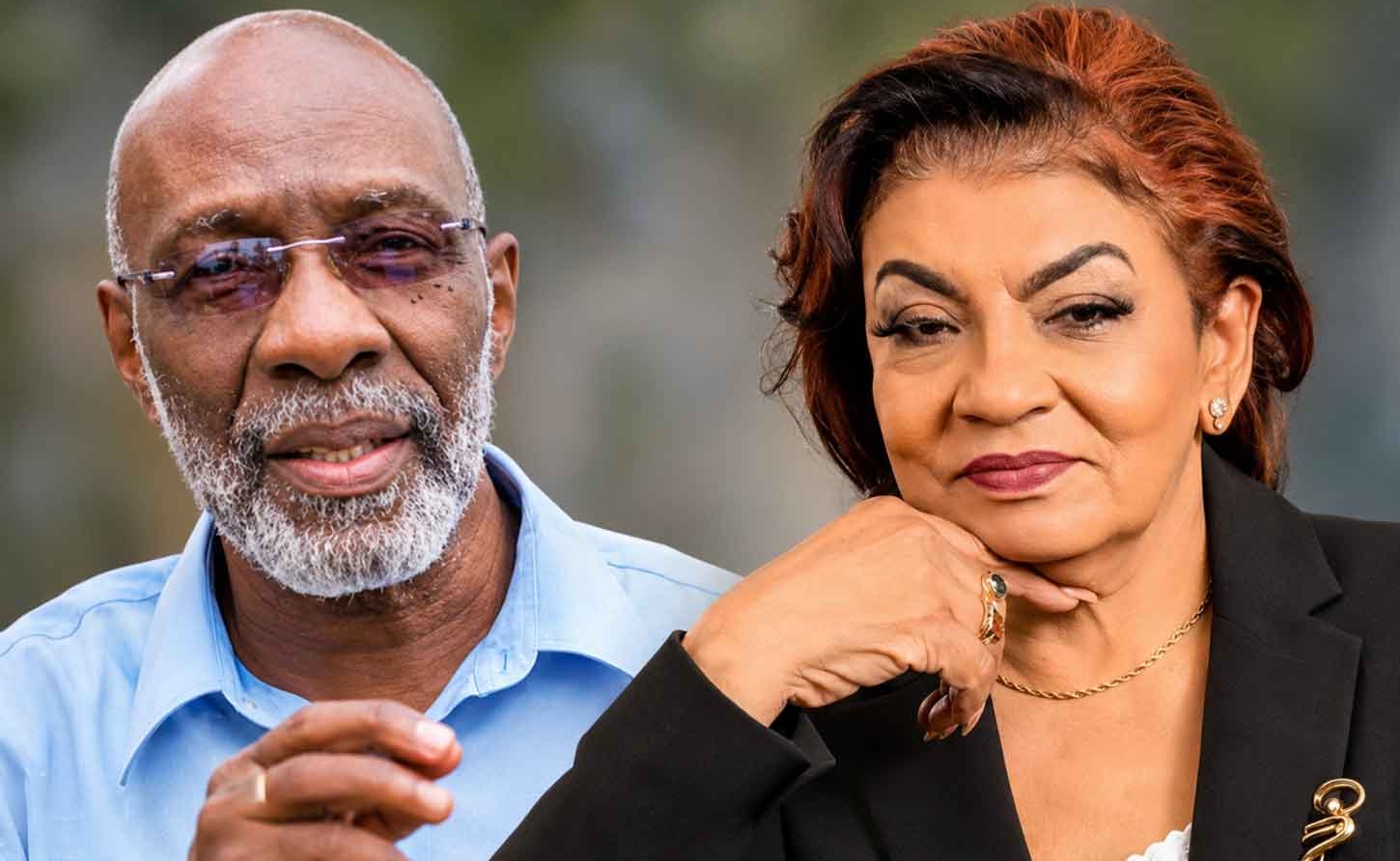
From Left GECOM Commissioner Vincent Alexander and Chair of GECOM Claudette Singh.
GECOM has not sat as a commission in fourteen months. Last Thursday its Chair and Chief Elections Officer received five Western envoys to discuss the conduct of elections in Guyana. Opposition-nominated Commissioner Vincent Alexander wants to know on whose authority.
MONTEGO BAY, Jamaica, November 8, 2026 - Calvin G Brown| The Guyana Elections Commission has not held a meeting since the small hours of September 7, 2025, when it declared the People's Progressive Party/Civic the winner of the general election and went home.
Yet on Thursday its Chairperson, retired Justice Claudette Singh, and Chief Elections Officer Vishnu Persaud sat down with the ambassadors and high commissioners of the United States, the United Kingdom, Canada, France and the European Union to discuss, in the missions' words, Guyana's electoral process and the strengthening of its institutions.
To Vincent Alexander, the photograph of that gathering — five envoys flanking a Chair who has refused for more than a year to convene her own Commission — is the most damning image to emerge from GECOM in a year of them.
"This meeting places a comatose GECOM in the spotlight," the veteran opposition-nominated commissioner wrote in a letter to the editor dated November 7. It raises, he says, three fundamental questions: what is the authenticity of such a meeting, what was its purpose, and what action — and from whom — is required to "de-comatose" the Commission.
How the Commission went dark
On October 10, 2025, Justice Singh answered a request to summon a meeting with a single sentence: "I am guided by Article 161(3)(b) of the Constitution as to the composition of the Commission, which will be decided on the convening of Parliament."
With Aubrey Norton's APNU displaced as the main opposition by Azruddin Mohamed's We Invest in Nationhood (WIN), the Chair deemed the status of Alexander, Charles Corbin and Desmond Trotman uncertain until Parliament settled it.
Parliament convened. It never took up the question. Nobody — least of all the Chair — asked it to. Fourteen months on, Alexander writes, "she maintains her posture and has not convened a meeting of the Commission."
The dispute has since hardened into stalemate. Mohamed formally advised President Irfaan Ali on June 30 to appoint Roysdale Forde, Siand Dhurjon and Damien Da Silva as the new opposition commissioners. Norton insists no vacancy exists, and the three sitting commissioners say only a court or the legislature can remove them.
Alexander's sharpest barb is that Singh's reading of the Constitution, if applied consistently, would unseat the Chair herself: her own appointment in 2019 rested on the agreement of a President and an Opposition Leader who are both now out of office.
Who did she speak for?
The heart of Alexander's complaint is not that the Chair met diplomats. It is that she did so on behalf of a body she has, in his words, "decommissioned, albeit unilaterally and unlawfully, but de facto by virtue of her freezing its operations."
"What authority does she have to hold discussions with the Diplomatic Corps on behalf of a commission" that has not met, he asks — "more so, to discuss matters that clearly fall within the purview of a constituted and sitting commission?"
Whatever was discussed in that room, he argues, was the Chair's view and the Secretariat's, not GECOM's: "There would have been no meeting of minds by the Commission."
He reserves a pointed word for the envoys themselves. Diplomats are accredited to deal with legitimate state agencies, he notes; it was "injudicious" for them to meet a Chair whose standing is itself in question.
The missions are not bystanders: in September the diplomatic corps said it was taking WIN's concerns over the deadlock "very seriously." Thursday's meeting was their answer — delivered to the one official Alexander holds responsible for it.
"What authority does she have to hold discussions with the Diplomatic Corps on behalf of a commission which has been decommissioned?" — Vincent Alexander, GECOM Commissioner
The cost of a year without a meeting
Alexander's ledger of what the freeze has cost is long. The 2026 budget — some G$6.9 billion in current expenditure approved by Parliament in February — went forward without the Commission ever voting on it, though the Constitution makes GECOM, not its Chair, responsible for its estimates.
The post-mortem on the 2025 elections has not been held. Commitments to extend biometrics, including digital fingerprint identification, and to act on observer-mission recommendations the Commission itself accepted, sit idle. Local government elections, constitutionally due and originally pencilled in for this month, have no date.
The posts of chief accountant, deputy and assistant chief elections officer and IT manager remain vacant. And, he alleges, the Chair has contrived to avoid appearing in court in the ongoing cases against elections officials — a claim WiredJa has not independently verified and which Justice Singh has not answered.
Alexander goes further than he has before, writing that the Chair's conduct "may even be seen to be treasonable," if treason is understood as subverting the authority of the state. It is a commissioner's characterisation, not a legal finding — the sound of a man who has run out of gentler words.
In August he had argued that her refusal to call meetings amounted to "misbehaviour," the constitutional threshold for removal. No one with the power to act on either charge has done so.
Justice Singh's position, stated to Kaieteur News in May, is that GECOM "cannot move forward with its work until it is properly constituted," and that she is treading cautiously to avoid legal challenge from whichever side is excluded. Her office had not responded to Alexander's letter at the time of writing.
A Caribbean problem, not a Georgetown one
For the wider region the episode should be uncomfortable. Six years after the five-month international vigil over Guyana's 2020 count, the Commission charged with preventing a repeat has not met in over a year, its Chair is accused of usurping its functions, and the only institutions that appear able to secure an audience with her are foreign embassies.
Alexander ends by demanding "judicial and or legislative intervention" and condemning "the silence and countenance of the powers that be, including the Diplomatic Corps." CARICOM, which has never been shy of pronouncing on Guyanese elections, might add itself to that list.
— 30 —
