
JAMAICA | Judges, Not Parliament, Should Sentence Gun Crimes, Says Opposition
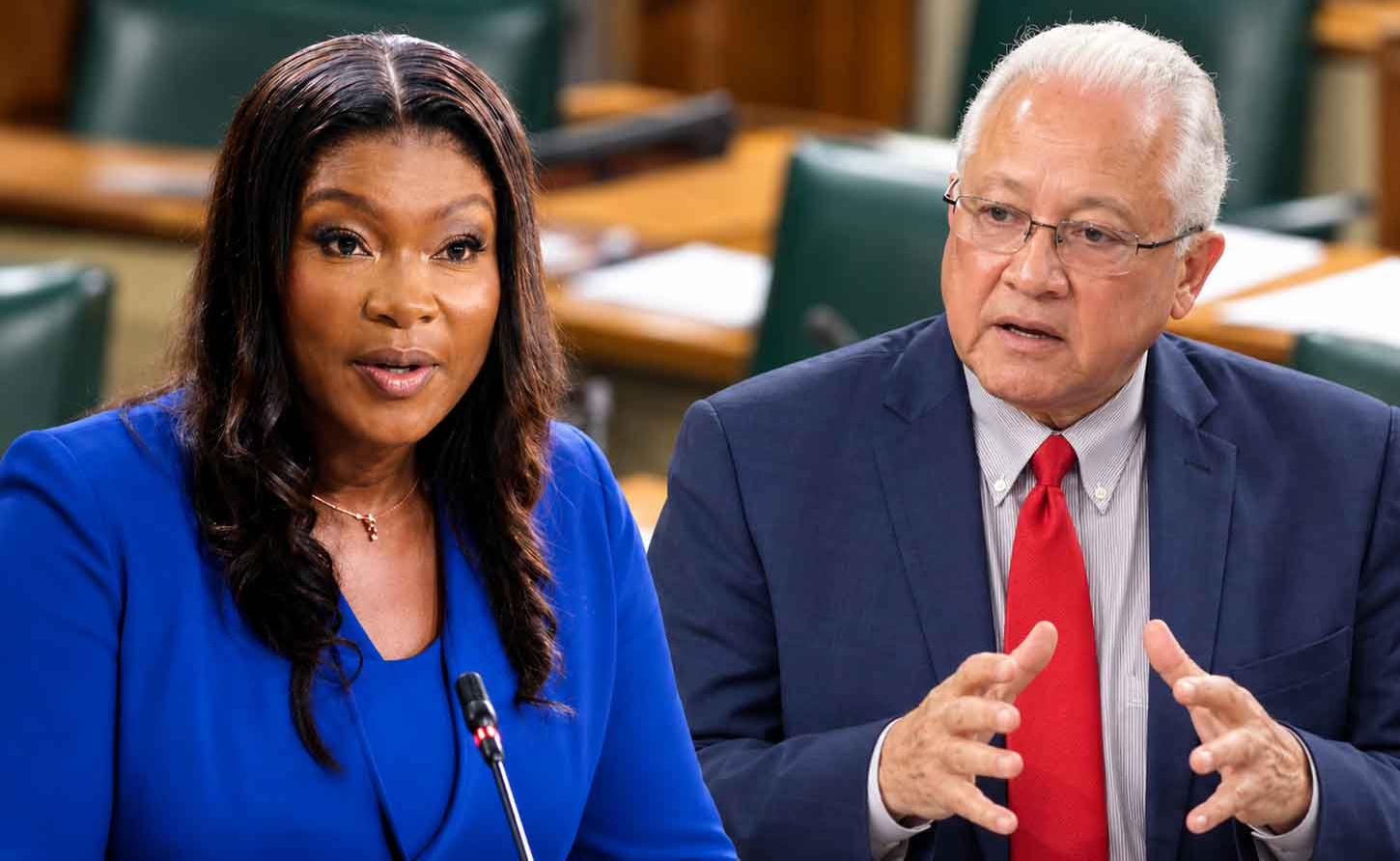
Opposition Spokesperson on Justice, Miss Zuleika Jess, MP and Minister of Justice Delroy Chuck
As Jamaica's defence bar stands mute outside the Supreme Court, Zuleika Jess summons the Justice Minister to account for a gun law that critics say has tied the hands of the bench.
KINGSTON, Jamaica, September 24, 2026 - Calvin G. Brown |At 9:00 on Wednesday morning, attorneys in full court attire assembled at the Supreme Court Complex in Kingston and at the Western Regional Gun Court. Among them were Jamaican Bar Association president Tenneshia Watkins and senior defence counsel Peter Champagnie. The placards did the talking: “Tough on guns: yes. Tough on children: no.”
Within hours, the Opposition had turned a courthouse vigil into a parliamentary campaign. Opposition Spokesperson on Justice Zuleika Jess, MP for St Elizabeth Eastern, announced that on Tuesday she had filed a formal Notice of Questions for Oral Answer with the Clerk of the Houses of Parliament, summoning Justice Minister Delroy Chuck to account for the Firearms (Prohibition, Restriction and Regulation) Act, 2022.
“We are seeing state-sanctioned injustice where the law forces the destruction of innocent lives instead of targeting violent criminals.” — Zuleika Jess, MP
The questions Chuck must answer
The questions demand two things: a clear timeline for amendments the Government has already promised, and a straight answer on whether it has consulted the Bar and the Advocates’ Association. The Opposition vowed to deploy “every constitutional and legislative mechanism available” and not to relent until judicial discretion is restored.
Its central target is the 15-year mandatory minimum. With no sentencing discount on the table, the release argues, the Act has “completely paralyzed the plea-bargaining process”. Defendants have little reason to plead guilty, and the Gun Court risks drowning in trials.
A child, a prop, and a judge with tied hands
Jess offers two cases. The first is a 14-year-old terrorised by a community don into carrying or hiding a gun. Under the Act, she argues, the judge may not weigh that coercion, and the child faces the same 15-year floor as the man who handed over the weapon.
The second is the music-video prop: a young producer with a plastic imitation firearm on set, facing the same minimum as a gunman with a loaded automatic.
That example has a real-life antecedent, and it deserves the full facts. In June, Jess cited producer Ewan Pryce, 47, who received the mandatory 15 years for imitation firearms found at his Grant’s Pen home in 2023. Pryce was also sentenced to life for stockpiling firearms. The principle Jess raises stands on its own; the case behind it is more complicated than a slogan allows.
‘Not one size fits all’
The profession insists it is not soft on crime. Its quarrel, the lawyers say, is not with strong penalties but with a regime that will not let judges distinguish between offenders, offences and circumstances. They want an “exceptional circumstances” clause, real incentives for early guilty pleas, reform of the certificate regime, and a review of the rules on imitation firearms and licensed holders.
“It cannot be a Cinderella approach, not one size fits all,” Champagnie said. He also rejected placards and online labels branding the protesters “PNP lawyers” and “gunman lawyers” as offensive and misleading.
The stakes are rising. The profession has announced a one-week withdrawal of services from the criminal courts beginning Monday, September 28.
The Government’s answer: it is working
Chuck said he was “really disappointed” by the protest, noting that at the September 13 Assize Service he had said the matter was under consideration and offered to meet. That meeting was set for 2:00 pm Thursday. The Minister’s line has not moved: the security forces and several colleagues credit the Act with driving down murders and shootings, and the Government will not signal any retreat on gun enforcement.
That argument has regional allies. Antigua and Barbuda Prime Minister Gaston Browne, whose Parliament is moving to raise minimum sentences, answered the Kingston protest by arguing that people caught with illegal guns have received one- or two-year terms, and that Parliament and the Executive ultimately answer for public safety.
Nor was the defence bar unanimous. At least one attorney publicly faulted the associations for resorting to a public spectacle.
The Opposition’s own record
The PNP enters this fight with history worth recalling. During the 2022 joint select committee, Opposition senators Donna Scott-Mottley and Peter Bunting and MP Fitz Jackson opposed the mandatory terms, with Scott-Mottley saying she had seen no evidence that they deter. Even a Government MP, Tamika Davis, voiced reservations. The Government conceded only one major point, replacing mandatory life for simple possession with the 15-year minimum. The Act also provides for its own review after five years.
The argument, in other words, is not new. What is new is a united bar, a strike date and a formal parliamentary summons.
Who decides what ‘tough’ means
Nobody on the courthouse steps argued that Jamaica should go easy on guns. The real question is who decides what “tough” means in an individual case: a Parliament writing one sentence in advance for every offender, or a judge looking at the one standing in the dock.
When Minister Chuck rises to answer, he will have to show that the gains his security chiefs claim depend on denying judges discretion in the hardest cases. The Opposition, for its part, must show that it can turn a lost committee-room argument into law. Between them stands a 14-year-old whom the statute, as written, cannot tell apart from the man who armed him.
— 30 —
