
JAMAICA | ‘No Sophistry Can Render Defensible the Indefensible’: Patterson Shreds Johnson Smith’s Cuba Defence
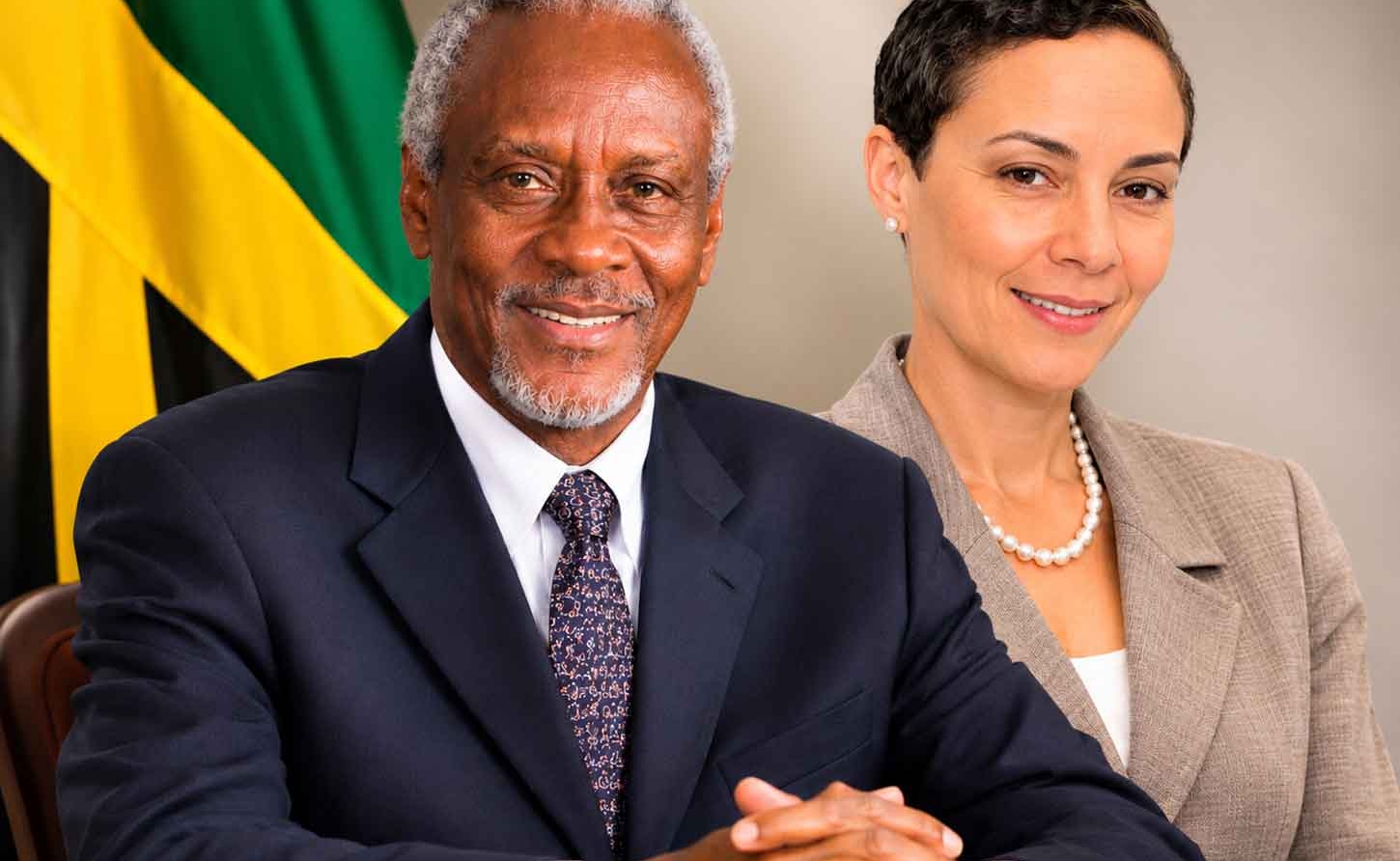
In this montage Illustration Former Prime Minister PJ Patterson is beside Foreign Minister Kamina Johnson-Smith.
Former prime minister says the Foreign Minister’s reply exposes “even more plainly than before” that Jamaica had no reason to abstain — and that her own admission “settles the matter”
MONTEGO BAY, Jamaica, November 4, 2026 — P.J. Patterson has returned fire. Four days after Foreign Minister Senator Kamina Johnson Smith dismissed his criticism of Jamaica’s abstention on the United Nations vote to end the United States embargo against Cuba, the former prime minister has issued a second statement that does not so much rebut her defence as dismantle it.
“No sophistry can render defensible that which is indefensible,” Patterson writes, “nor can a feeble reply lessen the shame resulting from an ill-conceived and unprecedented abstention at the General Assembly last week.”
On October 28, Jamaica broke with 34 years of consistent practice and abstained when the General Assembly voted 130 to 17, with 25 abstentions, to demand an end to the embargo. Every Jamaican government since 1992 — under Patterson, Bruce Golding, Portia Simpson Miller and, until last week, Andrew Holness — had voted yes.
Johnson Smith’s November 1 statement insisted that Jamaica’s opposition to the embargo had not changed, that abstaining was not the same as voting against, and that the parliamentary motion passed the day before the vote had not bound the executive to any voting position.
Patterson is unmoved. Her reply, he says, is “so incongruously crafted” that it “exposes, even more plainly than before, the absence of any reason or justification for Jamaica’s abhorrent abstention.” It is, he adds, “more notable for what it leaves unanswered. She has yet to explain how this violent shift better serves Jamaica’s interest or what steps we have taken since St. Kitts to permit meaningful dialogue.”
The Government’s own words
The core of Patterson’s case is that the Government has been hoisted on its own rhetoric.
“The Minister insists that Jamaica has not changed its opposition to the unlawful embargo,” he writes. “The question answers itself: why would Jamaica not vote to end it?” Opposition to the embargo, he argues, “must be expressed in a vote on the one day each year all the nations of the world are asked to decide: so our abstention cannot be accepted or justified.”
He then seizes on what he regards as the fatal concession in the Minister’s reply. “For as the Minister herself concedes, Jamaica could have voted in favour while expressing reservations that the resolution ought to encompass a wider ambit. That admission settles the matter. Staying the course on the road of principles was open to our Government which chose not to take it.”
The Government’s own parliamentary motion, Patterson notes, was moved by its Minister of State, who “told the House why Jamaica could not support a unilaterally imposed blockade against Cuba.” The preamble names the US embargo as a cause of Cuba’s suffering; its third clause speaks of Cuba’s isolation “under the blockade.”
“Those are the Government’s words,” Patterson writes. “Within twenty-four hours, that same Government would not vote to end the blockade it had condemned.” Then the sharpest line of the statement: “‘Principles indeed guide policy’ — not statements that hoodwink Parliament as the precursor to desultory abstentions in New York.”
To Johnson Smith’s argument that the motion took a broader, three-part approach the UN resolution did not reflect, Patterson answers with a lawyer’s precision. The three limbs, he says, “are not interlinked. Each hangs alone. Nothing in the motion makes any one of them a condition precedent for the rest.”
“The only shield we have”
Patterson rejects the framing of the vote as a judgement on Cuba’s politics. The annual resolutions, he writes, “do not entail pronouncements on political systems in Cuba’s domestic jurisdiction. It is not about economic ideology. It is about the egregious violation of international law.”
And then the warning that will resonate across a region of small states: “For a small nation, international law is the only shield we have. When we decline to defend it, we lower our own protection and shield.”
“For a small nation, international law is the only shield we have. When we decline to defend it, we lower our own protection and shield.”— P.J. Patterson
The cost, he argues, is already being counted. The abstention has delivered “a devastating blow” to Jamaican candidatures for UN councils, international committees and “the arenas of world sport where our athletes have carried our flag with such distinction.” His verdict is unsparing: “Once upon a time, Jamaica led the pack, today we are spectators to our own diminishment.”
“Once upon a time, Jamaica led the pack, today we are spectators to our own diminishment.”— P.J. Patterson
“Yes, I am perturbed and humiliated”
Johnson Smith had charged that Patterson’s original statement “relies heavily on emotion.” He pleads guilty — and turns the charge around.
“That I readily admit, but that does not render invalid the facts on which I rely,” he writes. “How can I not be emotional when Jamaica’s foreign policy drifts from the entrenched principles, steadfastly pursued despite changes in political Administrations over six decades?” He asks, simply: “Have we lost our moral compass?”
Patterson was in the room in December 1972 when Michael Manley, Errol Barrow, Eric Williams and Forbes Burnham defied Washington to recognise Cuba. He writes of “immense gratitude for what Cuba has done for the Caribbean Region without ever asking for anything in return,” and of Cuba’s role in Africa’s liberation struggle and the fight against apartheid. “When a neighbour who has given so much to liberation and human dignity is being strangled, and my country looks away, yes I am perturbed and humiliated.”
He reserves thanks for “the 7 Magnificent Caricom nations” — The Bahamas, Barbados, Belize, Grenada, St. Kitts and Nevis, St. Vincent and the Grenadines and Suriname — that voted yes while Jamaica, Guyana and Haiti abstained and Trinidad and Tobago voted no.
And he closes where Jamaica’s conscience has always found its voice. Bob Marley and Peter Tosh, he writes, gave the world “an anthem of universal appeal” in “Get Up, Stand Up” — and, Patterson insists, “It was never a call to abstain. Jamaica must stand again and keep standing until the fight for peace and justice is finally won.”
— 30 —
