
JAMAICA | The Mop and the Hammer: BOJ Soaks Up J$32 Billion as It Lifts Rates to 6.50%
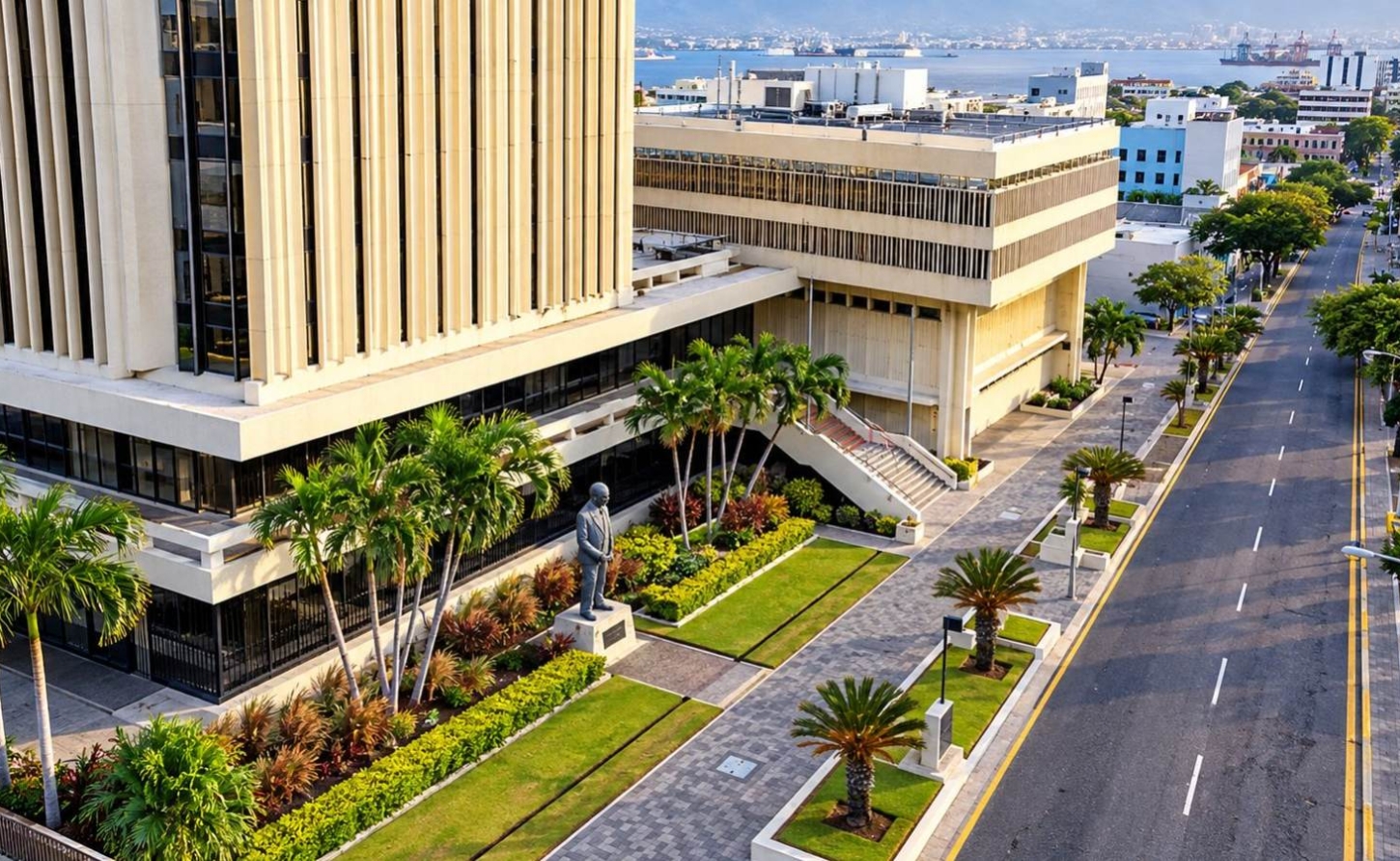
Bank of Jamaica headquarters in Kingston
On the day the central bank raised the price of money, investors queued to lend it J$45 billion. Taken together, the auction sheet and the rate decision show a financial system flush with cash and a public short of it.
MONTEGO BAY, Jamaica, November 19, 2026 - Calvin G. Brown | The Bank of Jamaica swung two tools on Wednesday. With the hammer, it raised its policy interest rate by half a percentage point to 6.50 per cent. With the mop, it drew J$32 billion out of the financial system through its weekly auction of 30-day certificates of deposit.
The hammer took the headlines. The mop, recorded on a single-page results sheet, says more about where Jamaica’s money is actually sitting.
What the auction sheet says
The Bank offered J$32 billion of its 6.25 per cent fixed-rate certificate of deposit (CD). It received 298 bids worth J$45.42 billion, or 1.42 times the amount on offer. It accepted 234 of them, and roughly J$13.4 billion was turned away.
Successful bidders will earn an average yield of 6.47 per cent. Bids were filled from the cheapest upward. Everything up to 6.745 per cent was met in full, and those who asked for 6.75 per cent received 62.22 per cent of what they wanted. Above that line, nothing was allotted. One bidder sought 8.50 per cent on J$100 million and left empty-handed. The most modest asked for only 6.00 per cent.
On settlement, 20 November, the stock of outstanding 30-day CDs rises to J$138 billion.
A CD of this kind is the central bank borrowing from financial institutions for a month. The purpose is withdrawal, not funding. Money locked away at the BOJ cannot be lent, spent or converted into US dollars.
Four weeks, one direction
Set beside the three auctions before it, Wednesday’s result is part of a pattern.
| Auction | Offer | Bids | Cover | Avg. yield | Cut-off | Outstanding |
|---|---|---|---|---|---|---|
| 28 Oct | J$28bn | J$47.57bn | 1.70x | 6.48% | 6.89% | J$124bn |
| 4 Nov | J$40bn | J$51.21bn | 1.28x | 6.56% | 6.85% | J$127bn |
| 11 Nov | J$38bn | J$49.05bn | 1.29x | 6.53% | 6.77% | J$128bn |
| 18 Nov | J$32bn | J$45.42bn | 1.42x | 6.47% | 6.75% | J$138bn |
Source: Bank of Jamaica auction results. Cover ratios calculated by WiredJa. Outstanding = total 30-day CDs on settlement.
Two things stand out. First, yields are drifting down. The average peaked at 6.56 per cent on 4 November and has eased since, while the cut-off rate has fallen every week, from 6.89 per cent to 6.75 per cent. That happened in the run-up to a rate increase, when lenders would ordinarily ask for more, not less. It suggests that cash is plentiful and has few better places to go. The Bank’s own summary of the rate decision describes the banking system as having sufficient liquidity.
Second, the stock is swelling. Outstanding 30-day CDs have grown by J$14 billion in three weeks, and J$10 billion of that came in the past seven days. The arithmetic implies that about J$22 billion matured this week against J$32 billion newly issued. The mop is working harder.
It is not free. A WiredJa back-of-envelope calculation, not a BOJ figure, puts the interest on a J$138 billion stock at about 6.5 per cent at roughly J$9 billion a year, if both were sustained. That is the price of the mop, and it is paid to financial institutions.
Jamaica’s financial system is being paid to sit still while Jamaican households are being charged more to move.
The hammer
The Monetary Policy Committee’s vote was unanimous, and the new rate took effect today. It is the second half-point increase since September and, as The Gleaner noted, leaves the policy rate 75 basis points above its level of a year ago.
The reason is inflation. The Statistical Institute of Jamaica put the annual rate at 8.2 per cent in October, down from 8.6 per cent in September but the fifth straight month above the Bank’s 4 to 6 per cent target. Food prices were 10.9 per cent higher than a year earlier and transport costs 15.0 per cent higher. Core inflation, which strips out farm produce and fuel, edged up to 5.4 per cent. Businesses surveyed by the Bank now expect inflation of 8.3 per cent a year ahead, up from 7.3 per cent in July.
The Committee said the increases to date “should be adequate to support a timely return of inflation to the target range”. That is the language of a central bank hoping it is nearly done.
There is a wrinkle. The policy rate is what the BOJ pays deposit-taking institutions on their overnight balances. From today that is 6.50 per cent. Wednesday’s CD, with its coupon set under the old rate, yields an average 6.47 per cent for a 28-day commitment. An institution with that choice would earn marginally more by leaving its money where it is. Whether the Bank reprices the coupon at the next auction on 25 November is the first test of how the two tools fit together.
Who gains, who pays
CD holders are not getting rich. A 6.47 per cent yield against 8.2 per cent inflation loses about 1.7 percentage points in real terms, before withholding tax. For institutions this is the least-bad place to park money, not a windfall.
Borrowers are on the other side of the ledger. Commercial banks commonly follow a policy rate increase with higher rates on mortgages, motor vehicle loans and business credit. Private sector credit was growing at 7.0 per cent in August, with loans to individuals up 8.3 per cent. The household that is already paying more for food, bus fare and light bills now faces dearer credit as well.
The tug of war
The case against the hammer is that this inflation is largely a supply story, and much of it is imported. The Bank itself reports that grain prices rose 7.7 per cent and shipping costs 54.8 per cent in the September quarter, with El Niño weighing on domestic food supply. No interest rate set in Kingston lowers a freight bill or brings a crop in sooner. Meanwhile the Bank projects growth of only 0.5 to 1.5 per cent this fiscal year, in an economy still rebuilding after Hurricane Melissa.
Professor Andre Haughton of The University of the West Indies, Mona, told The Gleaner the Bank is trying to cool demand while reconstruction spending supports it, a contest he called a “tug of war”.
The case for the hammer is that the first shock is now spreading. Core inflation and expectations are both rising, which is how a temporary price jump becomes a permanent habit. A small, open economy that imports its food, fuel and inflation has one cushion against all three: a stable exchange rate. The US dollar has traded near J$159 in recent weeks, and the Bank credits that stability with offsetting some of the pressure. Every Jamaican dollar mopped up is one that cannot chase a US dollar.
Both arguments are sound. That is the dilemma, and it is one familiar to central banks across the Caribbean, which have little say over the prices that arrive by ship.
What to watch
- 20 November: the BOJ’s scheduled sale of US dollars to the market through its B-FXITT facility.
- 25 November: the next CD auction, and whether the offer size and the 6.25 per cent coupon change.
- December inflation: the Bank expects a brief return to target as last year’s post-Melissa price spike falls out of the comparison, before inflation peaks in the March 2027 quarter. It does not expect a lasting return to target until late 2027.
- 18 December: the next rate decision. Wednesday’s CD matures the same day, so J$32 billion comes back just as the Committee speaks again.
Until then the mop and the hammer will keep working in tandem. The question for the Committee is how long a slow-growing economy can absorb both.
Sources: Bank of Jamaica auction results (28 October to 18 November 2026), Monetary Policy Press Release and Summary of Decisions (18 November 2026); Statistical Institute of Jamaica; The Gleaner.
-30-
