
JAMAICA | What Patterson Refused, Holness Has Signed - SOFA
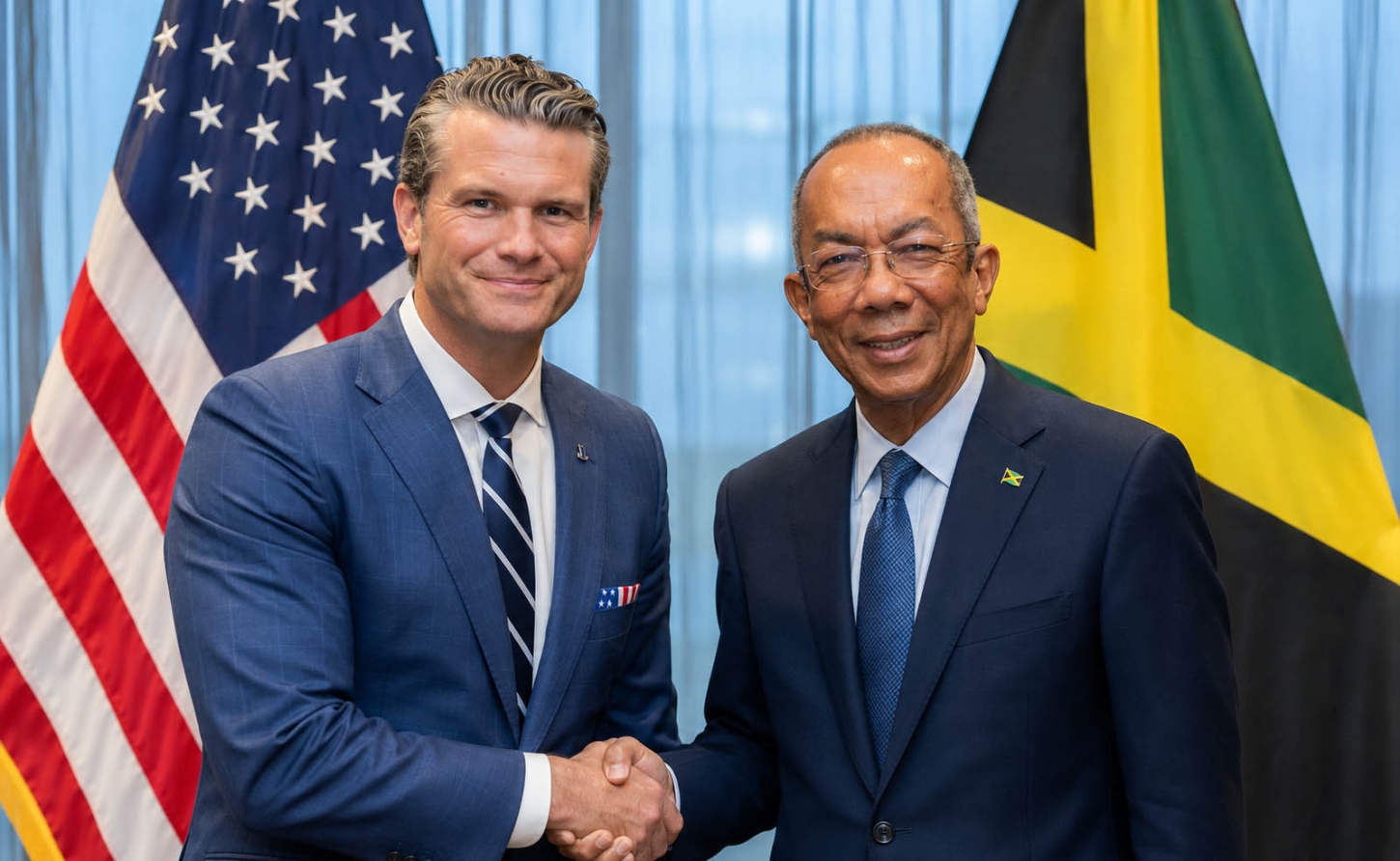
United States Secretary of War Pete Hegseth and Jamaica's National Security and Peace Minister Dr. Horace Chang
A Status of Forces Agreement, a statute from 1975, and not a single vote in Gordon House. The question was never whether Jamaica should cooperate with the United States. It is on whose terms — and by whose authority.
MONTEGO BAY, Jamaica, August 21, 2026 -Calvin G Brown - The announcement arrived on Thursday in about two hundred words of the flattest prose the diplomatic trade can manufacture. The Governments of the United States and Jamaica have signed a Status of Forces Agreement. It builds on an already strong bilateral security partnership. Jamaica joins more than 120 partner nations. Peace through strength.
What the announcement did not contain was the agreement.
No text has been published. No Ministry Paper has been laid. No date has been set for a debate in Gordon House, and — this is the part that ought to detain us — none is required. By the time most Jamaicans read about the SOFA on Friday morning, it had been signed, sealed and press-released on two continents.
The signing follows the bilateral meeting between United States Secretary of War Pete Hegseth and Deputy Prime Minister Dr Horace Chang on the margins of the Americas Counter Cartels Coalition Forum in Panama on 12 August. Eight days from a conversation in a conference centre to a binding international instrument is brisk work by any standard. It is extraordinarily brisk work for an agreement that alters which courts may try which people on Jamaican soil.
What a SOFA Is — and What It Is Not
Some of the early commentary has described this agreement as handing the United States operational authority inside Jamaica. That is not what the instrument does, and WiredJa News will not pretend otherwise in order to sharpen a headline.
A Status of Forces Agreement authorises no operation. It does not station a single marine. It governs the legal position of foreign personnel once they are lawfully here: who may try them when they offend, who pays when they cause harm, what they may carry, what they owe the customs officer at Norman Manley.
The transfer, in other words, is not operational. It is judicial.
That is the more serious matter, not the lesser one. Operations end. Jurisdiction does not.
The Act of 1975
To understand what Jamaica has actually done, one must read a statute almost nobody has read: the Visiting Forces Act, on the books since April 1975 and largely undisturbed since.
Section 4 is the hinge. The Act does not apply to any foreign state until the Defence Board — which sits under the general authority of the Prime Minister — designates that state by order, and declares the extent to which the Act applies. Not by Bill. Not by resolution. By order. The instrument that switches on every provision below is an administrative act of the executive.
And the provisions below are not trivial.
Section 7 gives the service court of a visiting force — a United States court martial — the primary right to try any offence arising from an act done “in the performance of official duty.” Jamaican civil courts, which section 5 declares to hold the primary right in the ordinary case, stand displaced the moment that phrase applies.
Who decides whether it applies? Section 10(3) answers plainly: a certificate from the visiting force’s own service authorities, stating that an act was or was not done in the performance of official duty, is receivable in a Jamaican court and is prima facie proof of that fact. Washington certifies the threshold of its own immunity, and a Jamaican judge begins from the presumption that Washington is right.
Section 18 permits members of a visiting force to possess and carry explosives, ammunition and firearms on their own authorities’ orders, and exempts them from our criminal law on unlawful drilling and the making or possessing of explosives.
Sections 20 to 22 are the ones that should interest the Ministry of Finance. A tort committed by a member of a visiting force within the scope of his duties is deemed to have been committed by a servant of the Crown. The claim runs against the Jamaican Crown. No judgment may be enforced against the individual. And under section 24, the money to satisfy such claims is defrayed out of moneys provided by Parliament.
There, at last, is Parliament’s role. Not to approve. To pay.
Patterson’s Jamaica refused to sign on the dotted line. This Jamaica has signed — and has not yet shown us what it signed.
The Shiprider Precedent
We have been here before, and we behaved better.
When Washington presented the Shiprider proposal in 1996, it sought blanket prior authorisation to pursue and search vessels in Caribbean waters without case-by-case consent. Jamaica and Barbados refused. P.J. Patterson took the matter to CARICOM, the region met in Barbados, and Jamaica was assigned to draft a model agreement consistent with Caribbean sovereignty.
Recalling it years later, Patterson put it with characteristic economy: the region did not reject the American proposal out of hand, nor bow in abject surrender — it simply “refused to sign on the dotted line.”
The negotiated agreement was signed in Kingston in May 1997. Crucially, it did not take effect on signature. It entered into force only when Parliament passed the Maritime Drug Trafficking (Suppression) Act in 1998 — debated, amended twice since, in 2004 and 2016, and answerable on the floor of the House each time.
Thirty years on, an agreement touching criminal jurisdiction over armed foreign personnel requires no such passage. The scrutiny has not advanced. It has gone backwards.
Section 30, and the Sea Outside
Context is not decoration. This SOFA was signed into a Caribbean in which the United States has struck more than sixty vessels and killed upwards of two hundred people, with no charge laid, no evidence published and no court seized of any of it.
At the Panama forum, Secretary Hegseth was blunt about the direction of travel: coordination was not the point, he said, because “ultimately this is about the operations we can conduct together jointly.” He announced that Colombia, Guatemala and Honduras had agreed to joint military operations on their own soil, and a coalition campaign plan is to be finalised by November.
Now return to the Visiting Forces Act, and read section 30.
Where a death involves a person with a relevant association with a visiting force, the coroner shall not hold the inquest unless the Minister responsible for justice directs otherwise. Where a member of that force has been charged abroad with the homicide of a deceased person, the coroner shall adjourn the inquest and discharge the jury, and may resume only on the direction of the Minister.
Set that clause beside that sea, and the abstraction acquires a face. It is not a hypothetical drafted for a filing cabinet in 1975. It is a live instruction to a Jamaican coroner in 2026.
The Government’s Case, Stated Fairly
It deserves to be stated, and stated properly.
Jamaica’s maritime space is roughly twenty-two times its land mass and it cannot be watched from Up Park Camp. The guns killing Jamaicans are overwhelmingly American in origin, and interdicting them requires American cooperation.
The JDF has trained alongside United States forces for decades without a formal status framework, which means the arrangements have until now been improvised — and improvisation, as any lawyer will tell you, favours the stronger party. More than 120 nations have concluded such agreements. Predictability is not, in itself, surrender.
And there is a genuine constitutional answer to the charge of executive overreach: Parliament did legislate. It passed the Visiting Forces Act in 1975, with its eyes open, and it may amend or repeal it tomorrow.
All true. None of it answers the question. A Parliament that delegated a power in 1975 is entitled to ask, in 2026, how that power is now being exercised — and to see the document.
Table the Text
Three weeks before the signing, a former Prime Minister of this country — a Jamaica Labour Party Prime Minister — told a diaspora audience in Philadelphia that our sovereignty and our regional leverage were under siege, and offered a formulation the present administration should sit with: “Putting America first should not mean putting Jamaica in jeopardy.”
Bruce Golding was not counselling isolation. Neither is WiredJa News. Jamaica is small, its sea is vast, and its enemies are better financed than its coast guard. Cooperation is not the question and never was.
The question is procedural, which is another way of saying it is constitutional. Publish the text. Lay the Defence Board order. Bring both to a joint select committee and let members ask the plain questions: what jurisdiction has been ceded, on what terms, with what duration, and with what mechanism of exit. Then let the House vote.
A sovereign nation may lawfully decide to host another nation’s soldiers on agreed conditions. What a sovereign nation should not do is find out the conditions from a press release.
What Of Cuba Ninety Miles North?
Consider what else happened on Thursday.
On the same day the joint statement went out, Secretary of State Marco Rubio announced a fresh tranche of sanctions against Cuba: nine state-owned entities, among them the Ministry of Construction and an agency that supplies Cuban labour to foreign employers, together with three officials of the Cuban Institute of Friendship with the Peoples.
It was one more round in a pressure campaign Washington escalated in January, after Maduro fell, and which has left the island with rolling blackouts and a health system in visible distress.
Jamaica is not a bystander to that campaign. More than four hundred Cuban medical personnel — doctors, nurses, biomedical engineers, technicians — hold up parts of our public health system. Washington has already restricted the visas of foreign officials it deems complicit in what it calls a labour-export scheme.
Grenadian officials have been named. Brazilian officials have been named. There is no reason to assume Jamaican officials are exempt from a policy that has, by its own terms, no geographic limit.
So Kingston now stands inside a formal military status framework with a government that is simultaneously sanctioning the machinery that staffs its hospitals. Those two facts were announced within hours of each other, and no one in authority has been asked to reconcile them.
In 1972, Michael Manley recognised Havana in concert with Errol Barrow, Forbes Burnham and Eric Williams — four leaders moving on the same day precisely because not one of them could afford to move alone. That was the founding act of Caribbean foreign-policy independence, and it worked because it was collective, deliberate and public.
Fifty-four years on, Jamaica has moved alone, has not published what it signed, and will learn the price of the arrangement not in Gordon House but on the day Washington asks for something Jamaica would rather not give.
— 30 —
