
TRINIDAD | Rowley brands T&T's Cuba vote 'shameful' as Persad-Bissessar invokes democracy to break 34 years of precedent
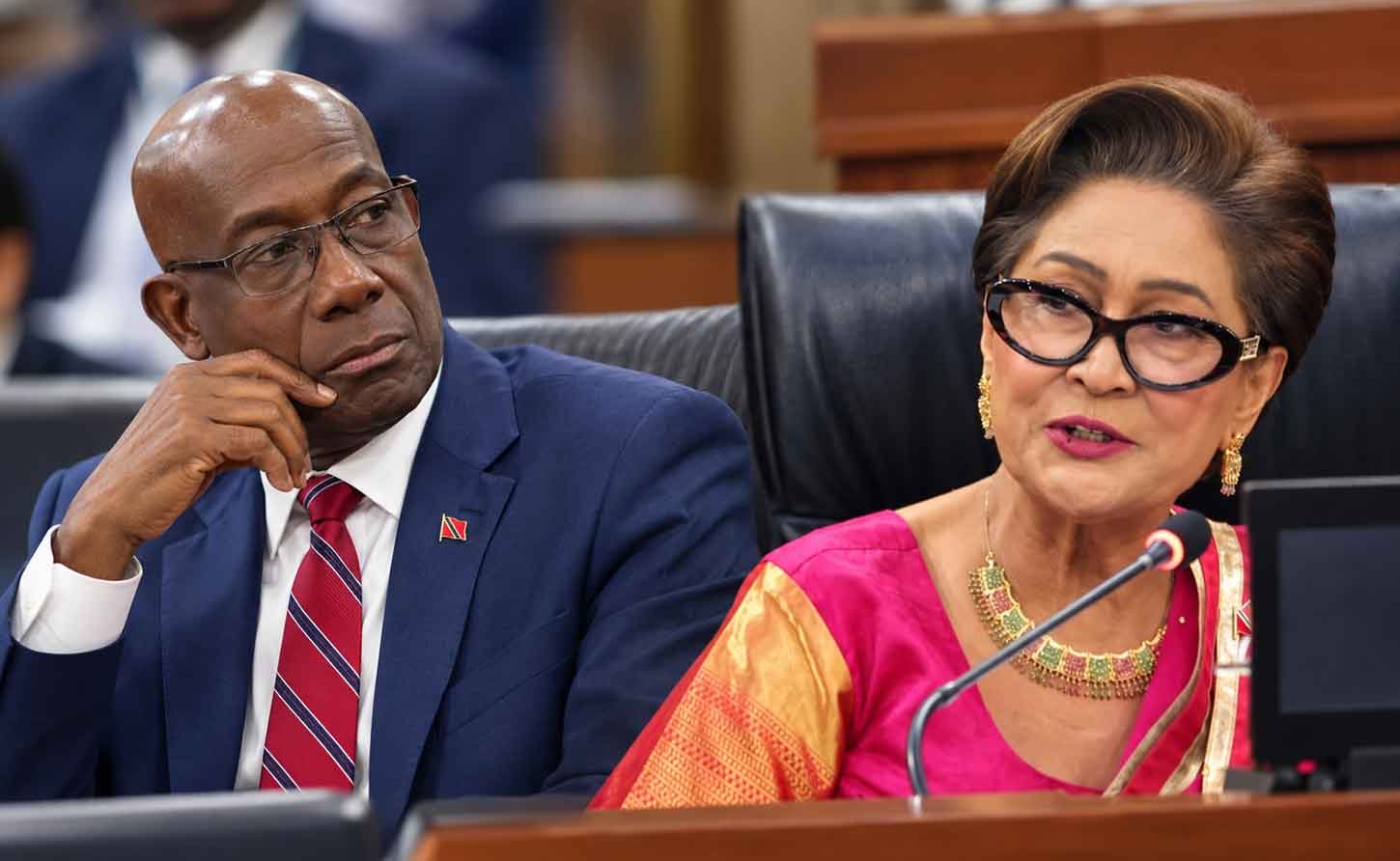
Image Illustrates former T&T Prime Minister Dr. Keith Rowley and Prime Minister Kamla Persad Bissessar.
Trinidad and Tobago becomes the only CARICOM state to vote against the UN resolution on the US embargo, trading a tradition that runs back to Eric Williams for a seat beside Washington
MONTEGO BAY, Jamaica, October 29, 2026 —Calvin G Brown | Caribbean | For 33 consecutive years, whenever the United Nations General Assembly asked the world whether the United States' economic stranglehold on Cuba should end, Trinidad and Tobago answered yes. On Wednesday, it answered no — and the man who held the prime minister's chair until last year is calling that answer a national disgrace.
Dr. Keith Rowley took to Facebook on Wednesday evening, hours after the vote, to brand his country's position "so shameful!" and to accuse the Kamla Persad-Bissessar government of selling the nation's dignity for favour in Washington.
"This is a government that is decisively disconnected from the people they are supposed to represent and prefer instead to express their vile behavior in lockstep with what is being roundly rejected by the wider world," he wrote.
The present government, he said, was the one the late President ANR Robinson once described as a "group of people who wield power without moral or spiritual values."
"That being their record we should never be surprised when they disregard these virtues and principles as they sell our dignity in the hope to curry favor instead of preserving our long established governance through decency and sovereignty," Rowley wrote.
“There is nothing romantic or idealistic about dictatorship masked as a revolutionary struggle for freedom.”— Kamla Persad-Bissessar
A break with everything since 1992
When the resolution first came before the General Assembly in 1992, Trinidad and Tobago was among 71 countries that abstained. Every year since, it has voted in favour — more than 30 times — including through the five years, from 2010 to 2015, when Persad-Bissessar's own People's Partnership government held power.
This week the resolution passed 130 votes to 17, with 25 abstentions — its weakest backing in three decades, after what Havana called a campaign of pressure and blackmail by the Trump regime. Trinidad and Tobago stood in the column of 17, alongside the United States, Israel, Argentina and Hungary. No other CARICOM member joined it.
Only days earlier, Rowley had signed an open letter with ten other former Caribbean heads of government — among them Jamaica's P.J. Patterson and Bruce Golding — urging every UN member to back the resolution. Persad-Bissessar had answered on Monday by accusing its signatories of hypocrisy.
Kamla: 'Nothing romantic about dictatorship'
The Prime Minister did not shrink from the vote. In her own Facebook post on Wednesday night she cast the decision as a stand for freedom, repeating the word "dictatorship" she had first attached to Havana earlier this year, and citing US Secretary of State Marco Rubio's position that Cuba cannot prosper without political reform.
"We cannot demand democracy, free and fair elections, freedom of expression and political rights for ourselves while remaining silent when those same freedoms are denied to the Cuban people," she wrote.
"Why should citizens of CARICOM nations enjoy the right to freely elect and change their governments while the Cuban people are denied that same democratic choice?"
She insisted the government empathised with Cuban suffering, but argued that compassion had for years been manipulated to prop up what she called a military totalitarian system — and she turned the sovereignty argument back on her critics: "Those persons in Trinidad and Tobago who support dictatorship in Cuba would never support it in our own country. There is nothing romantic or idealistic about dictatorship masked as a revolutionary struggle for freedom."
'Starvation of millions'
Her former foreign minister was unmoved. Dr. Amery Browne called the vote "disgraceful," a stain on the country's foreign policy and a mockery of the non-intervention principles Trinidad and Tobago had defended at the UN for a generation — at the very moment US fuel restrictions, in force since January, have left Cuba's 11 million people with dwindling electricity and rationed essentials.
"The members of Kamla Persad-Bissessar's regime have chosen to align themselves with the starvation of millions of innocent people, and they are openly endorsing a siege against the provision of basic supplies and the fuel needed to power incubators and lights and public transportation," Browne said.
He also found irony in a government lecturing Havana on freedom while, he said, it had used preventive detention orders during states of emergency and mounted "vicious and unbalanced attacks" on journalists at home.
The Chaguaramas question
Beneath the insults lies a question the whole region must now answer. In December 1972, Eric Williams, Michael Manley, Errol Barrow and Forbes Burnham met at Chaguaramas and, in defiance of Washington, recognised Cuba together — the Caribbean's founding statement of foreign-policy independence.
Persad-Bissessar says she respects every nation's sovereign right to set its own course. Her critics say that is precisely the principle her vote abandoned: the country that hosted Chaguaramas has, 54 years on, chosen to vote with the embargo rather than against it.
The embargo survived Wednesday's vote, as it has survived 33 before. What did not survive was Trinidad and Tobago's claim to a tradition. Whether that is a shameful surrender or an overdue reckoning with Havana is the argument that will now define Port of Spain's place in the Caribbean.
— 30 —
