
DIASPORA | Elected Abroad, Confirmed in Kingston: Who Really Runs Jamaica’s Diaspora Council
DIASPORA | Elected Abroad, Confirmed in Kingston: Who Really Runs Jamaica’s Diaspora Council
More than 300 delegates spent two days in Philadelphia last week, and the minister told them what Jamaica needs from them. The meeting passed no resolution, and no demand on the government was recorded — and the rules of the Global Jamaica Diaspora Council help explain why.
MONTEGO BAY, Jamaica, October 29, 2026 - Calvin G. Brown | The second Jamaica Diaspora Northeast USA Conference ended at Temple University in Philadelphia on Saturday. State Minister Alando Terrelonge, who led Friday’s opening session and Saturday’s town hall, told more than 300 delegates that Jamaicans abroad sent home US$3.12 billion in the 2025/26 fiscal year. He asked each delegate to consider volunteering at least 100 hours, to steer investment into housing, energy, water and logistics, and to press members of the US Congress for stronger climate action and help for vulnerable countries.
The conference passed no resolution. A WiredJA reporter who was in the room heard no discussion of ICE raids or deportations, although immigration was listed on the published programme, and nothing on voting rights for Jamaicans abroad. The press coverage of the minister’s two addresses records no demand of any kind put to Kingston.
That matters, because the fear is real. In February 2025 the Observer reported fear bordering on panic among Jamaicans across the United States, touching even some green-card holders, as the Trump administration’s deportation drive got under way. Limited voting rights sit among the diaspora’s common grievances, according to a Caribbean National Weekly commentary. Neither reached the floor.
The silence is by design.
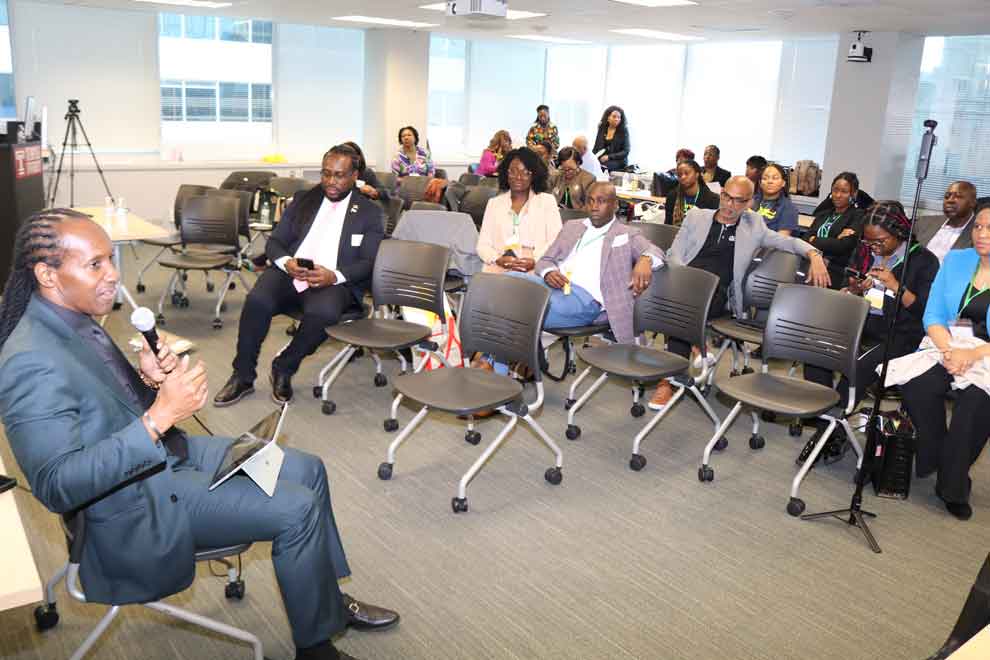
Minister of State in the Ministry of Foreign Affairs and Foreign Trade Hon Alando Terrelonge Address delegates at the town hall meeting at the second Jamaica Diaspora Northeast USA Conference at Temple University in Philadelphia on Saturday, October 24 at left is Consul General of Jamaica in New York, Oliver Mair and Christopher Benjamin, community relations officer at the Consulate General of Jamaica in New York. Photo Derrick Scott.
Under the council’s own Terms of Reference, the chair is the minister with responsibility for diaspora affairs. The vice-chair is a diaspora member, but appointed, not elected, and the ministry’s Under-Secretary for Diaspora, Protocol and Consular Affairs sits in the leadership alongside the chair. The secretariat is the ministry’s Diaspora Affairs Department, whose director doubles as council secretary.
Even the members who win elections in New York, Toronto or Birmingham do not take their seats on the strength of those votes. As diaspora commentator Dr Leo Gilling has noted from the same document, elected individuals are formally appointed by the Minister of Foreign Affairs and serve at the minister’s pleasure. Alongside them sit members appointed directly, with no electoral process at all.
The Terms of Reference put it more drily: the minister “will confirm” whoever wins the most votes, and the chair may terminate a membership on stated grounds. The same document insists the GJDC “is not an arm of the Government of Jamaica”. The ministry’s FAQ is more candid: the council is “an advisory and consultative body”. The diaspora is not electing representatives. It is nominating advisers for the minister to confirm.
The ministry’s February 24 release was headlined “New Diaspora Leaders Elected to Represent Jamaicans Overseas”. Its election page says the candidate with the most votes “will be appointed to the GJDC”. Gilling calls the gap between election and appointment a quiet disconnect. It is more than that. It lets a government borrow the legitimacy of an election without giving up any authority.
The money makes that harder to defend. Remittances were worth about 15 per cent of GDP in 2024, on Bank of Jamaica figures, and exceed total exports by nearly 80 per cent, the Gleaner reported. The US$3.12 billion Terrelonge cited rivals tourism’s estimated US$3.79 billion in 2025. Roughly two-thirds of it — 68 per cent in September 2025, on Bank of Jamaica figures — comes from the United States, the country whose immigration enforcement went undiscussed in Philadelphia.
Patrick Beckford, a founding member of the original Diaspora Advisory Board, has been saying this for years. Ahead of the 2026 vote he called for a boycott and for “an independent Diaspora-controlled body, one which is autonomous and free from any Government ministerial connection or control”. The council, he argued, “was never meant to be a ministerial extension or a loyalty test”. Dr Rupert Francis said taking part in the election was tantamount to a travesty, and that Jamaica should not run the GJDC.
Terrelonge’s reply, in a February 2 ministry release, called the calls for disengagement “disingenuous and without merit” and spoke of attempts to discredit the vote through mischief, misinformation and propaganda. The Observer, no radical paper, said the junior minister was taking a sledgehammer to swat a fly, and asked him to explain a 2023 turnout of roughly 3,000 voters from a diaspora of millions.
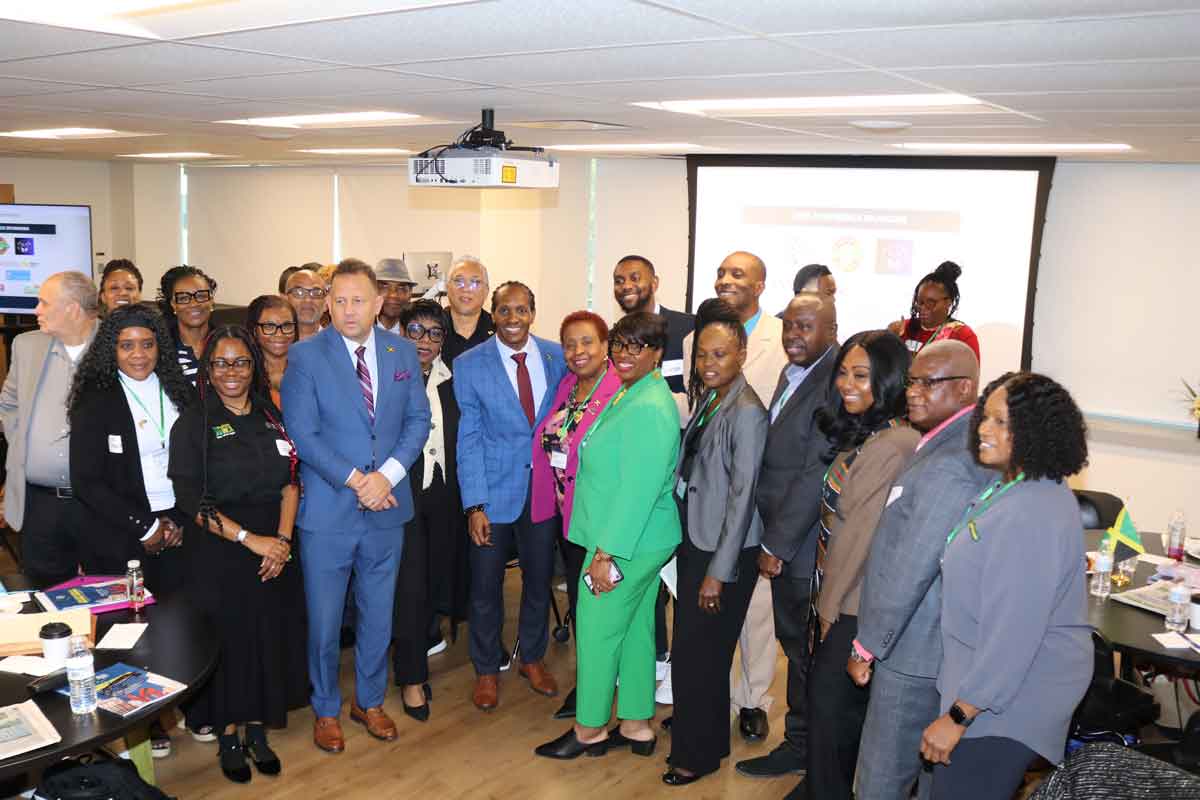
Minister of State in the Ministry of Foreign Affairs and Foreign Trade Hon Alando Terrelonge engages with delegates at the town hall meeting at the second Jamaica Diaspora Northeast USA Conference at Temple University in Philadelphia on Saturday, October 24 .2026. Photo Derrick Scott.
Philadelphia shows what happens once the votes are counted. Tulloch-Neil, who led the conference, was re-elected in February and, like every elected member, took her seat only on confirmation by the minister, as the Terms of Reference require. So did Janice McIntosh, who won the Southern USA seat covering 13 states including Florida. McIntosh told South Florida Caribbean News that her first order of business was to meet the council at the ministry, review the Terms of Reference, understand the mandate of the role, and ensure her work was “aligned with the priorities and expectations of the Ministry at this time”. Not the priorities of the Jamaicans across 13 southern states who voted for her. The ministry’s.
Tulloch-Neil has spoken of policy advocacy and round-tables with US legislators on immigration and dual citizenship. In Philadelphia the opening session featured the chargé d’affaires, the consul general and Jamaica’s ambassador to the UN alongside the minister. The one piece of lobbying reported was the minister’s request that Jamaican-Americans press Congress — on climate, on Jamaica’s behalf. A body chaired by the government finds it hard to make demands of the government, and in Philadelphia none was recorded.
The council was designed in 2019 as “a model for deeper partnership”, replacing a seven-member advisory board drawn from the US, UK and Canada with a council of roughly 30 spanning Africa, Asia, Europe and Latin America. The expansion was real. The independence never came.
Beckford has pointed out that an independent council in the United States would have to be registered there; a breakaway US group was already organising by mid-2024.
Senator Kamina Johnson Smith told April’s launch of the Biennial Conference that the diaspora is not an external population but an integral part of the national fabric. If that is so, US$3.12 billion a year has bought Jamaicans abroad the right to be asked for more hours, more dollars and more lobbying, and no standing to be heard on deportations or the ballot.
Partnership, the Holness administration calls it. From Philadelphia, it looked like management — from 2 Port Royal Street, by a minister who answers to the Prime Minister and not to a single one of the 1,700 who registered to vote in February.
-30-
