
CARIBBEAN | Sovereignty, Signed in Texas: The Barbados Shell at the Heart of Trump's Venezuelan Oil Grab
CARIBBEAN | Sovereignty, Signed in Texas: The Barbados Shell at the Heart of Trump's Venezuelan Oil Grab
Leaked terms of the “biggest oil deal in world history” show Washington taking first claim on Venezuela’s crude for half a century, through a Caribbean company whose investors need never be named.
MONTEGO BAY, Jamaica, OCTOBER 23, 2026 |Calvin G Brown | — Donald Trump announced it the way he announces most things: in capital letters, on a Friday night. The United States, he wrote on social media, had just entered an agreement with Venezuela on “THE BIGGEST OIL DEAL IN WORLD HISTORY!” The slogan travelled the world within hours. The contract did not.
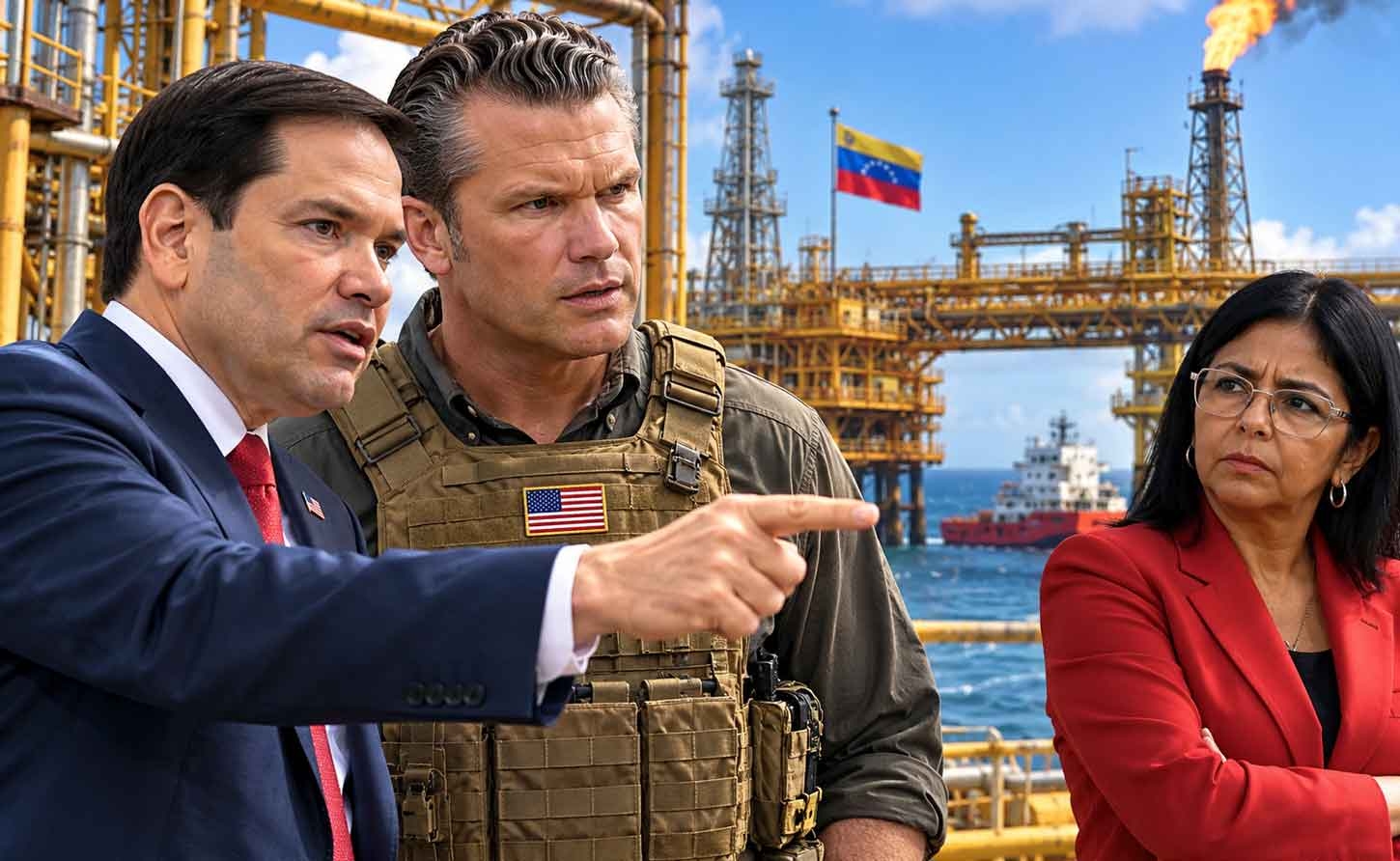
For nearly two months, the text of that accord was among Washington’s best-guarded secrets. That ended this week. ProPublica reviewed the 18-page strategic partnership agreement, signed for the United States by Secretary of State Marco Rubio and Defence Secretary Pete Hegseth, and found terms that favour American interests at every turn, while the Venezuelan government and the potential benefits to its people are largely absent from the text.
For the Caribbean, the most arresting detail is not in Caracas or Washington. It is in Bridgetown.
What the contract actually says
Strip away the rhetoric and the arithmetic is stark. The US gains the right to buy 20% of the oil produced by North American Blue Energy Partners (NABEP), the Barbados-headquartered company run by Venezuelan businessman Alejandro Betancourt, at $30 a barrel, less than a third of recent market prices. It also holds first priority on all of NABEP’s remaining output for the next 50 years, including an irrevocable right to its entire supply if the US declares a national emergency.
The price of admission is close to nothing. The US pays nothing upfront and will acquire its stake at one cent per warrant share, on terms that run until the 75th anniversary of closing. If a dispute arises, Venezuela cannot challenge the deal in its own courts. Any case must be argued before the US District Court for the Northern District of Texas, and Texas state law applies wherever federal law does not.
A sovereign nation’s most valuable natural resource will be adjudicated in a Texas courthouse.
Governance is equally one-directional. A majority of the seven-member board must be US citizens at all times. Betancourt is the only board member the agreement names, and there is no requirement for any Venezuelan government participation. The design is deliberate. A person familiar with the negotiations told ProPublica the governing structure was meant to give the dealmakers maximum control and to insulate them from future administrations that might seek to reverse it.
The headline promises also fray on contact with the text. Trump has spoken of a century of American energy dominance, but US purchasing rights expire in half that time. The operating rights appear to clash with Venezuelan law, which limits oil concessions to 25 years. Nor does the agreement explicitly oblige the company to pay the roughly $200 billion in royalties and taxes the White House says Venezuela will receive. Even the bargain barrel carries an asterisk: the $30 price excludes the cost of importing the thinner products needed to blend Venezuela’s heavy crude before it can flow through pipelines.
The man and the circle
At the centre sits Alejandro Betancourt, NABEP’s chief executive. The 46-year-old billionaire was confined to his Oxfordshire estate while fighting a Swiss extradition request tied to a money-laundering probe, and he remains under investigation in Spain. Fairness requires the other half of that sentence: Betancourt has not been charged in any country, and his lawyer maintains his innocence. A NABEP spokesperson said neither Betancourt nor co-signatory Orlando Alvarado has ever been charged, and called the claims against them baseless.
The deal’s road to completion is where the analysis sharpens. According to The Washington Post, senior Trump regime officials, among them Deputy Secretary of State Christopher Landau, asked foreign counterparts to let Betancourt travel freely and to close their investigations. The usual financing route was also closed. The International Development Finance Corporation is barred by US law from operating in Venezuela, so the Pentagon’s Office of Strategic Capital became the vehicle.
The partner, then, was a man whose legal troubles Washington itself helped to quiet. The money moved through a defence office rather than a development one.
The Barbados question
Now to Bridgetown. The US is acquiring its 35% stake through a Barbados-registered parent company, and the deal document says little about the owners and investors behind it, who could become enormously wealthy. ProPublica notes that under Barbados corporate law, there is almost nothing that can force those interests to be revealed publicly.
To be clear, Barbados is not a party to the deal; NABEP was registered there in 2024, long before Washington came calling. Barbados law does require companies to record their true owners, and since 1 September a central register holds those details, open to regulators at home and abroad but closed to the public. The investors, then, are hidden not from the authorities but from the people of the region whose oil, and whose reputation, are on the line.
That should still trouble every Caribbean finance ministry. For two decades, the region has endured blacklists, de-risking and correspondent-banking withdrawals, imposed largely at Washington’s insistence. The irony is acute: the same capital that pressed the Caribbean hardest on transparency now finds a Caribbean jurisdiction’s confidentiality convenient for its own purposes.
There is an uncomfortable coincidence, too. In April, Prime Minister Mia Mottley and Venezuela’s acting president, Delcy Rodríguez, announced a strategic partnership spanning food production, energy investment and language integration, with Mottley saying she wanted the Barbados National Energy Company to explore joint investments in Venezuelan oil and gas fields. Barbados thus finds itself courting Caracas as a partner while, by accident of corporate registration, hosting the vehicle through which Washington holds its stake.
Venezuela’s sovereignty ledger
Caracas does not see a surrender. Interim President Delcy Rodríguez has praised the accord as historic, insisted that Venezuela keeps sovereignty over its natural resources, and defended the choice of Betancourt. She has also pointed out that a 2022 Venezuelan arrest warrant against him for corruption was dropped a year later. The National Assembly, led by her brother Jorge Rodríguez, voted to back the measure even though no details had been made public.
The family politics are hard to miss. That same Jorge Rodríguez accused Betancourt of corruption in a televised speech in 2020. A legislature that endorsed a treaty it had not read, steered by a man who once denounced the deal’s chief beneficiary, is a thin foundation for an arrangement meant to last fifty years.
The exiled opposition is blunter still. María Corina Machado has accused Betancourt of corruption that caused great suffering for Venezuelans. Her critique lands on the contract’s central omission: the obligations run outward to Washington, and almost none run inward to Venezuelans.
The case for the deal
An honest analysis must give the defence its full weight, and it is not trivial.
Speed. NABEP is one of the few operators in Venezuela actually pumping oil. A former State Department official who studied the company argued that if the goal is to raise production quickly, buying into fields already producing makes sense.
Geopolitics. A US official framed the deal as a chance to secure fields that had largely been under the influence of Chinese and Russian companies. In a hemisphere where Beijing’s footprint keeps expanding, that argument carries weight in Washington and in some Caribbean capitals.
Investment and output. Energy Secretary Chris Wright predicted that Venezuelan output would pass 2 million barrels a day by the end of the decade, nearly double current production. For a country hollowed out by hyperinflation and a capital drought, any credible revival is welcome.
The question is not whether investment is needed; it plainly is. The question is whether this structure delivers it to Venezuelans, or merely through them. Even sympathetic readers face the timeline. Senate Democrats warned that it could take up to a decade before markets are meaningfully affected and Americans see any tangible benefit.
The view from the Caribbean
For the region, this deal is the closing chapter of a long story about who gets Venezuela’s barrels, and on what terms.
PetroCaribe, founded in June 2005, offered Caribbean states oil on concessionary terms before it collapsed by 2019. Jamaica was among its members. At its height, the arrangement let nations pay 60% of purchases within three months, with the balance deferred over 25 years at 1% interest. When sanctions choked it off, CARICOM leaders complained loudly. Dominica’s Roosevelt Skerrit put it simply: “We in the Caribbean are suffering immensely.”
The new order reverses the old logic. Under PetroCaribe, Caracas extended discounts outward to its neighbours. Under this accord, the deepest discount and the first call on production go to Washington, for fifty years and, in an emergency, for everything.
Under PetroCaribe, Caracas extended discounts outward to its neighbours. Under this accord, the first call goes to Washington.
Trinidad and Tobago knows the cost of standing in this crossfire. In December 2025, Venezuela terminated every energy agreement with Port of Spain, accusing the Persad-Bissessar government of complicity in the US seizure of an oil tanker. Barbados, meanwhile, is pursuing its own energy partnership with Caracas. Mottley has invoked the San José Accord and PetroCaribe as proof that the Caribbean has long depended on Venezuelan solidarity. Whether any such solidarity survives under a contract that gives the US first claim on NABEP’s production is now an open question.
What comes next
The deal is not yet complete. Its full force depends on closing conditions and on a set of implementation documents still being negotiated, which will settle the US stake and the rights of unnamed investors. That leaves a window for scrutiny, and the US midterms may widen it. Former US ambassador James Story has already framed the first question a new Congress would ask: “Why Betancourt?”
The Caribbean has questions of its own, and it should not wait for Washington to ask them. Who are the investors behind the Barbados parent? Has that parent filed its beneficial owners with the new Barbados register, and will any regulator with access ever say? And what remains of regional energy security when the hemisphere’s largest reserves sit under first-call contract to one buyer, enforceable in Texas?
The biggest oil deal in world history may yet prove to be exactly that. But a deal this large, this secret and this deliberately insulated from future governments is not merely a commercial transaction. It is a statement about who holds power in our neighbourhood, and the Caribbean has every right to read the fine print.
— 30 —
This analysis draws on reporting by ProPublica (Cate Brown, Aaron C. Davis and Sebastian Rotella), AP, Al Jazeera, AFP, CBS News, Venezuelanalysis, Barbados Today, the Jamaica Gleaner and the Jamaica Observer.
