
CULTURE | “Slavery” and “Black”: The Words That Empty a Room
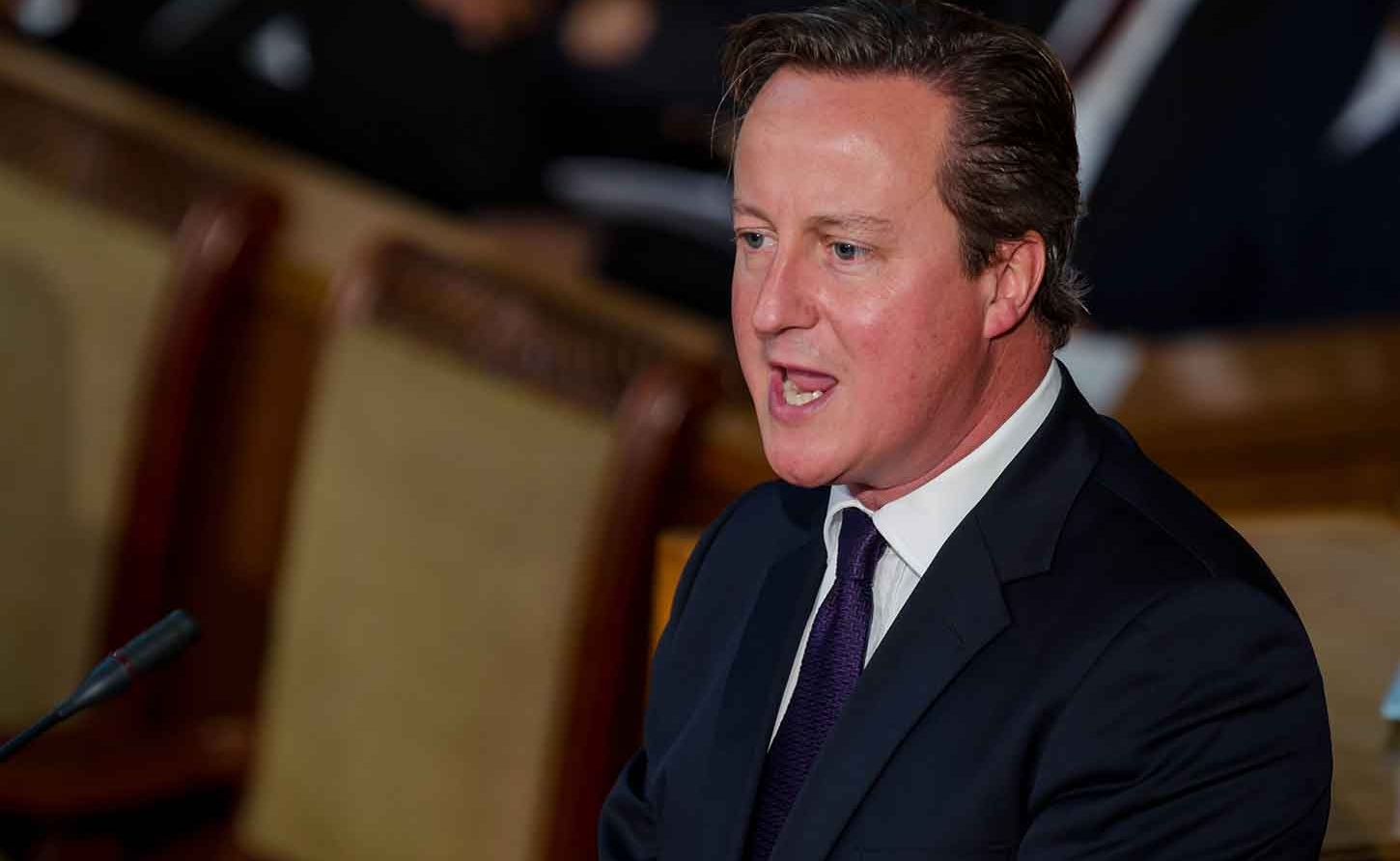
Former UK Prime minister David Camerob as he addressed Jamaica's parliament on September 30, 2015
David Cameron never told Jamaica to “get over it.” What he actually said from the floor of Gordon House was more careful — and considerably worse. It explains why two ordinary English words still change the pressure in a room.
CARIBBEAN | History and Culture | Calvin G. Brown | There are words in English that alter the pressure in a room. Say slavery in a mixed gathering in London, Toronto or Atlanta, and watch the shoulders rise half an inch.
Say black, meaning Black people, and watch a certain kind of speaker reach for something softer — urban, diverse, people of colour, the community — as though the plain word carried a charge the euphemism had safely discharged.
The reflexive explanation is guilt. That explanation is too easy, and it is wrong in a way worth examining. Guilt is retrospective and costs nothing; a man may feel guilty about the Norman Conquest over lunch and be no poorer by the pudding.
What produces the actual flinch is sharper and more practical: the suspicion that these are not historical words at all but present-tense ones, and that the sentence which follows them may contain a figure.
The most consequential instance of that flinch is on the public record. It was delivered in Kingston.
The sentence delivered at Gordon House
On 30 September 2015, David Cameron addressed a joint sitting of both Houses of the Jamaican Parliament. The relevant passage, from the text published by his own office, ran: “Slavery was and is abhorrent in all its forms. It has no place whatsoever in any civilised society, and Britain is proud to have eventually led the way in its abolition.
That the Caribbean has emerged from the long, dark shadow it cast is testament to the resilience and spirit of its people. I acknowledge that these wounds run very deep indeed. But I do hope that, as friends who have gone through so much together since those darkest of times, we can move on from this painful legacy and continue to build for the future.”
It has passed into Caribbean folk memory that Cameron told Jamaicans to get over it. He did not. That formulation belongs to Sir Hilary Beckles, chairman of the CARICOM Reparations Commission, who summarised Cameron’s thesis as: slavery is past, forget it, move on, the people of the Caribbean should get over it.
It was a characterisation of an argument, not a quotation of a man — and the distinction matters, not out of tenderness towards Cameron, but because the phrase he actually used is the more damaging of the two.
“Get over it” is a sneer. It is bad manners, and bad manners can be disowned by a press officer within the hour. “Move on” is a legal posture. It asserts that a matter is closed. Closure is not a thing a defendant announces; it is established by settlement, by judgment, or by the running of a limitation period. Cameron’s sentence performed the settlement it was requesting.
Note also what the sentence does with the intervening centuries. Friends who have gone through so much together. The construction converts a relationship between an owner and the owned into a shared ordeal, as though both parties had weathered the same storm from opposite ends of the same boat.
This is the grammar of the flinch in its most refined form — not denial, not apology, but the quiet insertion of a plural subject where there were, in fact, two entirely distinct ones.
Seven months
Here is why the word cannot be safely filed under history.
Britain abolished slavery in its Caribbean colonies and paid compensation — twenty million pounds of it, on the order of forty per cent of annual government expenditure at the time. The money went to the owners. The freed received nothing, and were additionally required to serve a period of unpaid apprenticeship. That much is familiar to every Jamaican schoolchild.
Less familiar is the mechanism. Britain did not have twenty million pounds to hand; it borrowed. The instrument survived, folded into a four per cent Consolidated Loan, and was not finally redeemed until 1 February 2015. British taxpayers — including the children and grandchildren of Caribbean migrants whose own ancestors were the property being valued — were still servicing that borrowing in the twenty-first century.
Cameron stood at Gordon House on 30 September 2015 and urged Jamaica to move on from a legacy Britain had finished paying for seven months earlier. Beckles made precisely this point: the transfer of public money to private holders of the debt made it a present-day activity, not a historical one.
The nervousness around the word is not squeamishness about an old atrocity. It is the recognition that the accounts were closed on one side only — and that the word functions as an audit trigger.
The second word
Black operates differently, and precision here is worth more than indignation.
Some of the anxiety is navigational rather than moral. Within a single lifetime the acceptable English term has travelled from Negro to coloured to Black to African-American and, in the United States, back to Black. Steven Pinker called this the euphemism treadmill: stigma attaches to the referent rather than to the word, so each new term absorbs the old freight and is retired in its turn.
Then came capitalisation — style guides landing on upper-case Black and lower-case white — which generated an argument of its own. A speaker who does not wish to give offence and cannot reliably identify the current setting will hesitate. That hesitation is not by itself a confession.
Treating every hesitation as a confession is analytically weak. It produces an unfalsifiable system in which discomfort proves guilt and composure proves denial, which is roughly John McWhorter’s objection to the fragility literature, and separately Adolph Reed’s complaint that the entire register substitutes etiquette for class analysis. An argument that cannot be lost is not an argument.
Beneath the navigational layer, however, sits something harder. Ossie Davis made the point decades ago simply by reading a thesaurus aloud: blackmail, blacklist, black market, black sheep, black day. Centuries of pejorative freight are loaded into the adjective before anyone applies it to a human being. That is not paranoia. It is lexicography.
Where the Caribbean parts company
And here the imported framework breaks — which is why it should be handled in this region with care.
Everything described above is a minority-in-a-white-majority phenomenon: American, British, Canadian. It does not survive the flight to Kingston. In Jamaica, blackness is not a delicate subject requiring circumlocution; it is the ordinary condition of the overwhelming majority.
Slavery is not whispered. Sam Sharpe is on the fifty-dollar note. Nanny is on the five hundred. Emancipation Day is a public holiday, restored deliberately after being abandoned.
The Jamaican room does go quiet — but at a different vocabulary. Browning. Good hair. She nice fi a dark girl. The anxiety here attaches to the colourism gradient and its class inflections; a related injury, but not the same one, and not one that any quantity of North American discourse will diagnose correctly.
Importing the framework wholesale flattens a Caribbean society into a diaspora reflection of an American one. That is precisely the analytical failure a Caribbean publication exists to avoid.
What was offered instead
There is a material footnote to the Cameron visit that captures the sentiment more efficiently than the speech does.
The day before the address, his government announced £25 million from the aid budget towards the construction of a 1,500-bed prison in Jamaica, so that Jamaican nationals held in British jails could be returned to serve their sentences at home. Britain would not discuss the ledger. Britain would fund a jail.
The arithmetic did not survive scrutiny. Downing Street’s own release put the saving to British taxpayers at roughly £10 million over thirty years. The figure that travelled through the British press, briefed by officials, was £10 million a year.
Jamaica’s security minister subsequently indicated that what had been agreed was the exploration of a transfer rather than a transfer itself. Kingston ultimately declined. A comparable approach to Nigeria came to nothing. The prison was never built.
But the sequencing is the point. No reparation, and a prison, offered within the same forty-eight hours, to a country whose grievance was that its people had once been property.
The case on the other side
It deserves stating at full strength, because the weak version is a straw man and straw men lose arguments only to themselves.
Britain did abolish, and did subsequently enforce abolition on others at real cost in treasure and lives. The practical objections to reparation are not frivolous: quantum is effectively unbounded, causation across two centuries is genuinely difficult to establish in law, and the identification of claimants raises questions no court has satisfactorily answered.
Cameron’s £300 million regional infrastructure fund was a defensible instrument on its own terms — development finance in place of juridical settlement.
The rebuttal is that aid is discretionary, revocable, and framed as generosity. Reparation is none of those things. A gift affirms the giver’s ownership of the decision to give; that is what makes it a gift, and that is exactly why it cannot substitute for a settlement.
There is honest disagreement inside the argument, too. The shift from slave to enslaved person is intended to restore agency — a condition imposed rather than an identity possessed — yet some Black historians resist it on the ground that the gentler construction files the edge off a brutality that ought to keep its edge. The vocabulary is not settled by one side handing rules to the other.
What the verb concedes
Which returns us to the two words.
Those who tense at them are not, in the main, concealing malice. They are responding accurately to a signal. These are the words at which a moral conversation threatens to become an accounting one, and the discomfort is a fair estimate of the size of the outstanding balance.
Cameron gave the game away in the verb. One cannot move on from a matter one has not conceded exists. The imperative presupposes the debt it was drafted to dismiss — which is why it was the wrong sentence to carry to Gordon House, and why it has outlived the ministry that produced it.
Eleven years on, the British position is materially unchanged; Sir Keir Starmer has ruled out an apology while allowing that he will engage with those who wish to raise it. The demand, meanwhile, has travelled from CARICOM communiqués to the floor of the General Assembly. Nobody has moved on. Britain has simply asked to be excused from the room in which the sum is being calculated.
— 30 —
