
JAMAICA | Low Risk Is Not No Risk: Congo's Ebola Surge and the Caribbean's Thin Margin
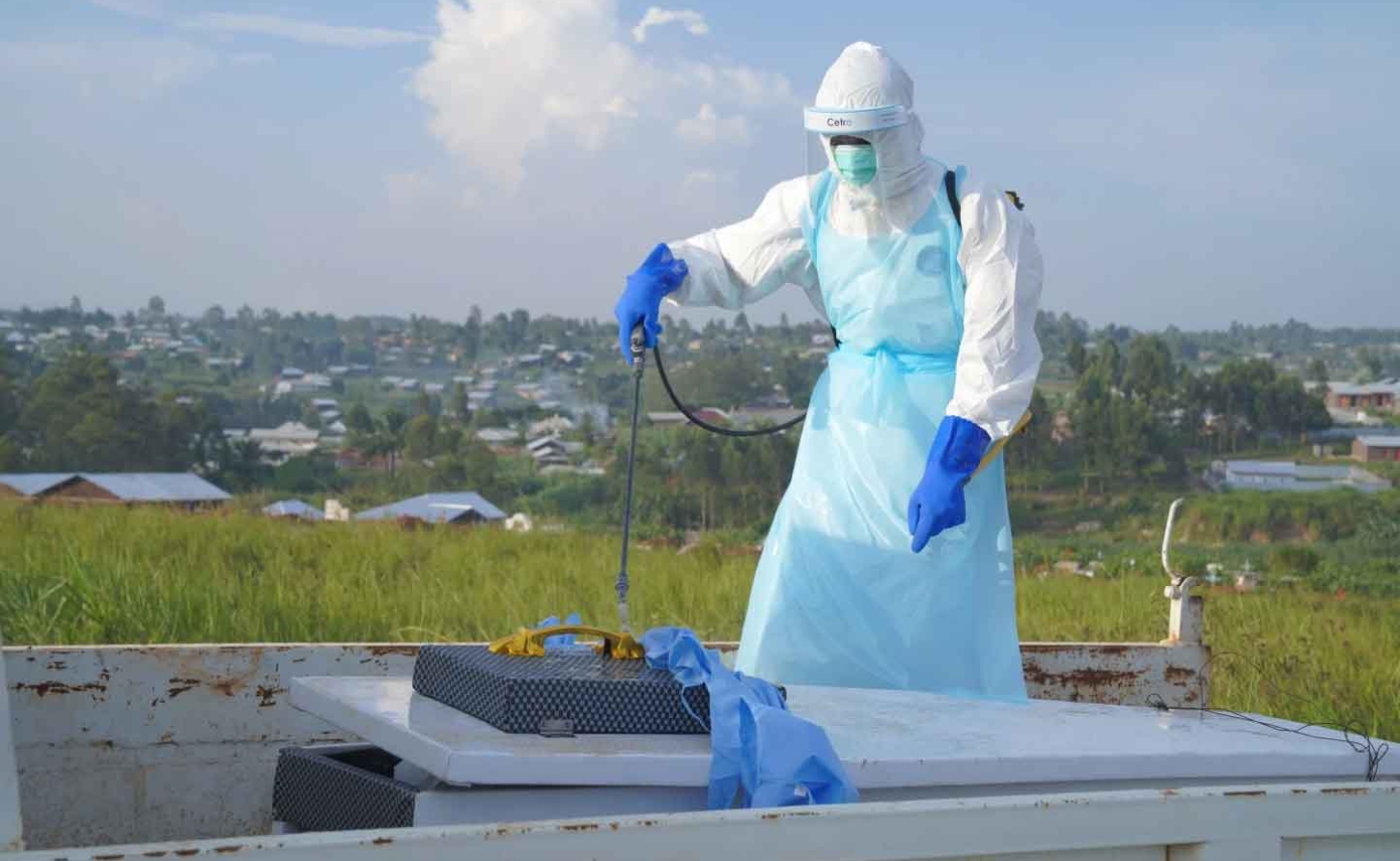
A health worker sprays the coffin containing the remains of Jacques Lobo Dhena who died of Ebola during a burial service in Bunia Ituri province, Eastern Congo August 12, 2026.| (AP Photo Dieudonne Dirole)
The World Health Organization says the Bundibugyo outbreak is on track to become the deadliest in history. The Caribbean’s defences are real — but they are built to detect, not to treat.
MONTEGO BAY, Jamaica | Calvin G Brown| August 12, 2026 - From a podium in Geneva on Wednesday, Dr Tedros Adhanom Ghebreyesus delivered the sentence that should concentrate minds from Kingston to Georgetown: the Ebola outbreak tearing through eastern Congo is, at its current pace, on track to eclipse the West African epidemic of 2014 to 2016 — the deadliest in history, which killed more than 11,000 people.
“The outbreak had a big head start, still way ahead of us, and we’re playing catch-up,” the WHO Director-General told reporters.
The Caribbean has spent three months being told the risk is low. That assessment remains correct. It is also, on its own, an inadequate basis for comfort.
The arithmetic
The numbers are contested only in their details. WHO’s last formal Disease Outbreak News, current to 30 July, recorded 3,605 confirmed cases and 1,587 confirmed deaths — a case fatality ratio of 44 per cent — across 49 health zones in five Congolese provinces.
By Wednesday’s briefing the reported toll had passed 2,000 dead from more than 4,300 cases, figures that fold in probable and suspected cases. Either way, this is now the largest Ebola outbreak ever recorded in the Democratic Republic of the Congo.
What makes it different is pharmacological. The Bundibugyo species has no licensed vaccine and no approved treatment. Two candidate vaccines entered first-in-human trials only this month. WHO’s emergency response director, Dr Abdirahman Mahamud, expects the peak in six months — and calls that the moderate scenario, with nine to twelve months possible.
What the region did right
To its credit, the Caribbean did not wait. Within days of WHO’s 16 May emergency declaration, CARPHA assessed regional risk as low while urging member states to hold a high state of readiness. Executive Director Dr Lisa Indar was explicit about why: the Caribbean is a major global travel hub, and the realistic route of entry is a single infected traveller.
On 18 May, CARPHA and CARICOM IMPACS reactivated electronic border screening to flag passengers arriving from or transiting affected areas. CARPHA’s Regional Referral Laboratory can now test for Ebola viruses.
Jamaica ramped up 21-day travel-history screening with mandatory quarantine; Health Minister Dr Christopher Tufton reported nine flagged arrivals, none symptomatic, and some 1,100 personnel sensitised.
That is a serious, functioning surveillance architecture. It is not the same thing as a treatment capability.
The flight that did not land
Which brings us to the most revealing episode of the affair. On 24 May, Air Peace flew the first direct service from Lagos to the Caribbean — a Boeing 777 carrying more than 284 passengers into Bridgetown, cutting a routing logic that had run through London and New York since colonial times.
It did not land in Antigua. Prime Minister Gaston Browne blocked it, citing what he called a conservative public-health posture.
The difficulty is geography. Ituri Province sits roughly 3,000 kilometres from Lagos — farther than Kingston is from New York. Nigeria and Ghana, the route’s principal source markets, have reported no cases in this outbreak.
Browne was also candid that his caution owed something to the 2022 Antigua Airways migrant controversy: “We got burnt there,” he told listeners. And Air Peace’s own commercial officer conceded the Antigua leg carried 24 inbound passengers and was unviable regardless.
So which was it — prudence, political memory, or a continent of 1.5 billion people treated as a single epidemiological unit? Caribbean governments owe themselves an honest answer, because the region cannot court African connectivity through AfCFTA and Afreximbank while flinching at the first aircraft that arrives.
Where the exposure actually lies
Screening detects. It does not cure. PAHO activated its Incident Management System and convened 394 participants from 30 countries on the harder questions — laboratory biosafety, clinical management, medical evacuation, safe and dignified burials. Those are the capacities that matter if detection fails, and they are thinner across the region than any border checkpoint.
Jamaica would face that test with a health system still absorbing Hurricane Melissa. Every isolation bed and trained infection-control nurse competes with reconstruction for the same shrinking pool of money.
The Caribbean’s position is defensible on both counts, but only if both are held at once: no small state can outsource its health security to distant agencies, and no region seeking African partnership can let fear do the work of evidence. Low risk is not no risk. Neither is it licence to shut the door.
— 30 —
