
Ghana Answers the Call: Accra’s Nurses Fill the Cuban Gap in Caribbean Health Care
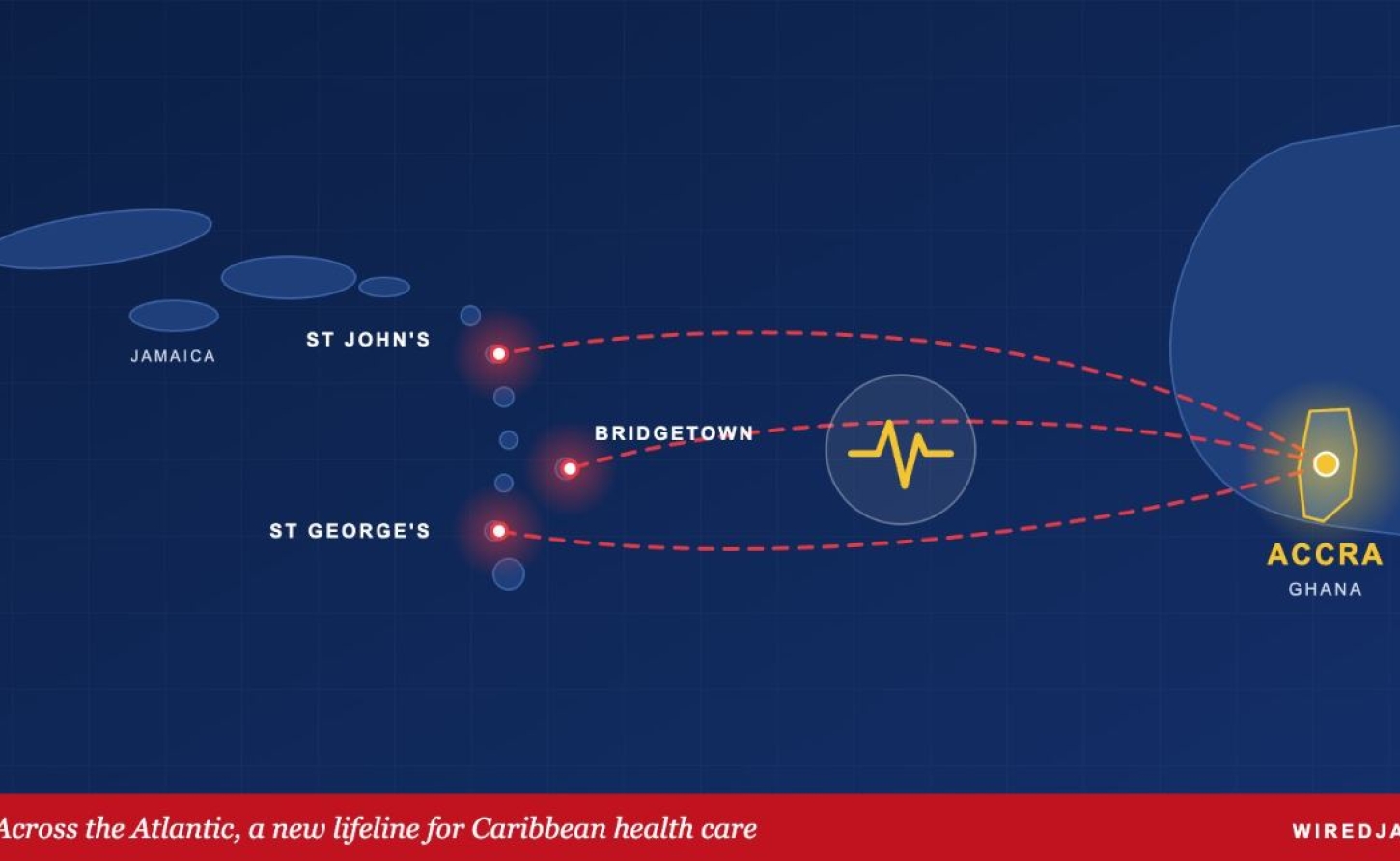
Map graphic showing flight paths from Accra, Ghana, to St John’s, Bridgetown and St George’s in the Caribbean
As Cuba's doctors are pushed out of the region, Ghana is sending its health workers in. The story says as much about Ghana's strength as it does about the Caribbean's vulnerability, and about the price of saying yes to Washington.
MONTEGO BAY, Jamaica, October 18, 2026, Calvin G Brown | — They left Accra to speeches, flags and a blunt instruction from Ghana's Minister of Labour, Jobs and Employment, Emmanuel Kwadwo Agyekum: "Go and work well, don't mess up." Sixty-one Ghanaian health workers, bound for Grenada on two-year renewable contracts, the second cohort the Spice Isle has received under Ghana's Labour Export Programme.
They are not alone. In January, more than 120 Ghanaian health professionals landed in Antigua and Barbuda. Barbados, which first chartered a flight to bring in 95 Ghanaian nurses in 2020, approved in Cabinet this year the recruitment of another 112, with Prime Minister Mia Mottley conceding plainly that the island is short of nurses. Accra says Germany, the United States and more Caribbean states are lining up next.
Across the region, a quiet transfer of care is under way. The white coats from Havana are leaving. The ones from Accra are arriving. And the order for that swap was not written in Kingston, St George's or Bridgetown. It was written in Washington.
The squeeze from Washington
In February 2025, US Secretary of State Marco Rubio expanded a visa-restriction policy to target not only Cuban officials but any foreign government official deemed complicit in Cuba's overseas medical missions, which the Trump administration brands forced labour. Washington's charge is that Havana rents out its doctors and pockets the bulk of their pay, by the US government's own estimate somewhere between 80 and 95 per cent.
Havana tells a very different story. For more than six decades, the US embargo has choked off Cuba's access to markets, credit and trade. One thing the embargo could not seize was the skill of the doctors and nurses Cuba trains at state expense. So the Cuban state acts as broker for that skill. Under government-to-government agreements, the host country pays Havana rather than the individual worker. Havana then pays its health workers their agreed emoluments, and the balance flows back into the free health and education system that trained them in the first place. Cuba insists the missions are voluntary and rejects the forced-labour label outright. Seen from Havana, the brigades are not trafficking. They are one of the few export earners the embargo has failed to strangle, and that is precisely why Washington wants them shut down.
The pressure was not abstract. In August 2025, the State Department announced visa restrictions on Grenadian officials and their families over the programme. Within weeks, St George's announced "important changes" to its Cuban Workers Programme and publicly acknowledged the US role in raising the matter.
Then the dominoes fell. In early March 2026, Jamaica ended a Cuban medical mission of 277 personnel that had served the island for some five decades, after the two governments failed to agree on paying doctors directly. Days later, Cuba withdrew more than 200 doctors from Guyana after Georgetown moved to pay them full salaries. Antigua and Barbuda wound down a medical partnership that had lasted more than a quarter century, while insisting it had not formally severed ties. Honduras went the same way.
It is worth remembering how defiant the region sounded at first. St Vincent's Ralph Gonsalves said he would sooner surrender his US visa than watch poor and working people die for want of care. Grenada's Finance Minister Dennis Cornwall, himself a graduate of a Cuban university, said he and his colleagues would give up their visas too, calling the Cuban doctors and nurses an irreplaceable part of the island's health system. Mottley, Rowley and others framed the visa threat as an assault on Caribbean sovereignty.
The defiance did not survive contact with the visa office.
None of this means the labour concerns are invented. Questions about how much of a Cuban doctor's wage actually reaches the doctor, and about the handling of their passports, are legitimate, and Jamaica's own review raised them. But Washington offered the Caribbean a complaint, not a solution. It demanded that small island states dismantle a pillar of their public health systems and sent no doctors, no nurses and no money to replace it. The bill for American foreign policy was handed to patients in rural clinics from Mandeville to Grenville.
A neighbour turned bully
The medical brigades are only one front in a wider cold snap. For generations, the relationship between the Caribbean and the United States rested on a simple bargain. Our people went north to work, not to settle: on the Panama Canal, in the cane fields and orchards, in hotels and hospitals. They earned, sent money home, and came back. The queue outside the US embassy was a fixture of Caribbean life, and it was a queue of workers, not supplicants.
That bargain is being torn up. From January 1, Washington slapped visa restrictions on Antigua and Barbuda and Dominica over their citizenship-by-investment programmes, and shut Haiti out almost entirely. Weeks later, the State Department froze immigrant visa processing for 75 countries. Jamaica, Barbados, Grenada, The Bahamas, Belize, St Lucia, St Kitts and Nevis, St Vincent and the Grenadines, Antigua and Dominica are all on that list, on the claim that their people are likely to become a burden on American welfare. Caribbean government ministers have been turned away. The administration boasts of revoking more than 100,000 visas in a single year.
The official language is about security and "public charge." The people at the embassy gate hear something else. The work is still there in America; the employers still want the hands. What has changed is who is welcome to do it. When the list of the barred reads like a roll call of Black and brown nations, when Africa and the Caribbean are hit hardest and Western Europe not at all, Caribbean people draw their own conclusion. On the streets of Kingston and Bridgetown it is summed up in an old line: if you're Black, get back. Washington may deny that race drives its policy. It should not be surprised that the region no longer believes it.
The result is a relationship that has cooled faster in two years than in the previous sixty. Caribbean people who once spoke of America as the land of opportunity are now giving it the evil eye. And the young Ghanaian nurse arriving in St George's is, in a sense, the answer: if the door to the north is closing, the region will build bridges east, across the Atlantic, to Africa.
Ghana steps into the breach
Into that vacuum stepped Ghana, and it did so with something the region badly needed: trained people, ready to go.
Ghana's strength is its capacity to produce health workers at scale. Its network of nursing and midwifery training institutions turns out graduates faster than almost anywhere in the region, and its recruitment pipeline has become disciplined. When Barbados first came calling in 2020, some 600 Ghanaian nurses applied, 150 were shortlisted and interviewed by a joint team, and 120 were selected, including cardiac, critical-care, emergency, operating-theatre and ophthalmic specialists. That is not a charity airlift. That is a system.
The deployments are also run as state-to-state agreements, governed by memoranda of understanding and service agreements rather than left to private recruiters. Ghana's ministers have sent their nurses off with explicit demands: honour the contract, guard the country's reputation, and come home when it ends. Chief of Staff Julius Debrah told the Grenada cohort that their conduct would decide whether the door to Ghanaian professionals stays open.
There is a deeper resonance here too. This is African labour crossing the Atlantic by choice, under contract, to strengthen Caribbean societies built by the descendants of Africans who crossed it in chains. For a region that has spent decades talking about reconnecting with the continent, Ghana's nurses are the reparative relationship made real: South-South cooperation that asks nothing of Washington's permission.
The uncomfortable truth behind the strength
But a hard-hitting account must also be an honest one, and the most important fact about Ghana's surplus is why it exists.
Ghana's Health Minister, Kwabena Mintah-Akandoh, has said the country has more than 80,000 trained health professionals sitting unemployed, not because Ghana has too many health workers, but because the state cannot afford to hire them. The Labour Export Programme is, by the government's own description, a jobs programme. Ghana's export of nurses is a measure of its training strength and, at the same time, of the fiscal weakness of its own health service.
Ghana's nurses' union, the Ghana Registered Nurses and Midwives Association, complained that it was not consulted before the Antigua recruitment and has urged Accra to fix pay and conditions at home and clear the backlog of unemployed nurses rather than ship them abroad. The association has also tracked an exodus of thousands of nurses who left on their own in search of better pay. And there is a striking irony: Ghana itself has relied on Cuban doctors since 1983, in part because its own doctors cluster in two cities and leave rural districts underserved.
There is a second gap the Caribbean must face squarely. The Cuban brigades included doctors and specialists. Ghana is sending mostly nurses. Nurses keep wards running, but they cannot replace an ophthalmologist, an anaesthetist or a surgeon. The physician hole Washington's policy created remains open.
What the region must do now
Ghana's nurses are a bridge, not a foundation. If Caribbean governments treat them as a permanent substitute for building their own workforce, they will simply have swapped one dependency for another, this time on a partner whose own nurses are restless and whose own patients are underserved.
The region has to do three things at once. It must make the Ghana partnership fair, with decent pay, clear career paths, skills exchanges that send knowledge back to Accra, and a seat at the table for Ghana's nursing unions. It must retain its own graduates; Cornwall himself admitted that Grenadians trained at St George's University are not staying to serve their own hospitals. And it must stop letting foreign capitals decide the shape of its health system.
Washington will claim a victory over Havana. Accra will claim jobs for its graduates. The real test is whether a pregnant woman in a parish clinic, or a diabetic pensioner waiting at a district hospital, gets seen by a qualified hand when she needs one.
Right now, that hand increasingly belongs to a nurse from Ghana. The Caribbean should be grateful. It should also be ashamed of how it got here, and determined never to be this exposed again.
-30-
