ANTIGUA| Facts Over Fiction: Browne Dismantles Persad-Bissessar's "Unreliable" CARICOM Claim
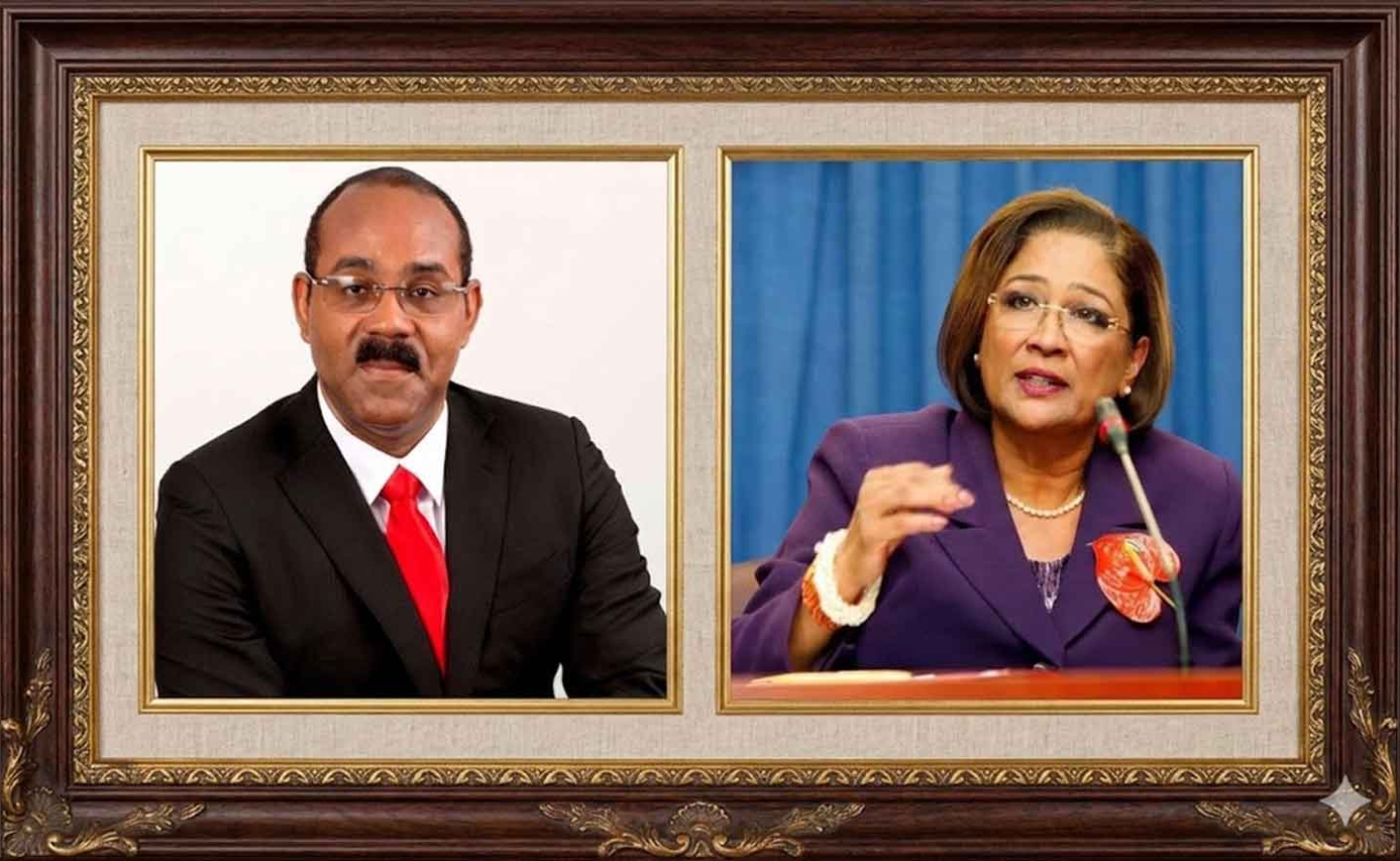
Prime Minister of Antigua and Barbuda, Gaston Browne and Prime Minister of Trinidad and Tobago Kamla Persad-Bissessar
Antigua PM deploys $1.1 billion in trade data to counter Trinidad leader's assault on regional unity
ST JOHN’S ANTIGUA, December 24, 2025 - When Trinidad and Tobago Prime Minister Kamla Persad-Bissessar declared CARICOM "not a reliable partner" on Saturday, she likely didn't anticipate that her own country's trade figures would be weaponized against her within 24 hours.
Antigua and Barbuda Prime Minister Gaston Browne delivered that reality check Sunday with a statement grounded not in diplomatic niceties, but in hard economic data that exposes an uncomfortable truth: Trinidad and Tobago has been CARICOM's biggest beneficiary for half a century.
The Billion-Dollar Inconvenience
Browne's rebuttal reads like an accountant's takedown of a politician's talking points. In 2024 alone, Trinidad earned more than US$1.1 billion in foreign exchange from CARICOM trade—comprising $784.7 million in domestic exports and $501.3 million in re-exports. CARICOM ranks as Trinidad's second-largest export market, exceeded only by the United States.
But here's the kicker: that trade hasn't been remotely balanced. Trinidad has recorded the largest merchandise trade surplus within CARICOM consistently since the organization's founding in 1973. Translation: Trinidad has been extracting wealth from the very "unreliable partner" Persad-Bissessar now dismisses.
The economic archaeology gets more damning. Under CARICOM's Common External Tariff, member states—including Antigua and Barbuda—apply protective tariffs on extra-regional imports specifically to support Trinidad's manufacturing sector. In 2024, CARICOM countries collectively forwent approximately $142.7 million in customs revenue by sourcing goods from Trinidad under this protection.
Browne frames this as "an economic sacrifice borne by Caribbean consumers in the spirit of regional solidarity." The subtext is brutal: Trinidad has been dining well at CARICOM's table while complaining about the menu.
Beyond the Balance Sheet
Browne doesn't stop at trade figures. He pivots to security—a sensitive nerve given Trinidad and Tobago's struggle with some of the Caribbean's highest levels of organized crime. Regional cooperation through CARICOM security mechanisms, intelligence sharing, and coordinated law enforcement, Browne argues, has been "an essential pillar of the response."
The implication cuts deep: when Trinidad needs partners to fight transnational crime, CARICOM delivers. Apparently reliability works one way.
The "Bad-Mouthing" Fiction
Perhaps most sharply, Browne categorically rejects Persad-Bissessar's claim that Antigua and Barbuda leaders "bad-mouthed" the United States—the assertion she deployed to explain why Antigua faced U.S. visa restrictions. "No evidence has been offered because none exists," Browne states flatly, challenging the narrative that painted his government as anti-American troublemakers.
Instead, Browne points to Antigua's "record of close collaboration with the United States, including constructive engagement on security matters, immigration, and consistent cooperation in multilateral fora." The visa restrictions? They've since been suspended following diplomatic engagement—the kind that doesn't require Trinidad-style "behave yourself" warnings to citizens.
The Kissinger Lesson Persad-Bissessar Forgot
Persad-Bissessar's gambit—trading regional solidarity for perceived American favor—rests on a fundamental misreading of great power politics. Henry Kissinger, former U.S. Secretary of State, famously observed that "America has no permanent friends or enemies, only interests." That cold calculus has governed U.S. foreign policy for generations.
Persad-Bissessar's public warnings to Trinidadians to "behave yourself" and avoid criticizing Washington lest they lose visa privileges suggests a belief that deference guarantees protection. History offers little comfort for small states banking on such loyalty. When American interests shift—and they will—Trinidad's enthusiastic alignment may prove as disposable as the "unreliable" CARICOM partnership she now scorns.
Browne's approach reflects a more sophisticated understanding: "Respectful dialogue with international partners is not subservience; nor is regional consultation disloyalty." Engage the United States, certainly—but from a position of collective Caribbean strength, not individual vulnerability.
The Reckoning
Browne's statement concludes with measured restraint: "That balanced approach has served our region well for decades. It should not now be diminished by rhetoric that divides where facts demonstrate the value of interdependence."
But beneath the diplomatic language lies a devastating indictment. Persad-Bissessar has characterized as "unreliable" the very organization that has bankrolled Trinidad's trade surplus for 52 years, supported its security infrastructure, and absorbed economic costs to protect its manufacturing sector—all while positioning Trinidad as supplicant to a superpower that, as Kissinger reminded us, operates strictly on interests, not friendships.
The facts aren't ambiguous. Trinidad has been CARICOM's principal economic beneficiary. Whether Persad-Bissessar's gambit proves strategically sound remains to be seen. What's certain is that her "unreliable partner" claim won't survive even cursory scrutiny of her own treasury's accounts.
Browne hasn't just disputed Persad-Bissessar's characterization. He's eviscerated it with Trinidad's own balance sheets—and with the hard lessons of geopolitics that apparently escaped Port of Spain's notice.
-30-
