CARIBBEAN | Cuba in the Crosshairs: No More Oil Or Money Going To Cuba, Trump Says
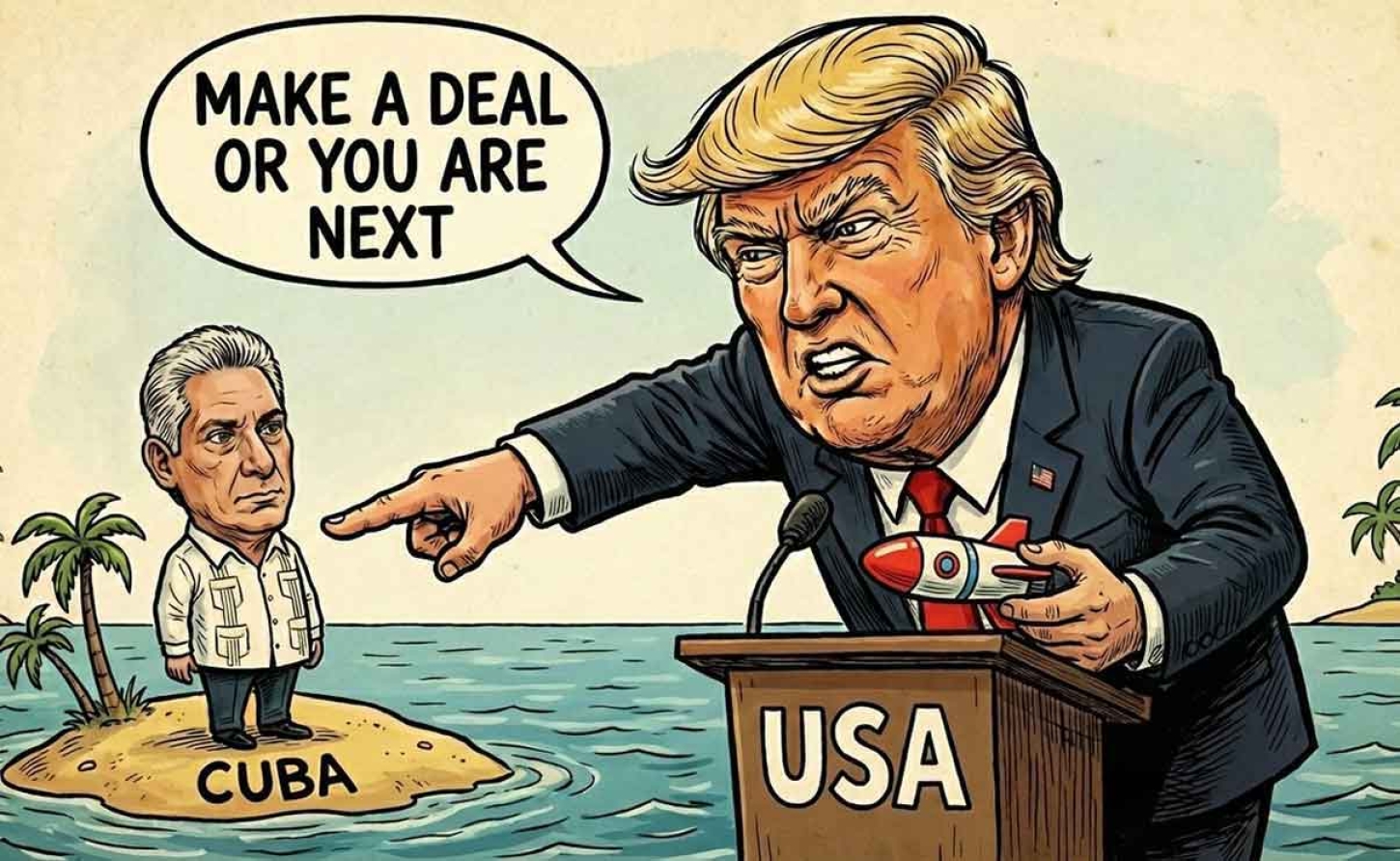
CARIBBEAN | Cuba in the Crosshairs: No More Oil Or Money Going To Cuba, Trump Says
Just days after seizing Venezuela's leader, Washington turns its gaze—and threats—towards Havana
By Calvin G. Brown | WiredJa
MONTEGO BAY, Jamaica, January 11, 2026 - The ink on Venezuela's forced capitulation has barely dried, yet Donald Trump is already telegraphing his next target. In a flurry of Truth Social posts on Sunday, the US president issued an unmistakable ultimatum to Cuba: "I strongly suggest they make a deal, BEFORE IT IS TOO LATE."
The menacing capitals are no accident. Barely a week after US forces seized Venezuelan President Nicolás Maduro in a brazen raid on Caracas—an operation that killed 32 Cuban security personnel—Trump appears to be setting the stage for the Caribbean's next confrontation. The question is no longer whether Washington intends to move against Havana, but when.
Rubio's Return: From Exile's Son to Regime Change Architect
Perhaps nothing illustrates the administration's intentions more starkly than Trump's repost of a message suggesting Secretary of State Marco Rubio could become Cuba's next president. "Sounds good to me!" Trump added, treating the prospect of installing an American official as head of a sovereign nation as casual entertainment.
Rubio himself has done nothing to temper expectations. Last week, the Cuban-American former senator—whose parents fled the island decades ago—warned that Cuban leaders should be "concerned" and declared they were "in a lot of trouble." For a Secretary of State to issue such naked threats against a neighbouring nation would once have been considered a diplomatic scandal. In the current climate, it reads as a policy preview.
The personal dimension cannot be overlooked. Rubio has built his political career on hostility toward Havana's government. Now, positioned at the apex of American foreign policy, he appears poised to transform generational grievance into geopolitical action.
Strangulation by Petroleum
Trump's strategy extends beyond military posturing. By seizing control of Venezuela's oil industry and redirecting shipments to American coffers, Washington has effectively weaponised Cuba's energy dependency. The island relied on approximately 35,000 barrels of Venezuelan crude daily—a lifeline now severed at the source.
"THERE WILL BE NO MORE OIL OR MONEY GOING TO CUBA – ZERO!" Trump declared, with characteristic bombast. The consequences are already materialising. Cuba's fuel and electricity crisis, chronic for years, has deteriorated sharply since the administration began confiscating sanctioned Venezuelan tankers.
This is economic warfare by another name. Without Venezuelan oil, Cuba's power grid—already prone to island-wide blackouts—faces collapse. Transportation grinds toward paralysis. Hospitals struggle to maintain basic functions. The goal is transparent: create conditions so desperate that the government either capitulates or crumbles.
Sixty-Two Years of Siege
What makes Washington's current offensive particularly cruel is its context. Cuba has endured the longest economic blockade in modern history—62 years of sanctions designed to strangle the island into submission. The embargo has cost Cuba an estimated $150 billion in economic damage, according to UN assessments that have repeatedly condemned the policy.
The Cuban people have survived through extraordinary resilience, but they have not escaped unscathed. Medical supply shortages, food insecurity, and infrastructure decay are daily realities. Now, with Venezuelan support eliminated and American pressure intensifying, the administration appears determined to deliver what six decades of sanctions could not: the final blow.
Trump himself has said the quiet part aloud, claiming military intervention is unnecessary because Cuba is "ready to fall." The implication is clear—why invade when you can simply wait for starvation to do the work?
A Zone of Peace Dashed Against the Rocks
For decades, CARICOM has championed the Caribbean as a "Zone of Peace"—a solemn commitment first articulated by Grenada's Maurice Bishop in 1979 and codified in the 2014 CELAC declaration. The principle is straightforward: disputes should be resolved through dialogue, sovereignty must be respected, and military might should never supplant international law in regional waters.
Trump has now dashed that aspiration against the rocks. In a New York Times interview published Thursday, the president was asked whether any limits constrain his global power. His response should chill every Caribbean leader: "Yeah, there is one thing. My own morality. My own mind. It's the only thing that can stop me."
He then added, with chilling finality: "I don't need international law."
The Caracas raid already demonstrated Washington's willingness to conduct military operations in the hemisphere with impunity. Thirty-two Cuban nationals died in that assault—dismissed by Trump as "DEAD from last week's USA attack" with chilling indifference. If Cuba falls within America's crosshairs, which Caribbean nation can consider itself safe from Washington's expanding definition of its "backyard"?
The Monroe Doctrine, that 19th-century declaration of hemispheric dominance, appears to be experiencing a 21st-century revival—with modern military capabilities to enforce it and a president who believes his personal morality supersedes the international legal order.
The Pattern Emerges
Those paying attention will recognise the sequence: inflammatory social media posts, economic strangulation, threats of unspecified consequences, followed by action. Venezuela witnessed this progression. Cuba is now experiencing its opening stages.
Trump's ultimatum—"make a deal, BEFORE IT IS TOO LATE"—offers no clarity on what terms might satisfy Washington. This ambiguity is itself the point. When the goalposts remain undefined, any response can be deemed insufficient, any resistance justification for escalation.
The Caribbean watches with mounting alarm. Cuba stands defiant but vulnerable. And in Washington, a president constrained only by his own mind has already identified the next domino.
-30-
