CARICOM | The Caribbean Pays High Health Cost for Trump’s Anti-Cuban Crusade
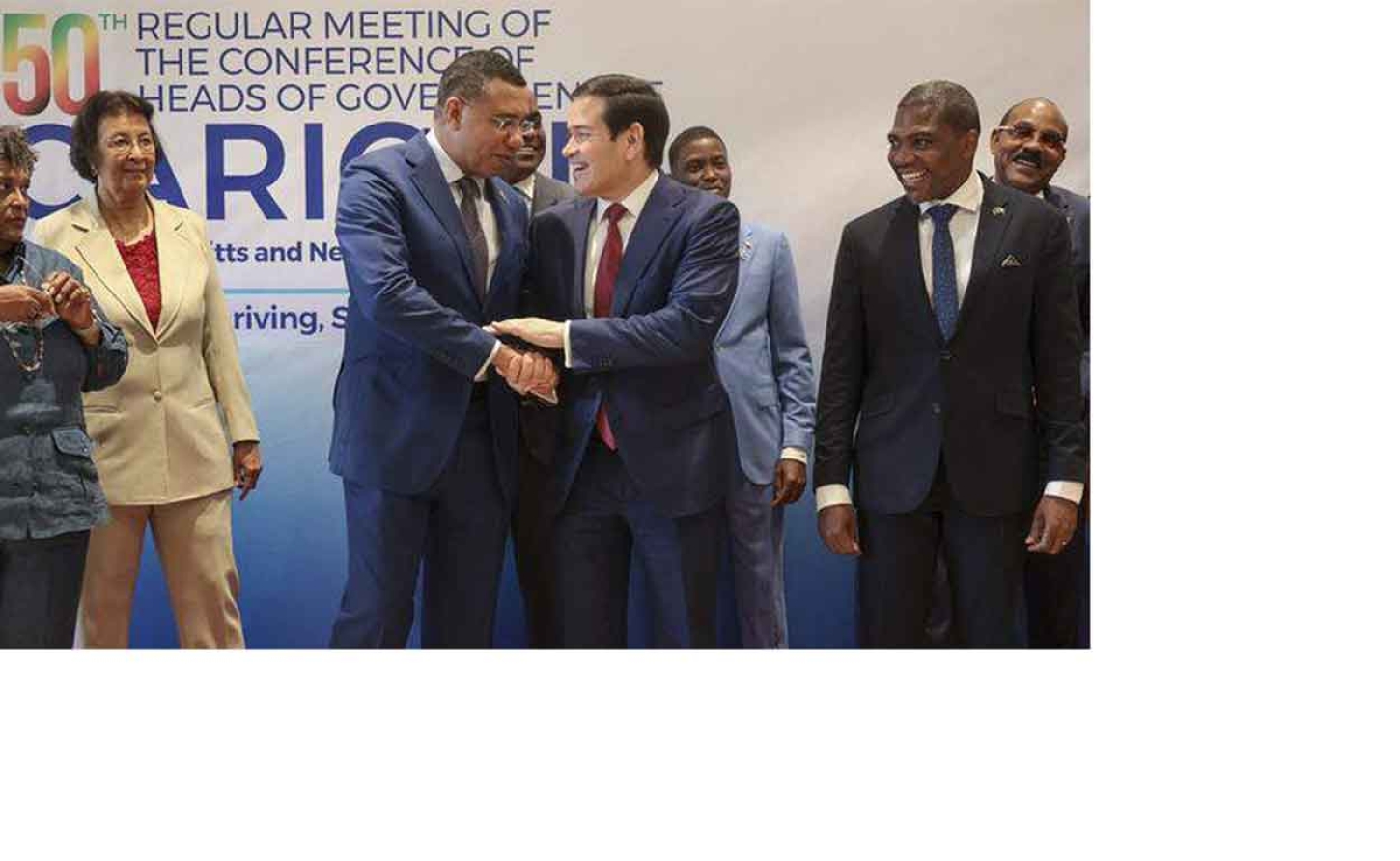
Prime Minister Dr. Andrew Holness greets US Secretary of State Marco Rubio at the recent CARICOM Summit in St. Kitts and Nevis
Marco Rubio orders Jamaica to expel its Cuban doctors. ICE hunts down Caribbean nurses in America. And Washington offers the region absolutely nothing in return.
THE NUMBERS THAT INDICT
KINGSTON, Jamaica, WiredJa | March 7, 2026 | Before the politics, count the people. In the thirty years that Cuban medical professionals served Jamaica’s public health system, they treated more than 8.1 million patients, performed 74,302 surgical procedures, attended 7,170 births, and by Cuba’s own reckoning, saved more than 90,000 lives.
Through Operation Miracle — the ophthalmological programme that has been a quiet revolution in Caribbean healthcare since 2010 — nearly 25,000 Jamaicans had their sight restored or meaningfully improved. These are not statistics. They are grandmothers who can see their grandchildren. They are working people who kept their sight and kept their livelihoods.
On March 4, 2026, the Holness administration communicated to the Cuban embassy that it was terminating the bilateral health cooperation agreement that has been in place since 1976. The Cuban Medical Brigade — 277 specialists dispersed across public health facilities island-wide — was withdrawn. Fifty years of partnership, ended in a diplomatic note.
A SYSTEM BUILT ON CUBAN SCAFFOLDING
The Cubans were not a supplemental layer bolted onto Jamaica’s health system. They were structural. General practitioners, specialists, biomedical engineers, nurses, and technicians were woven into the fabric of public hospitals from Kingston to the most remote parish clinics.
When Hurricane Melissa tore through the island in October 2025, the Cuban Medical Brigade did not evacuate with the tourists. They stayed. Many of them worked for more than 72 consecutive hours — treating the injured, recovering hospitals, serving communities whose own roofs had been destroyed.
The Holness government’s fig leaf — that individual Cuban professionals may be hired on personal contracts under local labour law — is precisely that: a fig leaf. Cuba has already moved decisively, announcing the full withdrawal of the brigade. The state cooperation framework is gone, and with it the organised pipeline that made this level of deployment possible. What remains is a void that no ad hoc arrangement can fill.
“The implications for the health sector are great and it is a terrible situation for any health minister, to be caught up between saving lives and foreign policy.” — Jamaica Gleaner
THE MEDICAL TOURISM DREAM DIES IN THE WAITING ROOM
The cruelest irony in this saga is the collision between the expulsion decision and Jamaica’s stated ambition to become a Caribbean hub for medical tourism. Jamaica has invested significant institutional energy in this vision — developing facilitative frameworks for private health sector investment, establishing national committees, participating in international trade conferences.
The pitch to international medical travellers is simple: quality specialist care in a tropical destination.
But medical tourism is a specialist’s game. It demands precisely the depth of expertise that the Cuban mission provided at scale, at cost, and with institutional consistency. You cannot credibly market Jamaica as a destination for complex procedures when your public health system has just shed 277 trained professionals.
The waiting rooms that will get longer and the surgeries that will be deferred are not merely a human tragedy — they are a direct advertisement against the very brand Jamaica is trying to build.
RUBIO’S GAMBIT AND THE HOLLOW ‘FORCED LABOUR’ FRAMING
Washington’s diplomatic campaign against Cuban medical missions rests on the argument that the Cuban state retains the majority of salaries paid to host governments, constituting forced labour.
It is an argument that conveniently serves United States foreign policy objectives while presenting itself as humanitarian concern. Secretary of State Marco Rubio went further, threatening to revoke visas for officials in countries that continued the arrangements.
The Gleaner’s own reporting is unambiguous: the decision to terminate was driven not by principled policy review, but by an increasingly impatient Washington whose demands dominated discussions at the Jamaican foreign ministry.
This is the Kissinger doctrine in its rawest form — nations do not have permanent friends, only permanent interests. And America’s permanent interest is isolating Havana, whatever the cost to Jamaican patients.
The precedent is not new. When Washington pressured Jamaica to exit PetroCaribe — Venezuela’s subsidised oil arrangement — Jamaica capitulated, seized Venezuela’s shares in Petrojam, and was subsequently sued for US$250 million. That matter remains unsettled. The pattern is consistent: Jamaica bends to Washington’s will, and Jamaica pays the bill.
WASHINGTON’S UNANSWERED INVOICE
Here is the question that no one in the Holness administration appears willing to ask loudly, and that Washington has certainly not volunteered to answer: Is the Trump regime prepared to pay the economic and human cost of the healthcare capacity it has just ordered Jamaica to dismantle?
The same administration that dispatched Rubio to pressure Caribbean governments into expelling Cuban doctors is simultaneously conducting the most aggressive immigration enforcement campaign in modern American history — one that is actively targeting Caribbean nurses and medical professionals living and working in the United States.
The Trump administration revoked legal protections for hundreds of thousands of Caribbean nationals, including Jamaicans, Haitians, and others. Workers from countries targeted by Washington’s immigrant visa pause make up nearly one in ten of the entire United States health care workforce.
The Caribbean diaspora doctors and nurses who might theoretically have been encouraged to return home now face a climate of deportation, detention, and uncertainty in the country where they built their careers.
The arithmetic is brutal in its clarity. Washington tells Jamaica: remove the Cuban doctors. Washington simultaneously tells Caribbean medical professionals in America: you are not welcome here either. And Washington offers Jamaica precisely nothing — no replacement healthcare partnership, no recruitment funding, no repatriation incentive, no medical cooperation framework.
Just a congratulatory statement from the U.S. Embassy in Kingston praising Jamaica’s “courage.” Courage, apparently, requires no compensation.
Washington tells Jamaica to expel the Cuban doctors. Washington deports our nurses from America. And Washington offers the Caribbean absolutely nothing in return.
THE HOLNESS CONTRADICTION
The timeline alone demands an answer. At the CARICOM summit in St Kitts and Nevis just days before the termination announcement, Prime Minister Holness praised Cuba for its contribution to regional health systems.
A year ago, Foreign Minister Kamina Johnson Smith called the Cuban medical programme “a vital pillar of Jamaica’s healthcare system.” Those were not throwaway diplomatic courtesies — they were accurate assessments of institutional reality.
Within seventy-two hours of Washington’s patience expiring, the vital pillar became a discarded column. The question of Jamaican sovereignty is not rhetorical. If a foreign secretary’s public assessment of a bilateral programme can be reversed by a phone call from Foggy Bottom, what exactly is the content of Jamaican foreign policy? What is the value of Jamaica’s word in any diplomatic engagement?
WHO PAYS? THE ANSWER LIVES IN THE PARISHES
The abstract consequences of this decision become viscerally concrete the moment you leave Kingston. The Cuban medical presence was not concentrated in the capital’s better-equipped hospitals.
It was distributed deliberately across the island, reaching communities that private practitioners do not serve because there is no profit in serving them.
Rural and underserved parishes, the communities that already carry the heaviest burden of Jamaica’s healthcare inequalities, will absorb the sharpest blow.
When the waiting rooms get longer. When the surgeries get deferred. When Operation Miracle’s eye-care programme goes dark for the people who needed it most.
When the post-hurricane recovery in communities already devastated by Melissa proceeds without the specialists who were there when the storm hit — those communities will pay in flesh and suffering what Marco Rubio demanded in geopolitics.
Washington has handed Jamaica a bill it cannot afford. The least the Holness administration owes the Jamaican people is the honesty to say so.
wiredja.com | Caribbean News, Analysis & Commentary | © 2026 WiredJa Media
