GUYANA | “Absolute Baloney”: Adams Dismantles U.S. Ambassador’s Defence of Guyana’s Exxon Deal
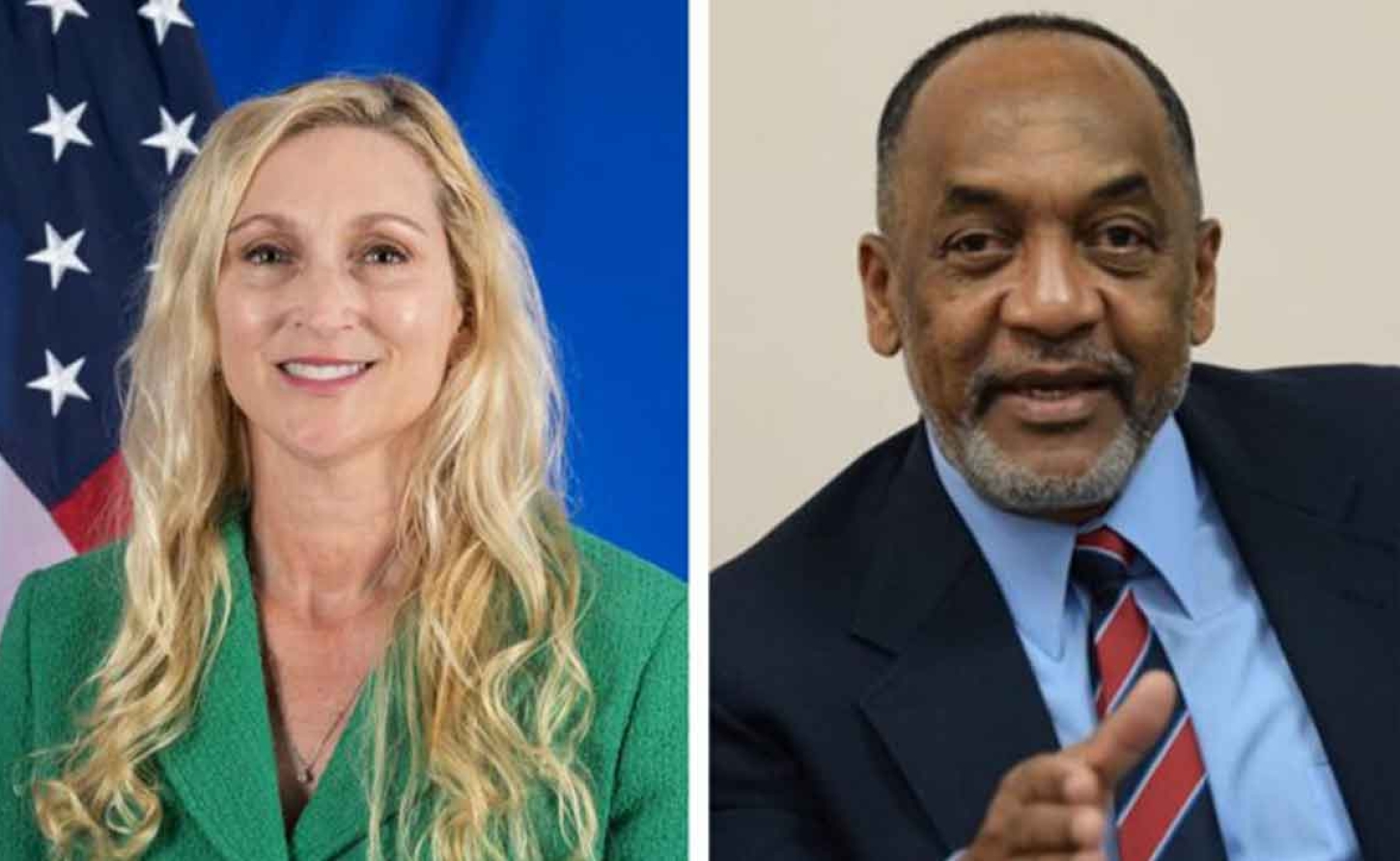
L-R US Ambassador to Guyana Nicole Theriot, and fmr EPA Executive Director Dr. Vincent Adams
Former EPA chief Dr. Vincent Adams—petroleum engineer, former U.S. Department of Energy official, and the man who forced ExxonMobil to comply outside the contract—says Ambassador Theriot’s position is factually wrong, legally flawed, and an affront to Guyanese sovereignty.
GEIORGETOWN. Guyana, April 5, 2026 - Calvin G. Brown - When United States Ambassador to Guyana Nicole Theriot declared that renegotiating the 2016 Stabroek Block Production Sharing Agreement would be “incredibly dangerous” and send “a terrible signal to international investors,” she perhaps did not anticipate the source of the rebuttal she would receive.
Dr. Vincent Adams is not a political opponent of the Irfaan Ali administration. He is not an armchair critic. He is a petroleum engineer with decades of experience in the international oil and gas industry, a former official of the United States Department of Energy, and the former Executive Director of Guyana’s own Environmental Protection Agency—the man who sat across the table from ExxonMobil and won concessions the contract never granted.
His verdict on the Ambassador’s position was surgical and unsparing: “Absolute baloney.”
Adams Takes Apart the Contract Clause by Clause
Ambassador Theriot grounded her warning in the sanctity of the signed agreement, implying the 2016 PSA is a fixed, immovable instrument that Guyana tampers with at its peril. Adams went directly to the text. “Clause 32 of the contract says you could renegotiate if both parties agree,” he stated flatly.
The so-called stability clause—which restricts Guyana from unilaterally imposing new terms or taxes—does not prohibit renegotiation. It requires mutual consent. That is a door, not a wall. The Ambassador’s characterisation that the deal is beyond revisitation is not a reading of the contract. It is a misrepresentation of it.
Adams went further, grounding his argument in established international legal doctrine. “There is a universal principle in contract law called ‘changed condition’ which more than applies to Guyana,” he said. When the 2016 agreement was signed, Guyana’s recoverable reserves were assessed at one scale.
The nation has since emerged as one of the most significant oil producers in the Western Hemisphere. The material conditions under which that contract was executed have changed so fundamentally that the legal basis for demanding its unaltered preservation is, in any honest reading, untenable.
He Has Already Done What Theriot Claims Is Impossible
The most devastating element of Adams’ rebuttal is not theoretical. It is historical. As EPA Executive Director, he extracted concessions from ExxonMobil that went well beyond the contract’s written terms—and he did it without litigation, without a renegotiated PSA, and without the sky falling on Guyana’s investment climate.
“We unilaterally went outside of the contract… by demanding and getting the parent company guarantee… by telling them that if not, they will not produce a barrel of oil.” — Dr. Vincent Adams
His team also secured unfettered access to offshore facilities, including the right to conduct unannounced inspections—provisions that did not exist in the original agreement. ExxonMobil, when faced with a government that meant what it said, complied. Adams’ record is the empirical refutation of Theriot’s argument.
Guyana has already demonstrated that it can exercise sovereign leverage over ExxonMobil and retain the company’s operational presence. The Ambassador’s warning that asserting that leverage would be catastrophic is contradicted by what actually happened when Adams did exactly that.
On the Government That Forgot Its Own Promises
Adams reserves particular contempt for the Ali administration’s abandonment of the position it campaigned on. He recalled the pre-election rhetoric with precision: “Bharrat Jagdeo and Irfaan Ali shouted from the roof top when in opposition that they will renegotiate ‘because the [APNU+AFC] government has sold out our patrimony and every Guyanese is sad whenever there is a discovery.’” He noted that one of Ali’s first public commitments after taking office was an explicit pledge to renegotiate the contract.
That pledge has been quietly buried. What replaced it is a government posture so accommodating to ExxonMobil that Justice Sandil Kissoon, in his landmark 2023 High Court ruling, found ExxonMobil in breach of its environmental permit obligations and described the EPA’s enforcement record under the current administration as “derelict, pliant and submissive.”
The court ordered an unlimited parent company guarantee and comprehensive insurance coverage for oil spill liability—the very protections Adams had fought to secure years earlier and which, under new leadership, had been allowed to erode.
Adams’ assessment of where responsibility lies is precise: “It is not Exxon to be blamed… they are only performing their fiduciary responsibilities… while our government is not performing their paramount responsibility to look after the best interest of its people.”
What the Ambassador Gets Wrong About Sovereignty
Ambassador Theriot pointed to ExxonMobil-supported signage and development projects as evidence of a genuine win-win. Adams is not impressed by signs. He is measuring Guyana’s take against the scale of the resource being extracted, against the royalty structures of comparable producing nations, against the legal and environmental protections that a government with genuine leverage would have long since enforced.
His core argument is one that no amount of diplomatic caution can neutralise: ExxonMobil is behaving exactly as a corporation should, pursuing maximum returns for its shareholders. The failure is not Exxon’s.
The failure belongs to a government that was elected on a mandate to renegotiate, that inherited proof of what assertive sovereign engagement could achieve, and that chose instead to defer—and to a U.S. Ambassador who, whether by design or instinct, arrived to reinforce that deference.
Dr. Vincent Adams has held the line before. He knows the contract. He knows the company. And he knows, from direct experience, that Guyana’s government holds far more leverage than it is currently willing to use. Washington’s comfort with the status quo is not Guyana’s obligation to maintain.
-30-
