
DIASPORA | RNFJ Unveils Ambulatory Clinic Plan for Manchester, With Hospital Blueprint in Hand
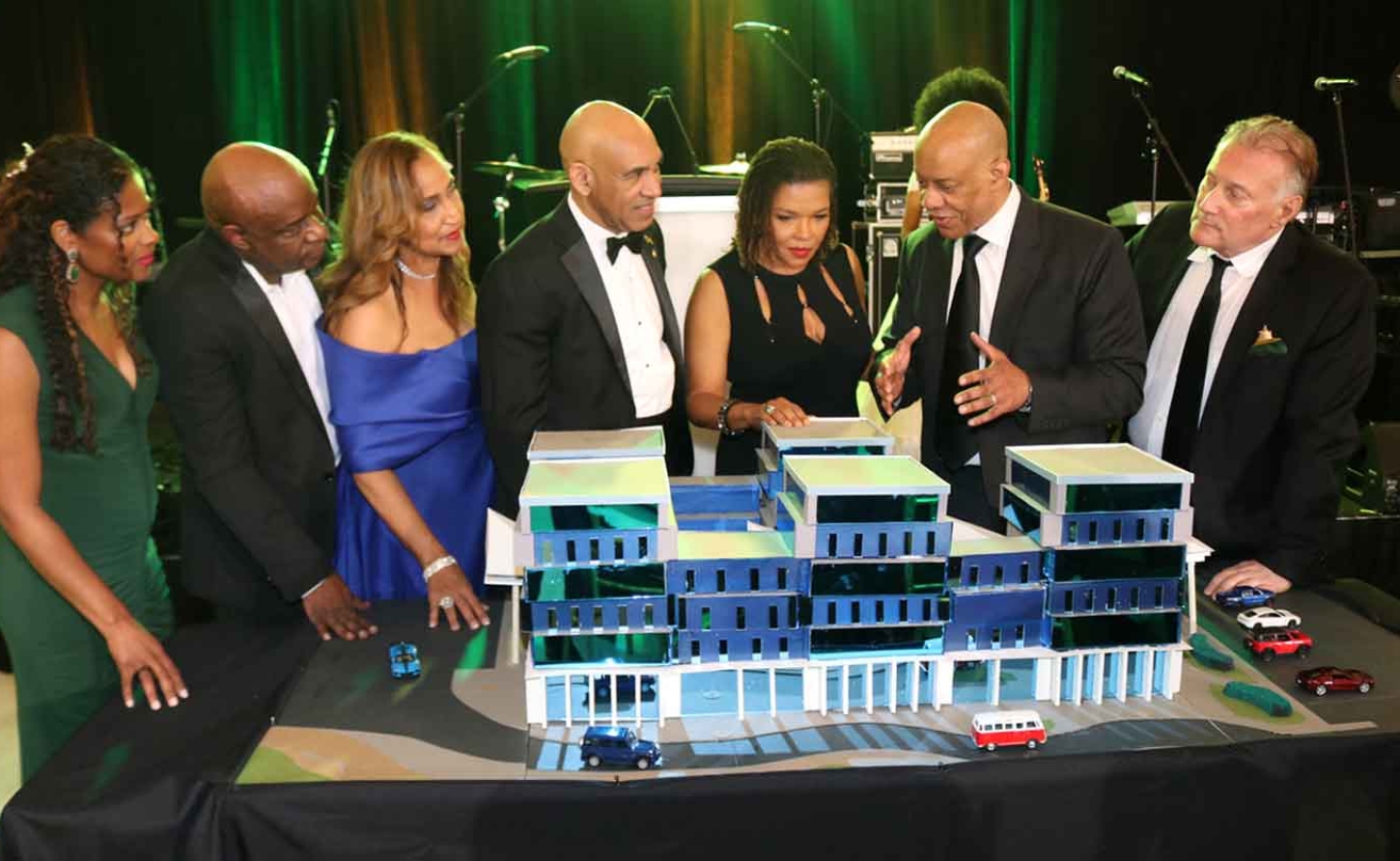
Jamaica’s Ambassador to the United States, Major General (Ret’d) Antony Anderson (fourth left) Stands beside former Ambassador to the United States and MP for Northeast Manchester, Audrey Marks, as they listen attentively to Architect Christopher Carter explaining the prototype for a full replacement hospital to be built in Southeast Manchester by Right Now For Jamaica (RNFJ) organization. Looking on from left are RNFJ Director Dr. Mikki Lake, RNFJ Vice President, Dr. Maurice Miles, RNFJ Director Dr. Trudy Hall and at the end is RNFJ President Ronald McKay. The prototype was unveiled at RNFJ’s Inaugural Gala, held at the Royal Ballroom in Bowie, Maryland, Saturday, March 28.| Derrick Scott Photo.
Maryland-based diaspora organisation Right Now for Jamaica moves from promise to blueprint — committing approximately US$175,000 to build a modular ambulatory clinic at Melissa-damaged Percy Junor Hospital, while unveiling a prototype for a full replacement hospital in Manchester.
WASHINGTON DC, April 5, 2026 - Derrick Scott - | Right Now for Jamaica (RNFJ) has put its money where its mission is. At the organisation’s inaugural fundraising gala, held March 28, 2026, at the Royal Ballroom in Maryland, the diaspora group announced plans to construct the Percy Junor Ambulatory Clinic — a modular, container-based healthcare facility — at an estimated cost of approximately US$175,000, with construction targeted for completion before year’s end.
The gala, held under the patronage of Jamaica’s Ambassador to the United States, His Excellency Major General (Ret’d) Antony Anderson, drew members of the Jamaican diaspora and friends of Jamaica in a fundraising push tied directly to post-Hurricane Melissa rebuilding.
Percy Junor Hospital, which serves as a critical referral facility for central Jamaica, sustained significant damage during Melissa while continuing to treat displaced and vulnerable citizens across the region.
It was Dr. Trudy Hall, Director of Right Now for Jamaica who stepped to the podium to outline exactly what that transformation will look like. “This is not a tent. The Percy Junor Ambulatory Clinic is engineered for permanence and scalability.
The design incorporates eight fully equipped examination rooms, triage capacity, procedural and surgical care, office space, and patient recovery bays all arranged around an efficient care corridor designed to support seamless clinical workflows while maintaining infection control and patient privacy.”
Primary care, paediatric services, surgical procedures, and specialty and sub-specialty consultations will all be deliverable under one roof, she told the over 300 attendees. Critically, Dr. Hall said, the facility is built to survive what Percy Junor just endured.
The modular architecture integrates backup power systems, independent water infrastructure, and off-grid capability — making it, in the words of the RNFJ team, a “disaster-ready healthcare platform.”
The facility will operate with a state-of-the-art electronic medical records system, supported by computers and tablets already delivered to Percy Junor Hospital by the RNFJ team in January 2026. The groundwork, in other words, is already being laid.
The announcement of the clinic was accompanied by a disclosure that should command equal attention: RNFJ has already secured approximately US$100,000 worth of medical supplies and equipment, now ready for shipment to Percy Junor Hospital.
The consignment includes new surgical instruments, automatic heart defibrillators, and four mobile ventilators — equipment that can mean the difference between stabilisation and death for a cardiac or respiratory patient before they can be transported to a tertiary facility.
Dr. Hall also presented the most consequential announcement of the evening — one that is the least immediately actionable but carries the greatest long-term weight: RNFJ’s unveiling of an architectural prototype for a full replacement hospital at Percy Junor, one that adopts the same modular, resilient design philosophy as the clinic.
Dr. Hall made clear that the ambulatory clinic is Phase One, and that the hospital replacement is the larger mission toward which the diaspora is being asked to invest. Manchester has long waited for a modern hospital capable of serving the demands of a growing, post-disaster population.
The Percy Junor facility, before Melissa, was already under strain. The hurricane stripped away any pretense that incremental fixes would suffice. RNFJ is offering a different calculus: build new, build resilient, build with diaspora capital, and build it now.
For her part, Minister of Efficiency, Innovation and Digital Transformation, former Ambassador to the United States, Hon. Audrey Marks and the evening’s honoree stated that the architectural model Dr. Hall had presented was more than a rendering. It was, she told the gathering, a reckoning.
“What you are seeing is really not just a paper model,” Minister Marks said. “This is how Jamaica is going to be rebuilt.” She spoke of a personal evolution — one that has reshaped how she thinks about political representation itself.
Having spent time in Northeast Manchester, seeing the landscape and the latent potential of the constituency she now serves, Minister Marks said she has found a clarity of purpose she did not previously possess. She now sees not simply a constituency to be managed, but a modern economy to be built — from the micro level upward, structured around market equity and sustained prosperity for its people.
Her vision for Percy Junor is unambiguous: a first-class hospital facility that does not merely serve Northeast Manchester but anchors the wider region’s healthcare future. “That is my intention,” she said, “and I thank you for sharing that dream with me tonight — to build the hospital and expand it to be first class, to serve the citizens of Northeast Manchester and surrounding areas.”
Minister Marks extended direct thanks to RNFJ for adopting Percy Junor Hospital as a cause and for driving the project forward with the urgency it demands.
She also acknowledged the inaugural President’s Award presented to her by the organisation — accepting it, she said, with humility and deep appreciation.
Jamaica’s Ambassador to the United States, Major General (Ret’d) Antony Anderson, in delivering the keynote address made the case — methodically and with conviction — for why diaspora investment in Jamaica is not generosity, but strategic necessity.
Drawing on the legacy of the Right Excellent Marcus Garvey, Ambassador Anderson reminded the room of Garvey’s foundational insight: that political freedom, without economic empowerment, remains fragile. In that framing, the work RNFJ is doing at Percy Junor is not humanitarian. It is nation-building.
In his address he commended members of the Diaspora for the outpouring of support given after Hurricane Melissa “My friends in the diaspora we need and appreciate the support you give us, but we are also seeking partnerships, and we are seeking investment from investors who want to grow with us and profit with us. And so tonight, I invite you to look at Jamaica not just as it is but rather as a nation of opportunity.”
He invited them to look at investing in Healthcare and Medical Tourism, Agriculture and Critical Minerals and Natural Resources, as these are lucrative areas that yield great returns and improve the country.
Ambassador Anderson’s message to the diaspora in that ballroom was unambiguous: the window is open, but it will not remain open indefinitely. Others are already moving. “Get in early,” he told them. “Build partnerships, secure your stake in Jamaica’s future.”
For RNFJ, that stake is a modular clinic rising in Manchester. For the diaspora at large, the invitation is broader — and the urgency, Anderson made certain, was felt.
Speaking on the transformation of Jamaica, he said that “this transformation is complemented by the SPEED initiative, Streamlining Processes for Efficiency and Economic Development, led by the Hon Minister Audrey Marks. SPEED is aimed at improving efficiency and driving growth.
In paying tribute to Minister Marks, Ambassador Anderson said “our honouree tonight, Ambassador Marks is clear about where she stands on this choice, hence the role that the Prime Minister has given her in shaping Jamaica’s future and getting us up to speed. Minister Marks represents modern Jamaican leadership, global in experience, national in commitment, and focused on execution.
Ambassador Anderson, Jamaica’s top envoy to the US, told the gathering that “this is our Jamaica, we are people forged in adversity that do not surrender to circumstance, but are sustained through our individual and collective wills and belief.”
-30-
