ISRAEL/IRAN | How Iran Pierced the Myth of Israel’s Invincibility, Plunging the Country into Darkness— And Why the World Barely Saw It
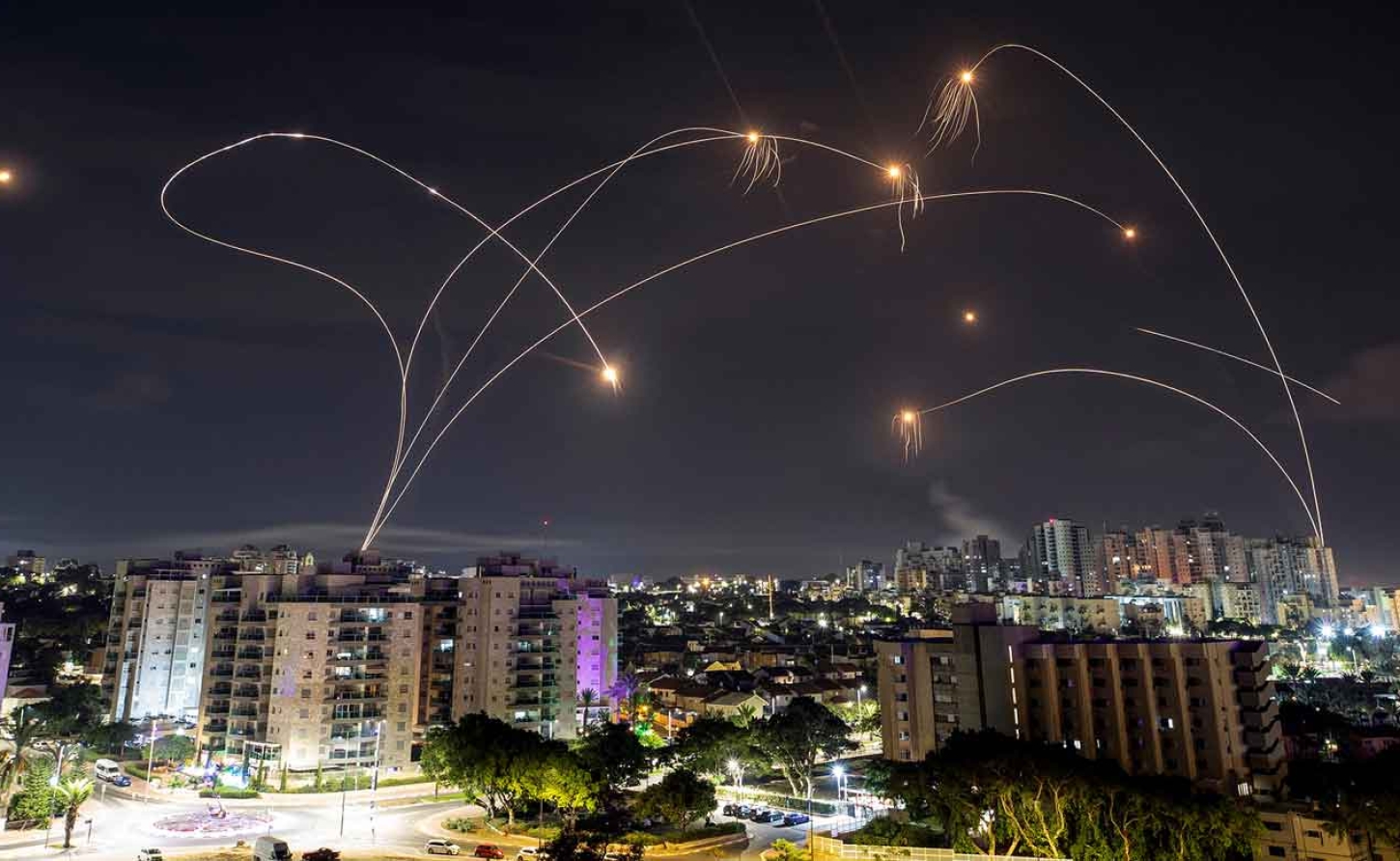
How Iran cracked Israel's unbreakable Iron Dome
A military first. A media blackout within a blackout. The story the world’s biggest newsrooms couldn’t — or wouldn’t — tell.
Calvin G. Brown | • March 19, 2026
They told us the Iron Dome was impenetrable.
They told us Israel’s multi-layered missile defense — Arrow, David’s Sling, Iron Dome — represented the most sophisticated air protection architecture in human history. A technological fortress suspended above a nation perpetually at war. Invisible. Invincible. Unbreachable.
Then, on the night of March 8–9, 2026, the lights went out in Tel Aviv.
Not metaphorically. Not briefly. The Orot Rabin Power Station in Hadera — Israel’s single largest electricity-generating facility, a coastal behemoth capable of producing 2,590 megawatts and powering roughly one-fifth of the entire country’s electrical grid — took a direct Iranian missile hit.
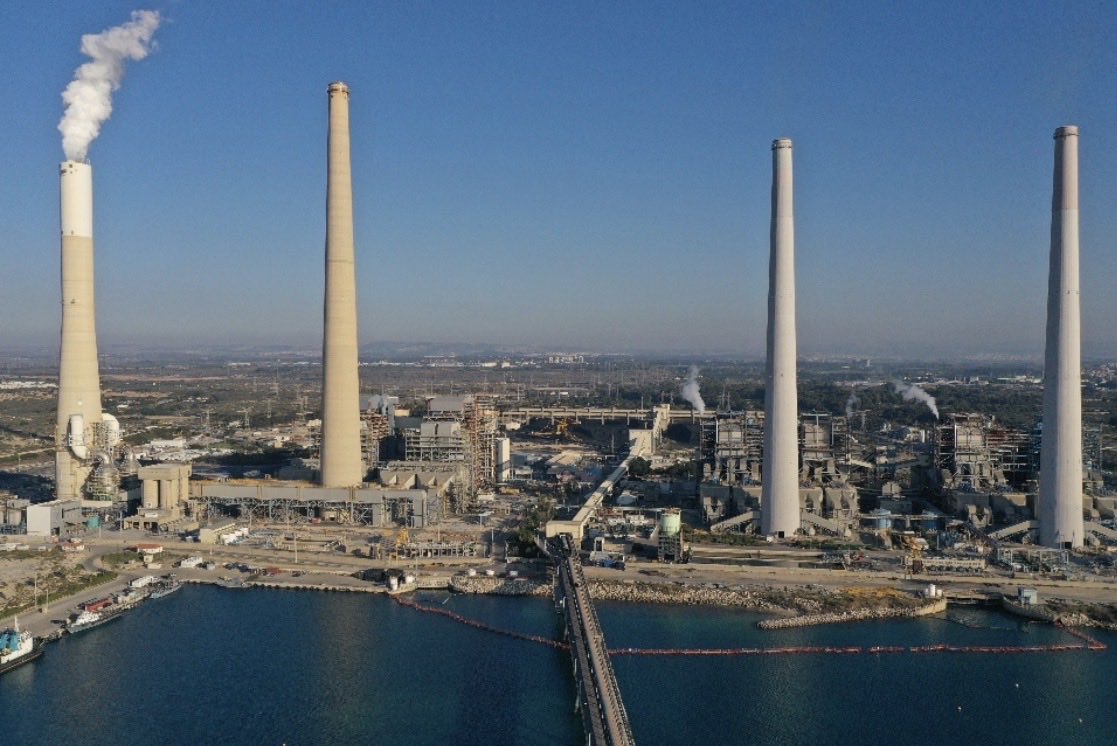
The Orot Rabin Power Station
“Our coverage of the war is not truthful.”
That sentence alone should stop every editor in the Caribbean, every journalist in the Global South, cold.
HOW THIS WAR BEGAN
The record must be stated clearly, because Western media has worked overtime to obscure it: on 28 February 2026, the United States and Israel launched surprise airstrikes on multiple sites and cities across Iran, killing Supreme Leader Ali Khamenei and numerous other Iranian officials.
This was not retaliation. This was not pre-emptive defense against an imminent attack. Iran and the US had been holding indirect nuclear negotiations in February, which saw substantial progress, with Iran willing to make concessions — but President Trump said he was “not thrilled” with the talks. Diplomacy was abandoned. Bombs followed.
Trump administration officials offered various and conflicting explanations for the war — to ward off an imminent Iranian threat, to pre-empt retaliation, to destroy Iran’s missile capabilities, to prevent a nuclear weapon, to secure Iran’s natural resources, and to achieve regime change. Even the Pentagon contradicted the White House. The IAEA confirmed there was no evidence of a structured nuclear weapons program at the time of the strikes.
For the Caribbean — a region that has watched Cuba sanctioned, Venezuela destabilized, Grenada invaded, and Haiti perpetually plundered — the pattern is familiar. When powerful nations decide that diplomacy is inconvenient, smaller nations pay in blood and sovereignty. The fact that Iran is not small does not make the principle any less recognizable.
THE NIGHT THE IRON DOME FAILED
The Orot Rabin Power Station sits on the Mediterranean coast, its capacity of 2,590 megawatts representing approximately 19 to 20 percent of Israel’s total electricity output. It is not a secondary target. It is not a peripheral facility. It is the heart of Israel’s central electrical grid — and Iran hit it.
Social media footage and eyewitness accounts depicted parts of Tel Aviv plunged into darkness, raising immediate concerns about energy security in the densely populated economic hub. The Haifa oil refinery was also struck, cluster munitions raining down across central Israel with devastating precision.
Here is what the defense industry press releases never explain about Iron Dome: it was designed to intercept short-range rockets from Gaza and Lebanon. It was not engineered to neutralize a sophisticated state actor deploying a trifecta of short- and medium-range ballistic missiles and one-way attack drones — cheap, mass-produced Shahed drones flying at low altitude, difficult for radar to detect, delivering volume that overwhelms even layered defense systems.
Iran fired close to 300 missiles at Israel in the first ten days of the war, nearly half carrying cluster submunitions capable of spreading dozens of explosive warheads over a radius of ten kilometres. The math of saturation eventually defeats the math of interception. Israel’s military architects knew this. They simply never expected the public to see it happen in real time.
And to a remarkable degree — they ensured the public wouldn’t.
THE BLACKOUT WITHIN THE BLACKOUT
When Iranian missiles plunged Tel Aviv into darkness, a second, more deliberate blackout was already in place.
Since the start of the war with Iran, the Israeli military imposed strict censorship regulations on local and international media, prohibiting reporters and networks from publishing the precise location of Iranian missile impacts, or even filming or photographing the extent of damage in a way that could give away the location.
Israel introduced a war censorship law criminalising the filming of missile strikes on Israeli soil, with penalties of 20 to 30 months in prison for standard violations and up to five years for serious cases. The law hits foreign press particularly hard.
The consequences were immediate and documented. On March 3, 2026, CNN Türk journalists Emrah Çakmak and Halil Kahraman were covering the aftermath of Iranian missile strikes near Israel’s Ministry of Defense when uniformed personnel walked into frame, seized equipment and cut the feed — live, on air, on screens across the world.
Al Jazeera has been banned from Israeli territory since May 2024 — the network the Caribbean depends on most for perspectives outside the Anglo-American mainstream.
The result is a manufactured fog of war. A senior manager at a foreign media outlet working in Israel explained: “In a lot of cases, we have official reports that there were no strikes or damage only to discover later that a target was hit. We can’t report or confirm so we don’t know if it happened or not. Our coverage of the war is not truthful.”
When you wonder why CNN, BBC and the major American networks seemed strangely silent about Israel going dark — now you know. This is not editorial oversight. It is engineered ignorance, backed by criminal penalties and state enforcement.
THE STRATEGIC PICTURE
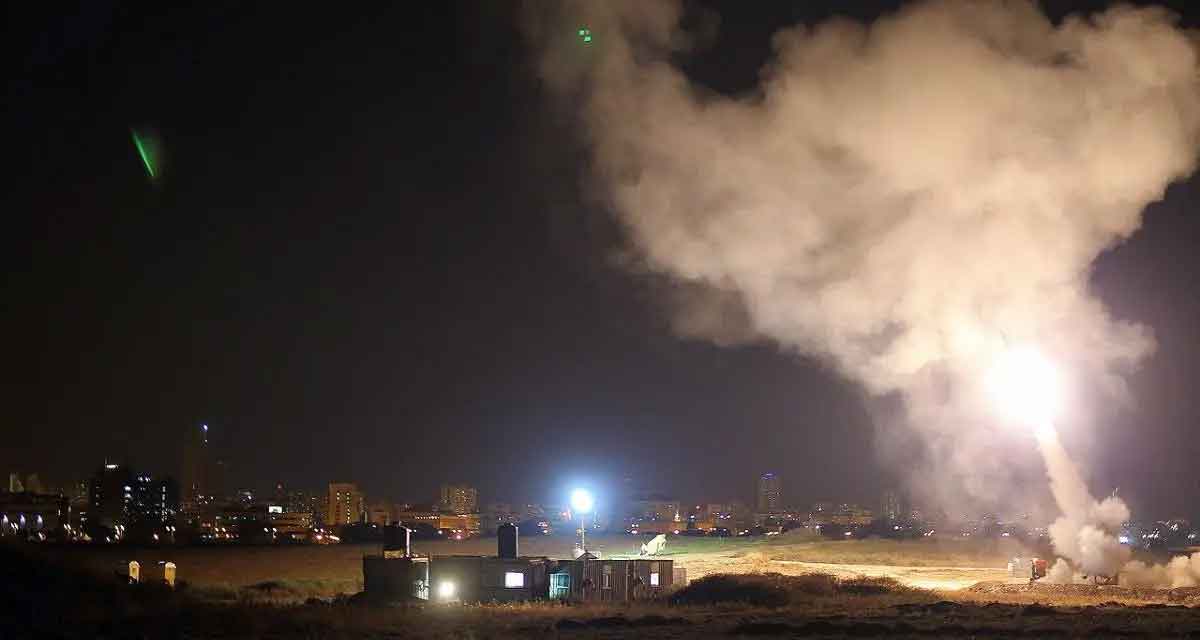
Iron Dome Protective Edge
The Caribbean is not insulated from these consequences. A closed Strait of Hormuz means global oil supply disruptions. It means shipping cost increases. It means fuel price shocks in island nations already battered by economic fragility. The missiles falling on Hadera are connected, through supply chains and energy markets, to the cost of filling a gas tank in Kingston, Bridgetown, or Port of Spain.
The US has employed Tomahawk cruise missiles from Navy destroyers in the Arabian Sea, deploying the Precision Strike Missile for the first time alongside MQ-9 Reaper drones and F/A-18 and F-35 aircraft — the full weight of the world’s most expensive military machine directed at a nation whose supreme leader was assassinated on day one of the conflict. Whatever one thinks of Iran’s government, the asymmetry demands acknowledgment.
WHAT THE DARKNESS REVEALS
The lights went out in Tel Aviv. The cameras went dark at the censors’ order. And somewhere between those two blackouts lies a truth that the world’s most powerful media organizations have been legally prevented from reporting fully.
Iran did what military analysts said was impossible: it hit Israel’s critical energy infrastructure with enough precision and volume to overwhelm a defense system the West has spent decades mythologizing. That is not propaganda. It is documented, confirmed, and consequential.
For a Caribbean region that has long understood how powerful nations manufacture consent — how invasions become “interventions,” how assassinations become “targeted operations,” how wars of choice become wars of necessity — the lesson of Israel’s darkened skyline is not one of satisfaction. It is one of recognition.
The Iron Dome is real. But so is the darkness.
And the most dangerous blackout of all is the one that keeps the rest of the world from seeing it clearly.
— Calvin G. Brown is the founder and editor of WiredJa.
-30-
