
CARIBBEAN | Global African Congress (GAC) Tribute to Fidel Castro at 100 - 13 August 1926 – 13 August 2026
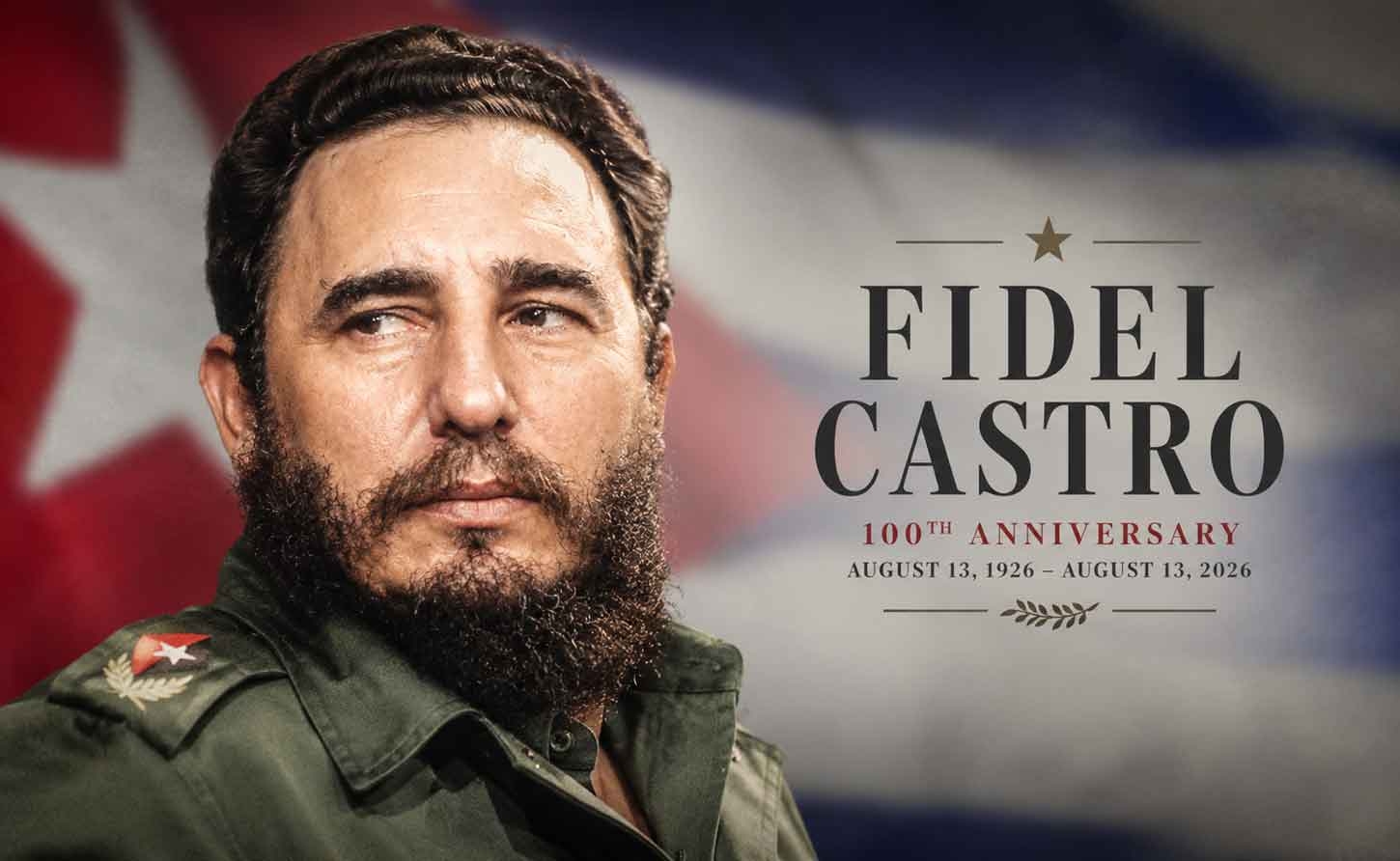
CARIBBEAN | Global African Congress (GAC) Tribute to Fidel Castro at 100 - 13 August 1926 – 13 August 2026
The Global African Congress (GAC) joins the people of Cuba, Africa, the Caribbean, and the Global South in commemorating the 100th anniversary of Fidel Castro Ruz's birth on 13 August 1926 in Birán, Cuba.
The GAC does not subscribe to supernatural explanations or pseudoscientific claims about human greatness. Yet there are human beings whose lives, convictions, courage, and contributions are so extraordinary that they transcend the ordinary measure of a lifetime. Fidel Castro was one such person.
A century after his birth, Fidel remains a towering figure in the history of the Caribbean, Africa, and the struggle of oppressed peoples everywhere. He was a revolutionary, visionary leader, internationalist, humanitarian, and a man who devoted much of his life to the pursuit of social and economic justice for what Frantz Fanon called “the wretched of the earth.”
Fidel’s life must be understood in the context of the centuries-long struggle against plantation slavery, colonialism, racism, imperialism, and the continuing structures of economic and political domination that have denied millions of people the opportunity to fulfill their human potential.
The Courage to Conquer Fear
Among Fidel Castro’s most remarkable human qualities was his extraordinary ability to confront and conquer fear.
That quality was evident on 26 July 1953, when he and his comrades launched the assault on the Moncada Barracks in Santiago de Cuba. The attack failed militarily, but its political significance would reverberate throughout Cuban and world history.
It was evident again in April 1961, when Fidel placed himself at the front of the Cuban resistance during the CIA-backed Bay of Pigs invasion. Cuba was a small island confronting the enormous military, political, and economic power of the United States. Fidel nevertheless refused to surrender the sovereignty of the Cuban people. And it was evident in Africa.
When apartheid South Africa sought to preserve white minority domination and military power in southern Africa, Cuba answered the call of African liberation. Under the leadership of Fidel Castro and the Angolan MPLA, Cuban internationalist forces fought alongside Angolans and other African liberation forces.
The decisive battles in Angola, culminating in the Battle of Cuito Cuanavale, helped alter the balance of power in southern Africa and contributed to the political circumstances that led to Namibian independence and the weakening of apartheid South Africa’s regional military dominance.
Cuba itself was placed at enormous risk during this period. Yet Fidel and the Cuban people continued to demonstrate that international solidarity was not merely a slogan but a duty.
Internationalism as a Moral Obligation
For the GAC, this is perhaps one of the most important dimensions of Fidel Castro’s legacy. Fidel understood that the liberation of one people could not be separated from the liberation of others.
Cuba emerged from a history of colonial domination, slavery, racial hierarchy, and foreign economic control. Yet rather than turning inward after the Revolution, Cuba extended its hand to peoples struggling for freedom and dignity. That internationalism was expressed dramatically in Africa.
Fidel’s solidarity with African liberation fighters and leaders—including Amílcar Cabral, Agostinho Neto, Samora Machel, Nelson Mandela, and Thomas Sankara—formed part of a broader commitment to African liberation and self-determination. His friendship and solidarity with Michael and Beverley Manley in Jamaica and Maurice Bishop in Grenada likewise reflected a Caribbean political consciousness that understood the interconnectedness of the struggles of Africa and the Caribbean.
These relationships cannot simply be reduced to Cold War geopolitics. They must also be examined through the lens of the historical relationship between Africa, the Caribbean, colonialism, and the African diaspora.
Fidel repeatedly demonstrated that Cuba considered solidarity with oppressed peoples an internationalist responsibility.
The Right to Human Potential
The GAC also asks that Fidel Castro’s legacy be evaluated against a question that corporate media and reactionary political and academic voices too often avoid: What happens when a society decides that the poor have the same right to human development as the wealthy?
For millions across the Global South, poverty historically meant that access to quality health care, education, professional training, and cultural development was determined by class and wealth.
A poor child could be denied the opportunity to become a physician, engineer, economist, scientist, teacher, musician, sculptor, or other professional—not because of a lack of intelligence or ability, but because the economic system had already determined the limits of that child’s possibilities. Fidel’s Cuba challenged that premise.
The Cuban Revolution placed extraordinary emphasis on universal education, health care, literacy, scientific development, culture, and the expansion of opportunities for people who had previously been excluded.
That is an important part of the Fidel Castro legacy that deserves serious examination rather than ideological dismissal.
Against Racism and Systems of Oppression
Fidel Castro’s political worldview was fundamentally opposed to racism and systems of racial domination. He understood the relationship between racism, colonialism, imperialism, and economic exploitation.
The GAC therefore remembers Fidel not simply as a Cuban revolutionary, but as a Caribbean son who recognized that the struggles of African peoples, Caribbean peoples, and other oppressed peoples were interconnected. His opposition to apartheid was not rhetorical.
Cuba sent its sons and daughters to Africa at considerable cost and risk. Cuban internationalists fought and died in Africa. They did so far from Cuba, in a struggle that many powerful states preferred to ignore or manipulate.
This is why the African dimension of Fidel Castro’s legacy cannot be erased from history.
Nor can it be reduced to the political narratives of those who continue to measure every act of international solidarity through the narrow lens of their hostility toward the Cuban Revolution.
Cuba Under Siege
The GAC also remembers that Cuba’s accomplishments were achieved under extraordinarily difficult circumstances.
The Cuban Revolution faced military invasion, assassination attempts, political destabilization, economic warfare, and the continuing United States economic embargo.
For decades, Cuba has had to defend its sovereignty while attempting to maintain social programs and economic development in the face of severe external pressure.
Whatever disagreements people may have with particular policies of the Cuban Revolution, historical integrity requires that Cuba’s achievements and shortcomings be examined within the circumstances in which they occurred.
It is equally necessary to acknowledge that Fidel Castro’s Cuba repeatedly extended assistance to people beyond its borders, including through medical and humanitarian internationalism.
Fidel, the Caribbean, and Africa
Fidel belonged to a Caribbean tradition that reaches from Toussaint Louverture through the great anti-colonial and Pan-African thinkers and freedom fighters of the modern era.
He understood that the Caribbean could never be separated from Africa. The bloodlines, cultures, histories, struggles, and aspirations of African and Caribbean peoples remain intertwined by a history created through slavery and colonialism but transformed by resistance.
Fidel’s relationship with African liberation movements therefore represented more than foreign policy. It was an expression of Caribbean internationalism.
This is why attempts by contemporary political figures—including Donald Trump and Marco Rubio—to reduce Cuba’s history to simplistic political caricature cannot erase the historical record.
The record remains.
Cuba stood with African liberation.
Cuba stood with Angola.
Cuba stood against apartheid.
Cuba stood with peoples fighting colonial domination.
And Fidel Castro stood with those struggles when doing so carried enormous political, military, and economic risks.
What Should History Remember?
The GAC does not ask anyone to treat Fidel Castro as a supernatural figure or to accept an uncritical mythology.
We ask for something much more demanding: Study him. Examine the evidence. Debate the contradictions. Measure the achievements against the circumstances. And judge his legacy by the same standards applied to every other world leader.
History should ask why a small Caribbean country could educate generations of physicians and professionals.
History should ask why Cuba sent doctors and health professionals to countries far beyond its shores.
History should ask why Cuban internationalists travelled to Africa to fight against apartheid military forces.
History should ask why Fidel Castro placed Cuba’s sovereignty at risk rather than surrendering it to a foreign power.
History should ask why so many African liberation leaders maintained relationships of respect and solidarity with Fidel.
And history should ask what it means for a leader to believe that the poor, the colonized, the racially oppressed, and the historically excluded are entitled to dignity and the full development of their human potential.
These questions cannot be answered by propaganda. Nor can they be answered by the corporate press, reactionary politicians, or academics who refuse to acknowledge accomplishments that challenge their ideological assumptions.
A Legacy of Hope
The Global African Congress recognizes Fidel Castro as one of the extraordinary political figures of the twentieth century and an enduring symbol of Caribbean internationalism.
His legacy is inseparable from Cuba’s own continuing struggle for sovereignty and social justice. It is inseparable from Africa’s liberation struggles. It is inseparable from the Caribbean’s unfinished struggle against colonialism, racism, economic dependency, and neo-colonial domination.
Fidel represented a vision of humanity in which hunger, preventable disease, illiteracy, racism, sexism, poverty, and exploitation were not inevitable conditions of human existence.
They were conditions that human beings could challenge and overcome. That vision remains unfinished.
As we commemorate Fidel Castro’s centenary, the GAC therefore calls upon Africans, Caribbean people, and the African Diaspora to study his life critically, honestly, and historically.
Let us remember the courage.
Let us remember the internationalism.
Let us remember the Cuban doctors who served far beyond Cuba.
Let us remember Angola and Cuito Cuanavale.
Let us remember the struggle against apartheid.
Let us remember Cuba’s solidarity with the peoples of the Global South.
Let us remember the enduring friendship with African and Caribbean liberation leaders.
And let us remember Fidel Castro as a son of the Caribbean who believed that the dignity of one people could never be separated from the dignity of another.
A century after his birth, the question is not whether everyone must agree with Fidel Castro.
The question is whether humanity is prepared to learn from the courage, discipline, internationalism, and commitment to human dignity that defined his extraordinary life.
Fidel Castro was a Caribbean giant.
He was a friend of African liberation.
He was an internationalist.
He was a revolutionary who refused to surrender to fear.
And for those who continue the struggle for a world free from racism, colonialism, hunger, poverty, exploitation, and oppression, his example remains worthy of study and remembrance.
Long live the spirit of international solidarity.
Long live African and Caribbean unity.
Long live the struggle for human dignity and social justice.
Long live the memory and example of Fidel Castro Ruz.
¡Hasta siempre, Fidel!
Global Afrikan Congress (GAC) - 13 August 2026
Cikiah Thomas. Ambassador General
Email:
-30-
