
CARICOM | Sovereignty Suspended: How the Trump Regime Is Rewriting the Rules in Caribbean Waters
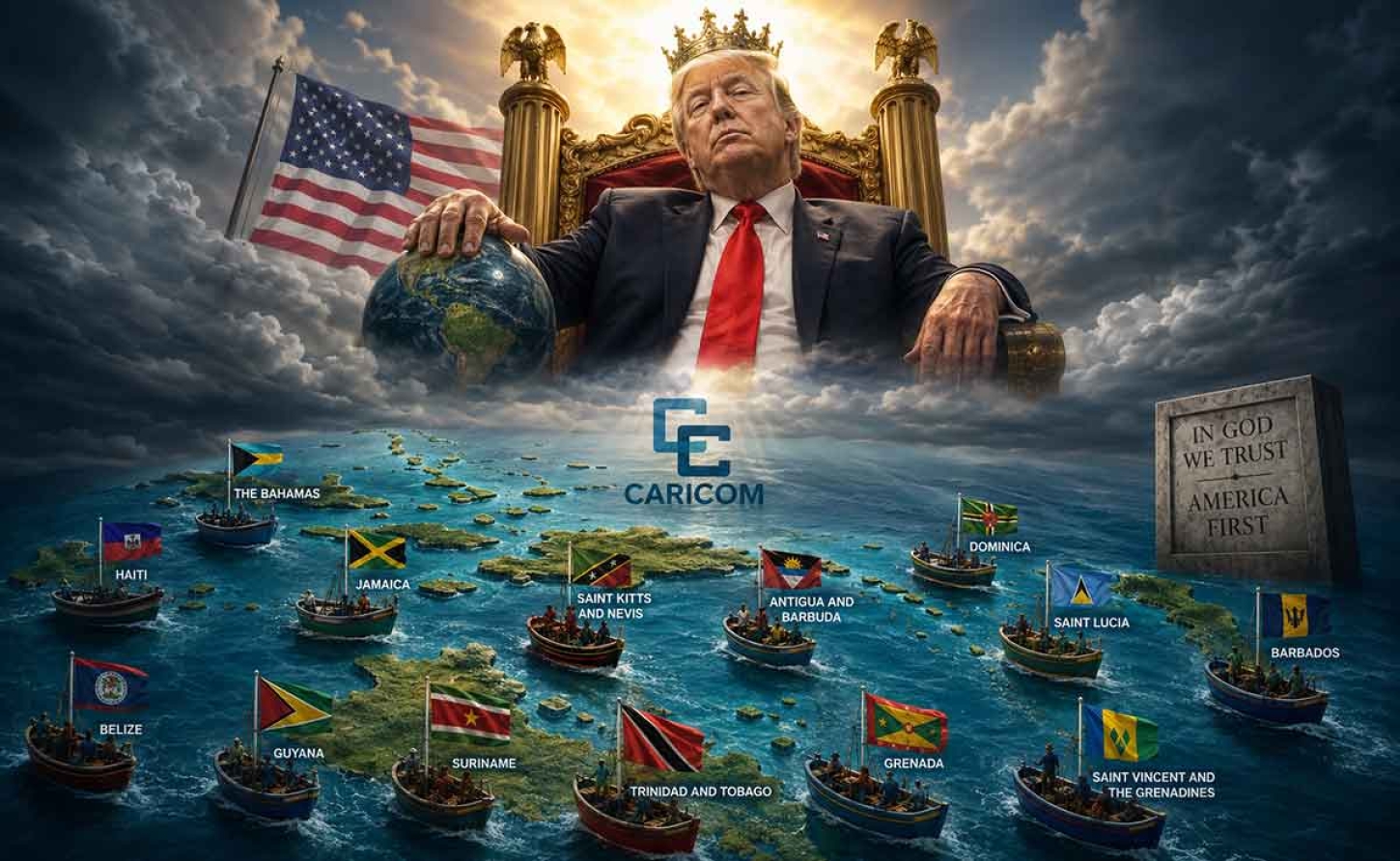
CARICOM | Sovereignty Suspended: How the Trump Regime Is Rewriting the Rules in Caribbean Waters
In eight months, Washington bombed Caribbean waters, seized a sitting president, and declared sovereignty a conditional privilege. The Caribbean barely raised its voice.
MONTEGO BAY, Jamaica, Calvin G. Brown | May 9, 2026 - Donald Trump said it plainly. No diplomatic softening, no hedging, no pretence of multilateral courtesy. Speaking to leaders from Latin America and the Caribbean in March 2026, the U.S. president declared that national sovereignty is “not a protective shield for criminal organizations.” Countries unable — or unwilling — to eradicate narco-traffickers from their territory, he warned, “shouldn’t be surprised if the U.S. intervenes.”
That was not a threat. It was a doctrine. And in the eight months prior to making it, the Trump administration had already demonstrated that it meant every word.
The Legal Architecture of Erasure
The groundwork was laid methodically. On his first day back in office, Trump signed an executive order designating drug cartels as foreign terrorist organizations. By October 2025, a formal memo to Congress declared the United States to be in a “non-international armed conflict” with narco-terrorist groups — an extraordinary assertion of presidential war powers that effectively granted the military a licence to kill in international waters without the inconvenience of congressional approval, due process, or evidentiary thresholds.
Then came the doctrinal capstone: the “Trump Corollary to the Monroe Doctrine.” Where the original 1823 Monroe Doctrine positioned the United States as the hemisphere’s protector against European colonialism, Trump’s corollary flipped the premise entirely. It declared that “the American people — not foreign nations nor globalist institutions — will always control their own destiny in our hemisphere.” The Caribbean, apparently, falls within that destiny. The region’s own nations do not.
“If sovereignty is conditional on Washington’s approval, it is not sovereignty. It is a leash — and the Trump regime has just pulled it tight.”
The Body Count as Evidence
Between August 2025 and May 2026, the United States military conducted at least 57 strikes on vessels in the Caribbean Sea and Eastern Pacific, killing more than 190 people. The dead were branded “narco-terrorists” and “unlawful combatants.” The Pentagon provided no formal identifications. Human rights groups, international legal scholars, and the Inter-American Commission on Human Rights have concluded that the killings violate both U.S. and international law.
What the boats carried is a matter of bitter dispute. The Intercept reported that U.S. government officials privately acknowledged that the targeted vessels were not transporting fentanyl, despite Trump’s public assertions to the contrary. Colombian President Gustavo Petro went further — identifying at least one victim as a fisherman and accusing Washington of extrajudicial murder and a flagrant violation of Colombian sovereignty. The description of the targeted vessels as fishing skiffs and civilian workboats — “pangas” used by coastal workers and small traders — points to a campaign of terror against working people, not drug lords.
The evidence of policy failure is equally damning. Cocaine prices remained stable throughout the campaign. Border seizures of cocaine in the United States actually increased. Drug transport declined by only 20 percent in the Caribbean — against Trump’s claim of 97 percent disruption. The strikes achieved nothing. The killing continues regardless.
The Collaborators in Our Midst
Perhaps the most uncomfortable chapter of this story is the one the Caribbean must write about itself. When U.S. Admiral Caine traveled to Port of Spain in late November 2025, Trinidad and Tobago’s new Prime Minister Kamla Persad-Bissessar did not protest American military operations in Caribbean waters. She deepened them.
Within weeks, the United States had installed a radar surveillance system on T&T soil. By December, the government had formally approved U.S. military aircraft use of Trinidad and Tobago’s airports for operational support — framed diplomatically as “logistical in nature,” but operationally indistinguishable from basing rights.
Trinidad and Tobago was not alone. The Dominican Republic, El Salvador, Guyana, and Panama were identified as supportive of U.S. military efforts in the region. Argentina, Ecuador, and Paraguay offered political support. Caribbean and Latin American states lining up behind Washington’s gun gave the operation a legitimacy it did not deserve and could not have manufactured alone.
Caracas as the Dress Rehearsal
Then came January 3, 2026. In the early hours of the morning, U.S. forces struck targets across Caracas and other Venezuelan locations, capturing President Nicolás Maduro and his wife Cilia Flores and flying them to the USS Iwo Jima, patrolling in the Caribbean. A 24-year-old Colombian woman, Joana Rodriguez Sierra, was killed in her bed during the raid.
The United Nations called it a violation of “fundamental international obligations.” Brazil, Colombia, Mexico, Cuba, Chile, and Uruguay condemned the operation. Secretary of War Pete Hegseth’s response to the international outcry was two words: “Welcome to 2026.”
Venezuela was not a rogue state seized in a moment of emergency. It was a Caribbean Basin nation whose elected — if contested — president was forcibly removed by a foreign military power and transported to face trial in New York. Whether one admires or abhors Maduro is irrelevant to the principle at stake.
The precedent has been set. A Caribbean head of state can be taken. Washington will decide when, and on what grounds.
CARICOM’s Failure of Nerve
Against this backdrop, the silence of the Caribbean Community is not a position. It is a surrender. While Colombia’s Petro warned that attacking sovereignty means “awakening the Jaguar,” while Brazil and Mexico demanded diplomacy over military aggression, CARICOM — the body that has spent decades championing the sovereignty and self-determination of small island states — offered the region no unified declaration, no emergency summit, no demand for accountability.
The irony is suffocating. CARICOM welcomed Interpol’s Secretary General at its 49th Regular Meeting to celebrate regional security cooperation. But when the gravest threat to Caribbean security arrived not from criminal networks but from the world’s most powerful military, the community looked away.
A Leash, Not a Shield
The Caribbean did not lose its sovereignty in a single dramatic act. It was eroded incrementally — through legal designations, through radar installations quietly accepted, through airport agreements diplomatically worded, through silences that were mistaken for prudence but functioned as permission.
Trump told the Caribbean, to its face, that sovereignty is conditional. He told the region that Washington will determine when a government has adequately policed its own territory — and that the alternative to compliance is American military action. He backed that declaration with 57 strikes, a captured president, and the blood of more than 190 people whose names his administration never bothered to learn.
If sovereignty is conditional on Washington’s approval, it is not sovereignty. It is a leash — and the Trump regime has just pulled it tight. The question the Caribbean must now answer is not whether it feels the pull. The question is whether it intends to resist.
— 30 —
