
HAITI | A Vote the Powerful Can Live Without
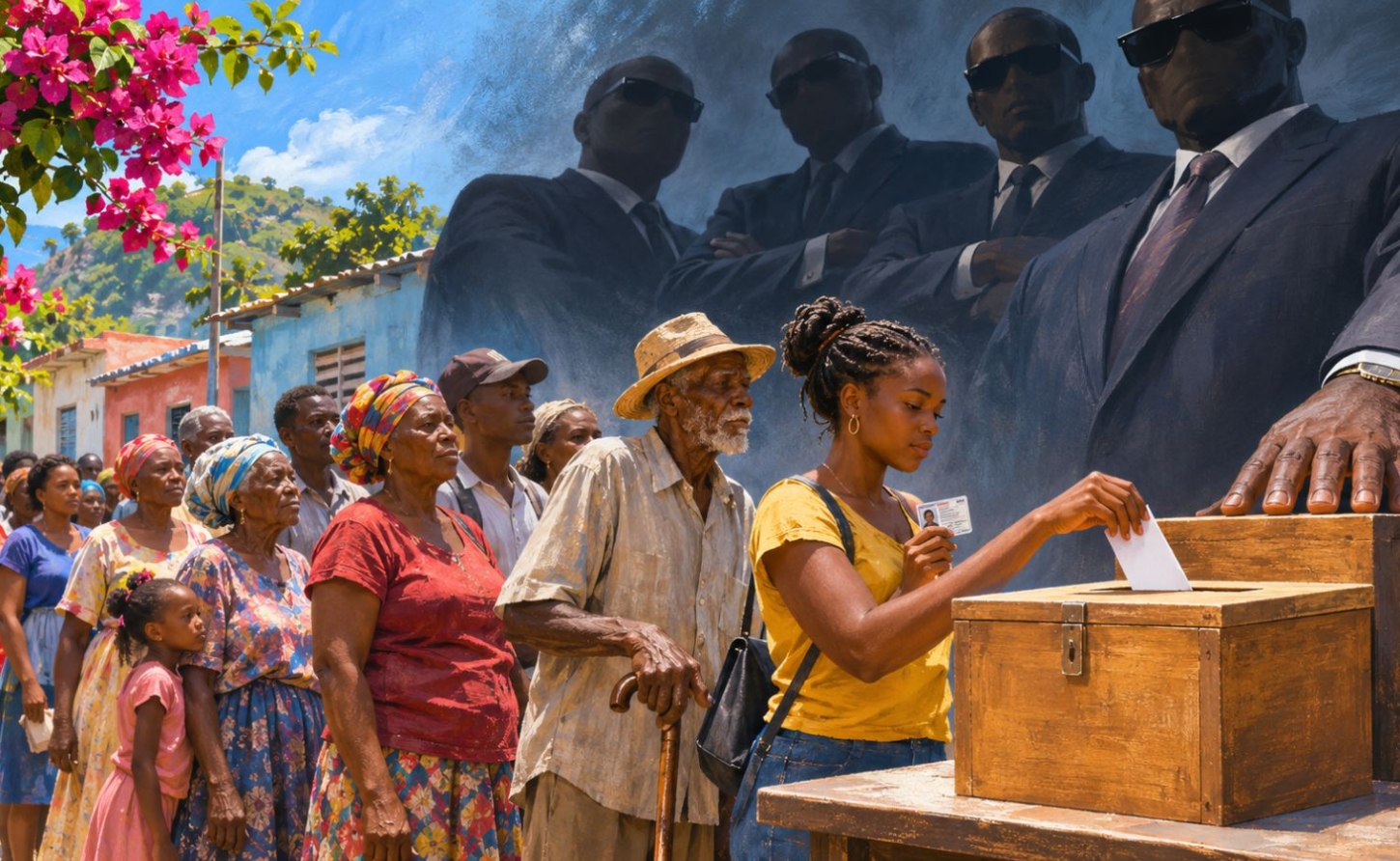
Illustration: AI-generated. Haitian voters queue at a ballot box while faceless figures in suits look on.
Haiti's next vote is now set for July 2027. It is being run by people nobody elected, under rules changed last month, on a voter list drawn wherever the state can still open a door. But the real question is not whether an election can be held. It is whether anyone with power needs one — and I will argue they do not.
MONTEGO BAY, Jamaica, November 7, 2026 - Op Ed by Calvin G Brown | Picture an 18-year-old in Carrefour, part of greater Port-au-Prince. She wants to vote in July 2027. First she must get on the voter roll — the list of people allowed to vote — at a registration centre, with her identity card. On November 7 the electoral council's own public list of centres had 1,448 entries. Carrefour was not on it. Pétion-Ville was on it 25 times. She may register at any centre she can get to — the CEP, the electoral council, says so — but her own commune has none.
First, nobody governing Haiti today was elected. The last national vote was in 2016. Since January 2023 there has been no elected official. The nine-person council that ran Haiti from 2024 was created by decree — an order from the top, with no parliament to pass it. Its mandate ran to February 7, 2026, or to the day an elected president took office. No president came. That day it handed power to the prime minister, Alix Didier Fils-Aimé, a businessman, after the US embassy backed him and US warships appeared offshore.
The CEP — the council that runs the vote — was appointed in September 2024 by order of that council and its prime minister.
Second, the gangs. In 2024 the US Treasury sanctioned former president Michel Martelly, in office from 2011 to 2016, saying he had "sponsored multiple Haiti-based gangs". He has not been convicted of anything and, AP reported in July, has not publicly addressed the allegations. This year the UN Panel of Experts on Haiti — the UN's own investigators — wrote that ties between some local officials and gangs "aim at consolidating territorial control and influencing upcoming elections".
The gangs are asking for a seat. On November 1 the leader of 400 Mawozo, a man under UN sanctions, wrote to the UN Secretary-General asking for dialogue. In several towns the gangs hold, the state has opened no centre.
Third, the rules changed in October. On October 6 the electoral decree was revised. Candidates no longer have to show that their assets are free from sanctions — penalties that freeze money and bar business — imposed by a foreign country. People on the United Nations' own list are still barred. On October 23 Martelly registered to run for president. He is sanctioned by the United States, Canada and the EU, but not by the UN.
The record shows that order of events. It does not show that one caused the other.
Fourth, the money. In December 2022 Canada sanctioned three businessmen. It called them "high-profile members of the economic elite in Haiti". It said it had reason to believe they used their status "to protect and enable the illegal activities of armed criminal gangs". One of them, through his lawyers, denies the allegation of gang financing "wholeheartedly". He has twice gone to Canada's Federal Court to be taken off the list. None has been convicted. The record does not show that any of them is delaying the vote. Money moves in other ways too. The UN’s investigators say the government signed a ten-year contract with an international company they do not name, for border security and “customs revenue optimization”, paid with a share of customs revenue — Haiti’s second-largest source of income.
Fifth, the region. On July 27 CARICOM's Eminent Persons Group, its envoys to Haiti, welcomed the CEP's calendar, which then promised a vote in December. In September the envoys said registration "was not meeting expectations" and was "constricted by the existence of territories beyond state control". On September 29 Jamaica spoke for CARICOM at the Security Council: "Armed gangs will not be allowed to determine Haiti's future." On October 6 the CEP postponed the December vote. CARICOM's website, checked November 7, has nothing on it. Jamaica's foreign ministry has posted nothing on it. Neither has said a public word about the Salvadoran soldiers now in Haiti, some 2,500 of them.
The other side is real. The West department — the region that holds the capital — once accounted for 60 per cent of the electorate, the Miami Herald noted in January 2025. Much of it is now beyond the state's reach. The CEP's secretary-general said in October: "We cannot wait for security to be restored across the whole territory to begin this work." His staff had registered just under 900,000 people by October 23. Some who say it is not safe enough to vote mean exactly that.
The people who do want a vote: the 18-year-old in Carrefour. The people who marched from Bon Repos on November 2. Haïti Liberté reports one sign read "The State, we are tired of counting dead bodies in La Plaine". They were not marching for a ballot. They were asking the state to act like one. EFE, a news agency, relayed unnamed media reports that the Viv Ansanm gang coalition forced people to march. It did not confirm them. Neither can I. These are the weakest people in the room.
Here is the argument, and it is mine, not the documents'. Nobody with power pays a price if the vote does not happen. The prime minister governs without one. The CEP's calendar runs to October 2027 whether the roll is whole or not. The promise of an elected president by February 7, 2026 was missed. The prime minister's promise of one by February 7, 2027 cannot now be kept.
And a half-election would cost none of them anything a real one would not. Petit-Goâve has 31 registration centres. Port-au-Prince has 14. Carrefour has none. Say the July 2027 vote is counted in the hills and the provinces, with the capital's poor left off the roll. It would produce a president with a certificate and no enemies among the people who matter. The region whose envoys welcomed the CEP's calendar in July is not looking at the map.
-30-
