
JAMAICA | IT'S NOT NEW | Bartlett Once Put Up US$4.5 Million To Keep American Airlines Flying
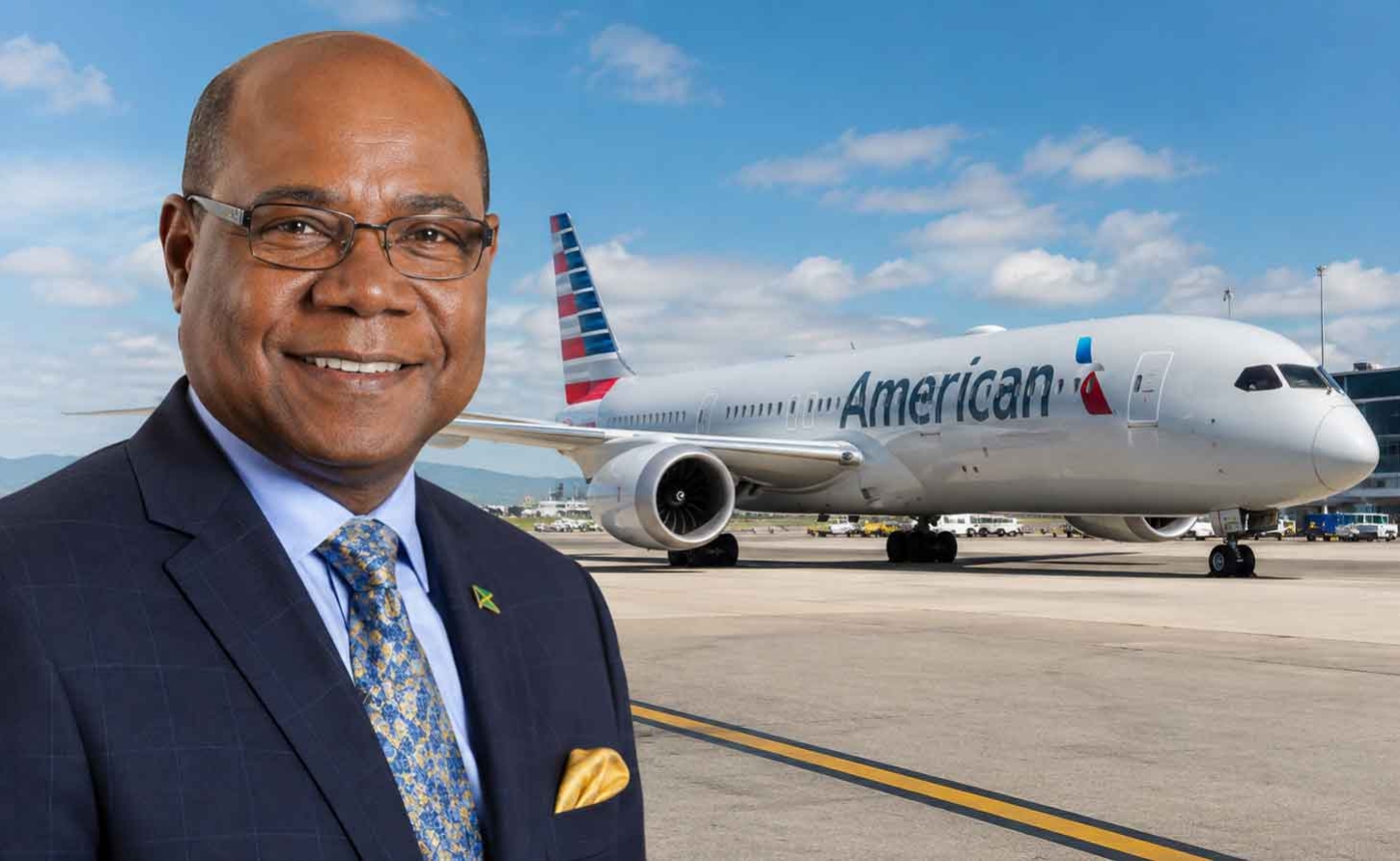
Tourism Minister Hon. Edmund Bartlett
Spirit is gone and Miami is selling at US$3,744. In 2008 the same minister called doing nothing a disservice to Jamaica.
MONTEGO BAY, JAMAICA, September 3, 2026 — Calvin G. Brown | Analysis | Spirit Airlines shut down at three o'clock on the morning of 2 May, ending thirty-four years of flying and erasing every Jamaican route it operated. Four months on, the cost of that morning is legible in a booking screen.
In the third week of August, American Airlines was quoting US$3,744 for a return between Montego Bay and Miami on the 20th to the 27th. For the 22nd to the 29th, US$3,472. Southwest fares between Montego Bay and Tampa were running near US$1,000. JetBlue's Fort Lauderdale flights were repeatedly sold out on the dates checked.
Ninety minutes of flying. Less time in the air than the drive from Montego Bay to Ocho Rios.
Prices fell sharply on later dates, which tells you exactly what is being priced. Not distance. Not fuel. Not the cost of running a narrowbody across the Windward Passage. Urgency.
The premium falls on the traveller who cannot choose when to go — the funeral, the specialist appointment, the registration deadline, the emergency. An aviation source at Sangster put the consequence bluntly: in an emergency, Jamaicans cannot get a flight out.
Four months before it happened, the Ministry of Tourism told the country it would not.
The Ministry's forecast, and the figures that answered it
In May, the tourism minister put Spirit's collapse at just under three per cent of Jamaica's passenger load and predicted that other carriers would absorb it. Absorption is precisely what did not occur.
Airlines set routes, aircraft assignments, crew rosters and schedules six months or more ahead. When Spirit folded in May, the summer schedules of every remaining carrier were already fixed. There was no spare lift to absorb anything — only a fixed number of seats and a sudden surplus of people who needed them.
The half-year arrivals figures contain something close to a natural experiment, and it is the most useful number Jamaica has produced this year.
Arrivals from the United States fell 27.9 per cent. Canada fell 23.4 per cent. Europe fell 6.7 per cent, and in June European arrivals were flat — up a statistically meaningless 0.1 per cent. Cruise arrivals held almost steady across the half-year at 690,951 passengers, down 2.9 per cent.
European visitors faced the identical hurricane. The identical shortage of rooms, the identical damaged resorts, the identical coverage of a battered island. Cruise passengers faced all of it too. Every variable the Government cites as the cause of the downturn applied to them in full.
What separated the segments that collapsed from the segments that held was one thing: whether access to Jamaica is priced by an airline.
Non-resident Jamaican arrivals rose 7.6 per cent in June, a figure the Government has reached for. It does not mean the fares are affordable. Measured against 2024, non-resident Jamaican arrivals are down 16.5 per cent. A diaspora that borrows, begs or empties savings to get home is not evidence of a functioning market.
This week's answer: a list of shocks
Pressed on it this week, the Government hit back at the Opposition with a recitation of external causes — back-to-back hurricanes in Beryl in 2024 and Melissa in 2025, the collapse of Spirit, airline capacity cuts on key United States routes, global cost pressures, oil market uncertainty. All of it real. None of it a plan.
And on the one question that matters to the woman in Fort Lauderdale pricing a flight to a funeral, the record is blank. The Government has not indicated whether it is seeking to lure other airlines to the island to provide budget-friendly options.
That silence is a choice, not a constraint. Jamaica knows how to buy seats. It has done it before, under this minister, in circumstances that were considerably less severe.
September 2008: 'NOT AN OPTION'
Eighteen years ago, American Airlines marked the Caribbean for cuts. Edmund Bartlett did not wait to see how the market would absorb it.
"Doing nothing was therefore NOT AN OPTION," he wrote at the time, the capitals his own. "We had to be proactive to guarantee the tourist industry a network of air service to protect the local tourist industry. Any other decision would have been a disservice to Jamaica."
What he did was underwrite the seats. Under the arrangement, he explained, the Government was not paying out US$4.5 million to American but had "ONLY provided a guarantee for additional seats which I am confident will be filled." It secured well over 2,000 additional seats a week ahead of the 2008/09 winter.
The capacity that bought is a matter of record on the airline's side. From 2 November 2008, American went from two daily nonstops between Miami and Montego Bay to three. Dallas/Fort Worth went from one weekly flight to five weekly, then daily. On 31 January 2009 the carrier flew its first-ever nonstop from Chicago O'Hare into Montego Bay.
Miami. Dallas. Chicago. The state did not ask the market to supply those routes. It paid to have them.
Bartlett was also at pains to say none of this was unusual. Seven regional counterparts, he said, had entered similar arrangements with American, and other Caribbean destinations were in discussions to follow. He called revenue guarantees common industry practice, and noted that Jamaica Vacations Limited — JamVac — had for many years used this and similar mechanisms to attract airlift and open new gateways.
That is the minister's own account of the tool. It is not a construction placed on him by critics.
Why the tool went back on the shelf
A guarantee is a promise to absorb someone else's downside. When the seats do not fill, the state pays. That is the whole point of it, and it is why airlines sign.
The Gleaner's Edmond Campbell reported that the Government could be called on to pay more than J$133 million to American Airlines under the revenue-guarantee airlift agreement, on the Miami, Dallas and Chicago routes into Montego Bay.
The money was never the scandal. The process was.
The Office of the Contractor General investigated the American Airlines airlift agreements; the report is dated 1 February 2010. In Parliament, Prime Minister Bruce Golding conceded that the agreement had been signed by the Chairman of Jamaica Vacations without Cabinet approval, and that this was a clear breach of government policy.
He said he had told the minister and the chairman there must be no recurrence. Alongside ran allegations that the tourism ministry had breached procurement rules and that Bartlett may have misled Cabinet.
JamVac was then, and is now, a public body of the Ministry of Tourism, incorporated in 1978 and fully funded by the Government of Jamaica. A wholly state-funded company whose chairman could commit the country to a multimillion-dollar contingent liability Cabinet had not seen.
But here is the part that governs 2026. Even The Jamaica Observer, editorialising against the administration at the height of it, allowed that there was plenty of evidence the agreement had worked for the good of Jamaica's tourism. The seats flew. The routes opened. What failed was how the country bound itself, not whether it should have.
Institutional Jamaica took away the wrong half of that lesson.
Busy elsewhere
It would be unfair to say the minister has ignored airlift. In April he pointed to growth from South America through Copa into Sangster, six weekly flights out of Colombia between Medellín and Bogotá, four Virgin services into Montego Bay from Heathrow, and Condor stepping up.
In his 2026 sectoral presentation, under the theme "Trust and Confidence," he set out a governance overhaul in which JAMVAC keeps responsibility for airlift, cruise development, homeporting and access expansion.
That is real work. It is not work on the thing that broke.
A Medellín rotation does not carry a Jamaican from Fort Lauderdale to a burial in Hanover. A Heathrow frequency does not restore competition on the Miami shuttle.
The corridor that failed is the cheap, plentiful, competitively priced North American corridor, and the response has been to build new gateways while waiting for that one to heal on its own — the exact posture the 2008 statement was written to reject.
What accountability would look like
The capacity to intervene has not been abolished. Jamaica has a state-funded company whose statutory purpose is to provide, protect and increase airlift capacity, and whose airlift mandate the minister personally reaffirmed months ago. The mechanism exists. The precedent exists. The minister who set the precedent is in the chair.
What is missing is willingness to touch an instrument that burned the administration once — a reluctance that is understandable and, on the record, indefensible.
Nothing established in 2010 said that guaranteeing seats was improper. What it established was that this Government had done it without Cabinet approval, outside the procurement rules, and in a way the Contractor General thought worth investigating.
The remedy for that is not abstinence. It is a Cabinet submission, a tabled agreement, a published ceiling, and a reporting line to Parliament on every dollar drawn down. If a guarantee is worth giving, it is worth defending in the open. If it cannot be defended in the open, it should not be given.
There is an honest version of the Government's present position. It would say plainly that revenue guarantees are too costly, too risky or too distorting, and that Jamaicans must pay whatever the traffic will bear until capacity returns by itself.
That would at least be a position. It would also be the precise position the Minister of Tourism denounced, in capital letters, in September 2008.
He called it a disservice to Jamaica.
Calvin G. Brown is Senior Correspondent at WiredJa Online.
