
SPORTS | OP ED| Sir Garfield Sobers: Cricket, Liberation, and the Caribbean Imagination
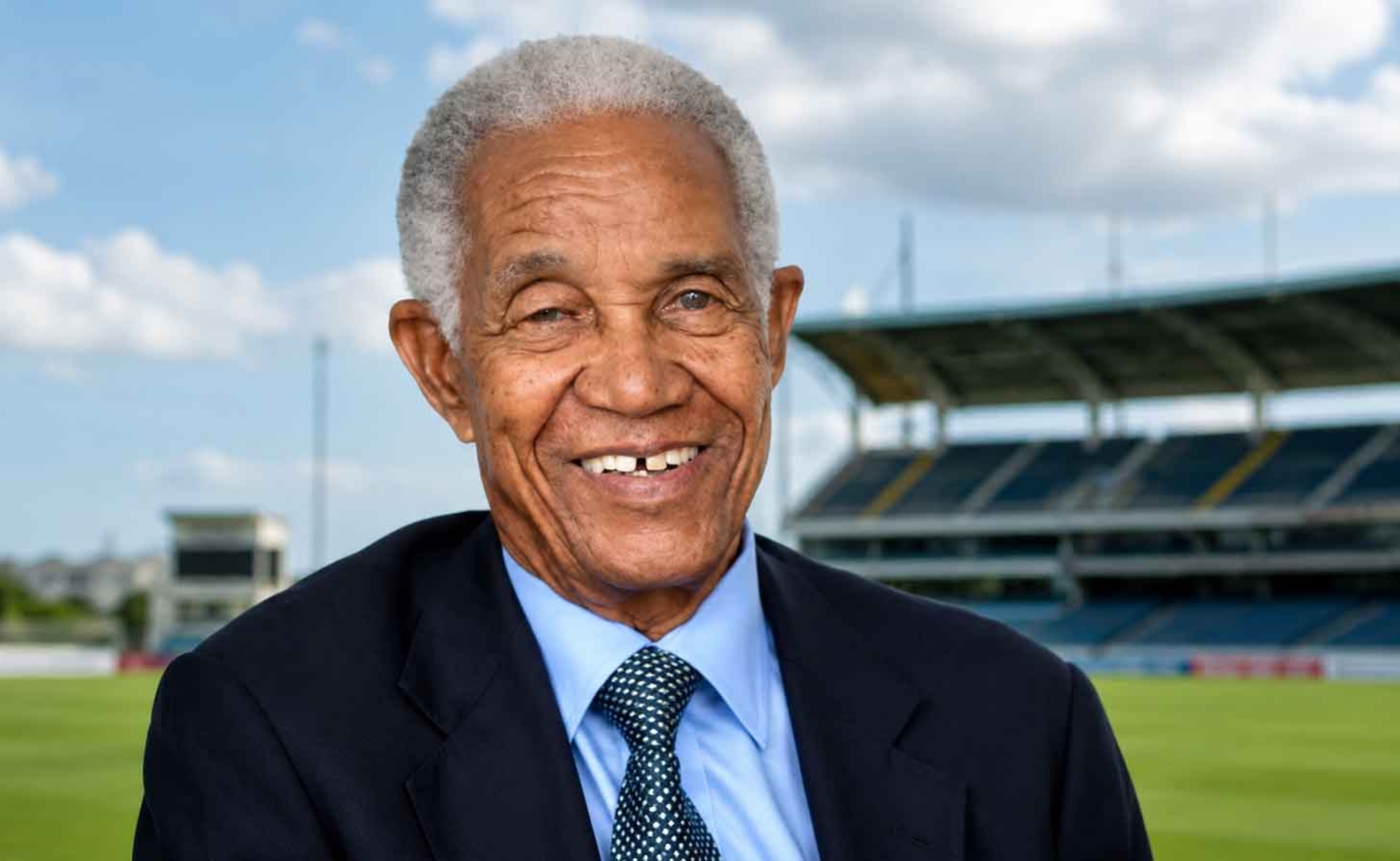
Sir Garfield Sobers of Barbados, a Caribbean Hero
Sir Garfield Sobers at the crease during his prime years. For millions across the Caribbean, his confident stride, raised collar, and masterful batting became symbols of Black excellence, Caribbean pride, and the possibility of transcending colonial limitations. By Cikiah Thomas
Introduction: More Than a Cricketer
Sir Garfield St. Aubrun Sobers, who passed away in Barbados, the land of his birth, leaves behind a legacy that transcends statistics, records, and sporting achievements. History will remember him as cricket's greatest all-rounder. Caribbean people, however, will remember him as something even greater.
He was one of the architects of Caribbean self-confidence.
Sobers emerged during a period when the peoples of the Caribbean were struggling to free themselves politically, economically, culturally, and psychologically from centuries of colonial domination. Through the seemingly simple acts of batting, bowling, and fielding, he helped transform how millions of Black people viewed themselves and their place in the world.
Like many great historical figures, his significance cannot be measured solely by what he accomplished. It must also be measured by what he inspired. For generations of Caribbean people, Gary Sobers represented possibility itself.
The Arrival of a Caribbean Giant

Cikiah Thomas
Across the region, transistor radios become instruments of collective listening. Schoolboys pause their games. Cane cutters stop for updates. Fishermen gather at wharves. Nurses listen quietly between shifts. Construction workers ask a familiar question:
"What's the score?"
Moments later, the commentator's voice crackles through the static.
"Sobers drives magnificently to the boundary for four."
The crowd erupts. The Caribbean erupts. Another chapter is being written.
Yet Sir Garfield Sobers was never simply accumulating runs. Every innings became a symbolic confrontation with the colonial assumptions that had long defined Black people as incapable of intellectual, cultural, or athletic excellence equal to that of Europeans.
The cricket field became a site of resistance. The bat became an instrument of affirmation.
The scoreboard became evidence that the descendants of enslaved Africans could not only compete but excel.
Cricket and Colonialism
To understand Sobers' historical significance, one must understand the role cricket occupied within the British colonial project.
Cricket was more than a sport. It was a cultural institution designed to reflect the values of Empire. It was presented as evidence of British civility, discipline, and superiority. Colonial subjects were encouraged to admire the game and, by extension, admire the imperial system that introduced it.
But history often unfolds in unexpected ways. The colonized learned the game. Then they mastered it. Eventually, they transformed it!
C.L.R. James famously asked: "What do they know of cricket who only cricket know?"¹
His question remains relevant today. To understand Garfield Sobers merely as a cricketer is to misunderstand his historical significance.
He represented a challenge to the ideological foundations of colonialism itself.
When West Indians defeated England, they were not merely winning a sporting contest. They were overturning deeply embedded assumptions about race, civilization, and power.
The Psychological Liberation of a People
Frantz Fanon argued that colonialism creates not only political domination but also psychological domination. ²
The colonized are taught to doubt themselves. They are encouraged to see themselves through the eyes of their oppressors.
Their history is minimized. Their achievements are ignored. Their confidence is systematically undermined.
For many Caribbean people born under colonial rule, these realities were familiar.
Schools’ taught loyalty to Empire. British achievements dominated textbooks. European heroes occupied center stage.
Black achievement was often treated as exceptional rather than normal.
The appearance of Gary Sobers helped disrupt this colonial narrative.
His brilliance was impossible to dismiss. His dominance was impossible to deny.
His achievements forced both colonizer and colonized alike to confront a different reality.
Black excellence required no qualification. It stood on its own.
Walter Rodney and the Meaning of Sobers
Walter Rodney taught that colonialism systematically underdeveloped Africa and its diaspora. ³
Underdevelopment was not accidental. It was a consequence of exploitation.
The same system that extracted wealth also sought to diminish confidence and obscure achievement.
Against this backdrop, Sobers' rise carried profound meaning.
Each century challenged colonial assumptions. Each wicket demonstrated mastery. Each remarkable catch affirmed capability.
The significance of his achievements extended beyond the boundary rope because they contributed to a broader struggle for dignity and recognition.
Gary Sobers helped Caribbean people imagine themselves differently.
He helped people believe that greatness could emerge from Bridgetown, Kingston, Georgetown, Port-of-Spain, Castries, Roseau, Basseterre, and beyond.
Every Child Wanted to Be Gary
No social survey was required to measure Gary's influence. The evidence was visible throughout the Caribbean.
Every schoolboy wanted to be Garfield Sobers. In village fields. On dusty roads. In urban neighbourhoods. On beaches. In schoolyards.
Children raised imaginary collars. Copied his stance. Mimicked his strokes. Imagined themselves walking confidently to the crease.
Gary became the standard against which greatness was measured.
For many children, he was their first living example of Black excellence operating on a global stage.
His influence reached beyond cricket and into questions of identity, ambition, and self-worth.
The West Indies and Caribbean Nationhood
The West Indies cricket team accomplished something politicians often struggled to achieve.
It united the Caribbean. Long before CARICOM. Long before many regional institutions.
The West Indies cricket team gave Caribbean people a shared identity.
When the team won, Jamaicans celebrated. Barbadians celebrated. Trinidadians celebrated. Guyanese celebrated. Antiguans celebrated.
The victory belonged to everyone.
Sir Garfield Sobers became one of the most important symbols of this emerging Caribbean consciousness.
His success reinforced the idea that the peoples of the region possessed more that united them than divided them.
He embodied the possibility of Caribbean nationhood.
Meeting My Hero
One of my lifelong dreams was to meet Sir Garfield Sobers.
That dream became reality during the historic period when Barbados formally completed its transition from a constitutional monarchy to a republic.
Meeting Gary was a profound moment. It was equally meaningful for my colleagues Michael Heslop and Basil Thomas, who shared in the excitement of the occasion.
Two years later, I had the privilege of meeting him again in a more relaxed setting.
During our conversation, I told him something that had remained with me since childhood. I explained that as a young boy, I genuinely believed he lived somewhere in my community.
My father, my uncle, and their friends spoke about him with such familiarity and affection that it seemed impossible that he could be anywhere else. They described his performances as though they had witnessed every ball from a seat beside the boundary.
Years later, I realized that what I had witnessed was not merely admiration for a sportsman. I had witnessed a people claiming one of their own.
Their pride in Gary Sobers helped shape my own development as a Caribbean patriot.
Then Gary said something that would have delighted my family.
He told me that Sabina Park in Jamaica was his favorite ground on which to play cricket.
My father would have treasured hearing those words.
For him and countless others, Gary was not merely a Barbadian hero. He belonged to the entire Caribbean.
Beyond the Boundary, Beyond Empire
Today, as we mourn Sir Garfield Sobers, we also celebrate what he represented.
He represented excellence without apology. He represented Caribbean unity. He represented confidence in the face of colonial contempt.
He represented the ability of a formerly colonized people to redefine themselves on their own terms.
Fanon reminded us that every generation must discover its mission and fulfill it. ⁴ Gary fulfilled his.
Through discipline, brilliance, courage, and grace, he transformed the psychological landscape of the Caribbean.
He taught us that greatness could emerge from our communities. He taught us that excellence belonged to us as much as anyone else. He taught us to dream beyond the limitations imposed by empire.
Conclusion
The innings has ended. The bat has been laid to rest. But the legacy remains.
Whenever a Caribbean child picks up a bat and imagines greatness, Sir Garfield Sobers lives on.
Whenever Caribbean people affirm their common destiny, Sir Garfield Sobers lives on.
Whenever we reject the colonial notion that our future must be defined by others, Sir Garfield Sobers lives on.
Cricket's greatest all-rounder has departed.
But the liberating example he provided will endure for generations.
Gary Sobers did not merely play cricket. He helped a people discover themselves.
Endnotes
- C.L.R. James, Beyond a Boundary (London: Stanley Paul, 1963), 25.
- Frantz Fanon, Black Skin, White Masks (New York: Grove Press, 1967).
- Walter Rodney, How Europe Underdeveloped Africa (London: Bogle-L'Ouverture Publications, 1972).
- Frantz Fanon, The Wretched of the Earth (New York: Grove Press, 1963), 145.
Selected References
Austin Clarke. Growing Up Stupid Under the Union Jack. Toronto: HarperCollins Canada, 2012.
Fanon, Frantz. Black Skin, White Masks. New York: Grove Press, 1967.
Fanon, Frantz. The Wretched of the Earth. New York: Grove Press, 1963.
James, C.L.R. Beyond a Boundary. London: Stanley Paul, 1963.
Rodney, Walter. How Europe Underdeveloped Africa. London: Bogle-L'Ouverture Publications, 1972.
Sobers, Garfield. Sobers: Twenty Years at the Top. London: MacGibbon & Kee, 1975.
-30-
