
CARICOM | From Sam Lord’s Castle in Barbados, The Third CARICOM Confab on Reparations Opens
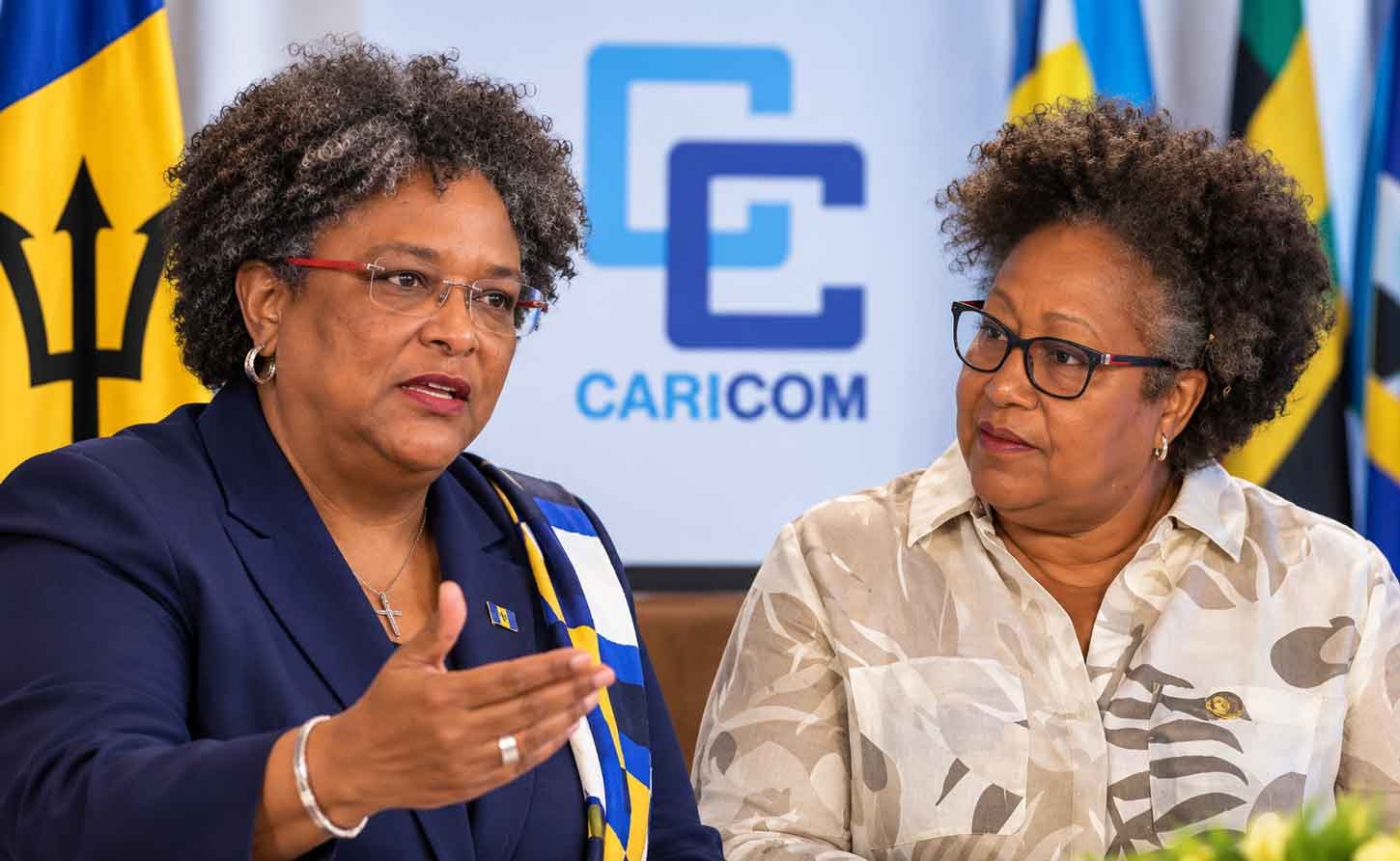
Prime Minister Mia Mottley and CARICOM Sec Gen Dr. Carla Barnett
CARICOM Regional Conference on Reparations opens in Barbados — the first since the United Nations named chattel enslavement “the gravest crime against humanity.”
ST PHILIP, Barbados, September 17, 2026 | CALVIN G. BROWN | REGIONAL — There is a quiet irony in the choice of venue. When the Third CARICOM Regional Conference on Reparations opens this evening at the Wyndham Grand Sam Lord’s Castle, delegates will gather on ground once worked by people held in bondage.
Samuel Hall Lord, the planter whose Georgian mansion of about 1820 gives the resort its name, inherited the Long Bay and Pool plantations along with the enslaved people who laboured on them, as Barbados’ Nation newspaper has chronicled. Island legend remembers him as a wrecker who hung lanterns in coconut trees to lure ships onto the reef. The archive remembers something less romantic.
It is on that ground that the region will spend three days, 17 to 19 September, debating how to repair what was done. The theme: “Reparatory Justice as the Coming Enlightenment.”
The opening ceremony, scheduled for 6:00 p.m. Atlantic Standard Time, is to be addressed by Barbados Prime Minister Mia Amor Mottley, who chairs the CARICOM Prime Ministerial Sub-Committee on Reparations; CARICOM Secretary-General Dr Carla Barnett; and Sir Hilary Beckles, chair of the CARICOM Reparations Commission (CRC). Proceedings are being carried on CARICOM’s YouTube channel, Facebook and UWI TV.
A mandate from the General Assembly
What sets this gathering apart from its predecessors is a document: UN Resolution A/RES/80/250. Adopted on 25 March 2026 — the International Day of Remembrance of the Victims of Slavery and the Transatlantic Slave Trade — the Ghana-led text declared the trafficking and racialised chattel enslavement of Africans the gravest crime against humanity. It carried 123 votes in favour, 52 abstentions and three against: Argentina, Israel and the United States.
The resolution is non-binding, and the objections were pointed. Washington’s delegation argued that no legal right to reparations flows from historical wrongs that were not illegal under international law when they occurred. The European Union, which abstained alongside the United Kingdom and Canada, welcomed the initiative but contended that ranking one crime against humanity above others has no footing in law.
The question is no longer whether the wrong was grave. It is what repair looks like — and who pays.
Those arguments will follow delegates into St Philip. Supporters counter that the vote has shifted the burden of the debate from acknowledgement to action. For Caribbean audiences, the ledger needs little explanation: the borrowing Britain raised in the 1830s to compensate slave owners — not the enslaved — was not fully retired until February 2015.
From manifesto to measurable targets
Organisers say the conference will give practical guidance on implementing the revised CARICOM Ten-Point Plan for Reparatory Justice, now subtitled A Manifesto for the Coming Enlightenment. Its headline deliverable is a 2027–2031 Action Plan for Reparatory Justice, intended to set measurable targets for joint work with partners across the global African community.
The African dimension is unmistakable. Representatives of the African Union are expected at a high-level session with CARICOM leaders, and the Barbados meeting comes a day after the inaugural sitting of the High-Level Global Advisory Council on Reparatory Justice, chaired by Ghana’s President John Mahama. Writing in Saint Lucia’s The Voice this week, commentator Earl Bousquet, who chairs his country’s National Reparations Committee, put attendance at roughly 200 advocates from the Caribbean, Africa, the diaspora and Europe.
The agenda is framed against three global milestones: the 25th anniversary of the Durban Declaration and Programme of Action, the Second International Decade for People of African Descent, and the African Union Decade for Reparatory Justice.
Thirteen years, three conferences
By diplomatic standards, the movement has travelled fast. The first conference, hosted by St Vincent and the Grenadines in September 2013, launched the CRC and received the late reggae icon Bunny Wailer as patron of the regional movement. Antigua and Barbuda hosted the second in 2014, where Jamaica’s former Prime Minister P.J. Patterson delivered the keynote.
Sceptics will ask what three days at a luxury resort can accomplish against the resistance of the world’s most powerful capitals. It is a fair question, and the answer will lie less in tonight’s speeches than in the targets delegates are prepared to sign by Saturday.
The first Enlightenment, after all, theorised liberty while its financiers underwrote the slave ships. The Caribbean’s wager is that the next one will finally settle the account.
— 30 —
