
GUYANA | Same Words, New Danger: The Fine Print in Washington’s Essequibo Pledge
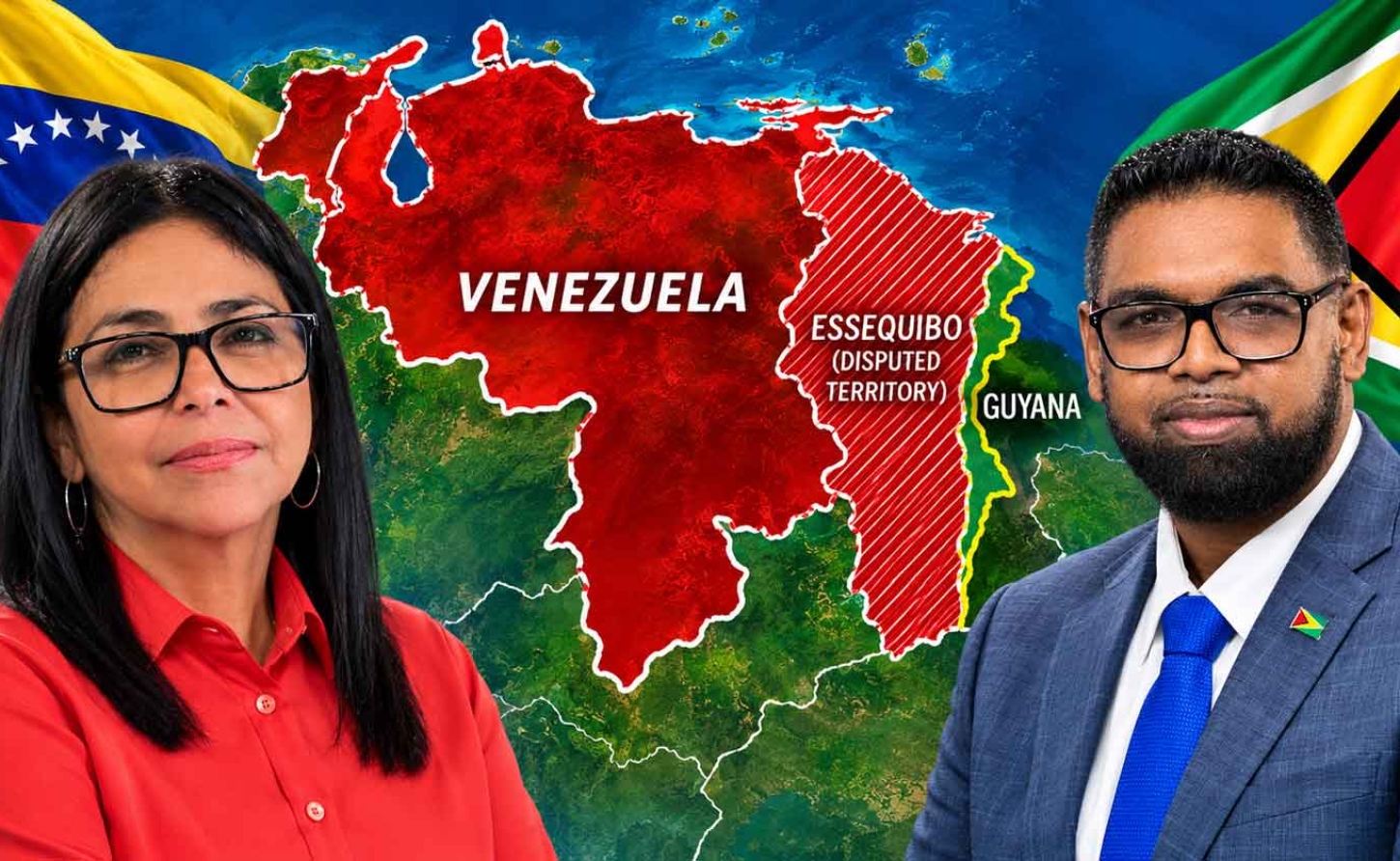
Venezuela’s acting president, Delcy Rodriguez and Guyana's President Mohamed Irfaan Ali
The US Embassy in Georgetown insists nothing has changed on the Guyana–Venezuela boundary. The wording bears that out. It is the world around the wording that has shifted, and a clause that was once boilerplate now reads like an open door.
MONTEGO BAY, Jamaica, November 19, 2026 | Calvin G Brown| — Diplomatic reassurances are meant to end conversations. The one issued by the United States Embassy in Georgetown on Thursday has started one.
Responding to reports that a senior Trump regime official had floated the idea of Venezuela taking partial control of the Essequibo, the embassy declared that US policy on the land boundary “has not changed”.
Washington, it said, reaffirms its support for the 1899 Arbitral Award, which should be respected “unless or until a new boundary is set by a competent legal body or with the consent of both parties.”
Within hours, the New York-based Caribbean Guyana Institute for Democracy (CGID) had seized on that closing clause as an “intimation” that a new border is thinkable. “Guyanese are not prepared to give an inch more,” the group said. “Not even a blade of grass!”
So who is right: the embassy that says nothing has moved, or the critics who smell a concession? The uncomfortable answer is both.
How a policy planner rattled Georgetown
Reuters reported this week, citing three people familiar with the matter, that Jeremy Lewin, then the State Department’s director of policy planning, told Guyana’s Foreign Secretary Robert Persaud at a September meeting in Washington that he could help broker territorial talks with Venezuela’s acting president, Delcy Rodríguez.
Two sources told the agency he raised the possibility of Venezuela taking partial control of the Essequibo, roughly the western two-thirds of Guyana.
Lewin, who left the department at the end of October, told Reuters the discussions were “preliminary” and followed a May letter from Rodríguez to President Donald Trump seeking American mediation. Guyanese officials, by the agency’s account, sought clarification elsewhere in the department and were told that policy stood where it was.
Guyana’s Ministry of Foreign Affairs says it has received “the assurance of the United States Government that nothing has changed since.” President Irfaan Ali told Bloomberg there had been “absolutely no change” in Guyana’s own position, and that both countries would have to accept the eventual ruling of the International Court of Justice (ICJ).
The clause is old. That is the point.
Here is what the embassy’s critics have missed and its defenders have not advertised: the caveat is not new. In December 2023, days after Nicolás Maduro staged his referendum on annexing the Essequibo, then Secretary of State Antony Blinken telephoned President Ali.
The State Department’s account of that call asked all parties to respect the 1899 Award “unless, or until” they reached a new agreement or a competent legal body decided otherwise. The department’s spokesman repeated the formula days later.
Thursday’s statement is that sentence, lightly reupholstered. On the text, Washington is telling the truth.
Take the clause apart and it looks less sinister still. The “competent legal body” is the ICJ, where Guyana itself is the applicant, asking the judges to confirm the Award. Hearings on the merits closed on May 11 and judgment is pending. Attorney General Anil Nandlall has pledged that Guyana will abide by the ruling “whatever it may be.” On that limb, the American position is Guyana’s position.
The second limb, “the consent of both parties”, hands Georgetown a veto. No consent, no new boundary. A lawyer would call it a restatement of the obvious: sovereign states may always redraw a border by agreement.
In 2023 the caveat was a footnote. In 2026 it has a constituency.
Same text, different world
But statements are read in context, and the context is unrecognisable. In 2023 the clause came from a Washington openly hostile to Caracas, and it arrived alongside joint military flight drills with the Guyana Defence Force. Nobody imagined an American official treating the “consent” pathway as an invitation.
Since the January US operation that ended Maduro’s rule, Washington and the Rodríguez government have drawn closer. Rodríguez has written to Trump asking for help.
She told the ICJ in May that the controversy must be resolved politically under the 1966 Geneva Agreement, and used the United Nations General Assembly in September to press Guyana to negotiate. Bilateral negotiation is the road Caracas has always preferred, and “consent of both parties” is its signpost.
Then came Lewin. Once a senior American official has, by Reuters’ account, actually proposed walking down that road, the clause stops being boilerplate.
The contradiction Washington has not resolved
The State Department’s answer to Reuters was that it receives policy proposals from outside parties, and that its position on the boundary is unchanged. Lewin was no outside party. He ran the department’s policy planning staff, and he told Reuters his discussions were “fully directed and authorized” by the White House.
Both accounts cannot be the whole truth. Either a senior official freelanced on the territorial integrity of a friendly state, or the White House tested an idea and the State Department is now tidying up.
The embassy statement answers neither question. Nor does it say the one thing that would have ended the matter: that the United States will not sponsor, broker or encourage any negotiation over the status of the Essequibo.
The court Washington calls corrupt
There is a deeper awkwardness in the embassy’s formula. The “competent legal body” on which US policy rests is one Washington has spent four decades backing away from. It withdrew its acceptance of the ICJ’s compulsory jurisdiction in 1985, after the court agreed to hear Nicaragua’s case against it.
When Nicaragua won, the US vetoed Security Council draft resolutions calling for compliance, one of them co-sponsored by Trinidad and Tobago. Further exits from treaty clauses granting the court jurisdiction followed in 2005 and 2018.
The hostility is current. In October 2025 the State Department greeted an advisory opinion on Gaza aid with the words “Another corrupt ruling by the ICJ.” On Thursday, as the court found that Myanmar had committed genocide against the Rohingya, Washington’s response was to warn against “politicisation” of the body.
The US is not a party to Guyana’s case and will not be bound by the judgment. That is not the issue. Guyana has pledged to comply; Venezuela has told the court that a ruling will not change its position.
Under Article 94 of the UN Charter, Guyana’s remedy against a defiant neighbour runs through the Security Council, where Washington holds a veto. A victory at The Hague would be only as strong as American willingness to stand behind a court it disparages. And if Washington will not treat the judges’ word as final, “the consent of both parties” becomes the only door left open.
CGID’s case, and its limits
CGID wants the PPP/C government to reject the embassy’s wording outright. The demand has emotional force and political logic, since it puts the administration on the spot. It also has two weaknesses.
The group’s release says a US official “requested” that Guyana concede territory; Reuters’ reporting is that the possibility was floated. And to reject the “competent legal body” language would be to reject the very court Guyana has spent eight years petitioning.
The sharper demand is narrower. Georgetown need not quarrel with the ICJ limb. It should say, publicly and in terms, that the “consent” limb is a dead letter because consent will never be given.
Leverage, not law
The real exposure is not legal. It is the arithmetic of power. Guyana is a small state that looks to Washington for security support, and an American-led consortium pumps its oil. Consent extracted from a dependent partner is still, on paper, consent. A regime that treats borders as deal terms does not need to change its policy statement. It needs only to raise the price of saying no.
The Caribbean stake
CARICOM has long backed Guyana’s territorial integrity and the judicial route. At the time of writing, no fresh statement from the Secretariat on the Lewin affair could be located. It should not wait.
Every small state in this region holds borders and maritime zones that rest on old awards, old treaties and the assumption that great powers will not reopen them for convenience. If the Essequibo becomes negotiable when Washington’s interests in Caracas shift, nothing is settled anywhere.
What to watch
Three things. First, the ICJ judgment, which will give the “competent legal body” its say. Second, whether Georgetown or Washington closes the consent door in plain words. Third, who inherits Lewin’s brief, and whether Rodríguez’s letter ever receives a reply.
The embassy says the policy has not changed. It is right. That is precisely the problem: the words stood still while everything around them moved.
— 30 —
