
TRINIDAD & TOBAGO | Persad-Bissessar Strips Rowley and Young of Diplomatic Passports, State Security Detail”
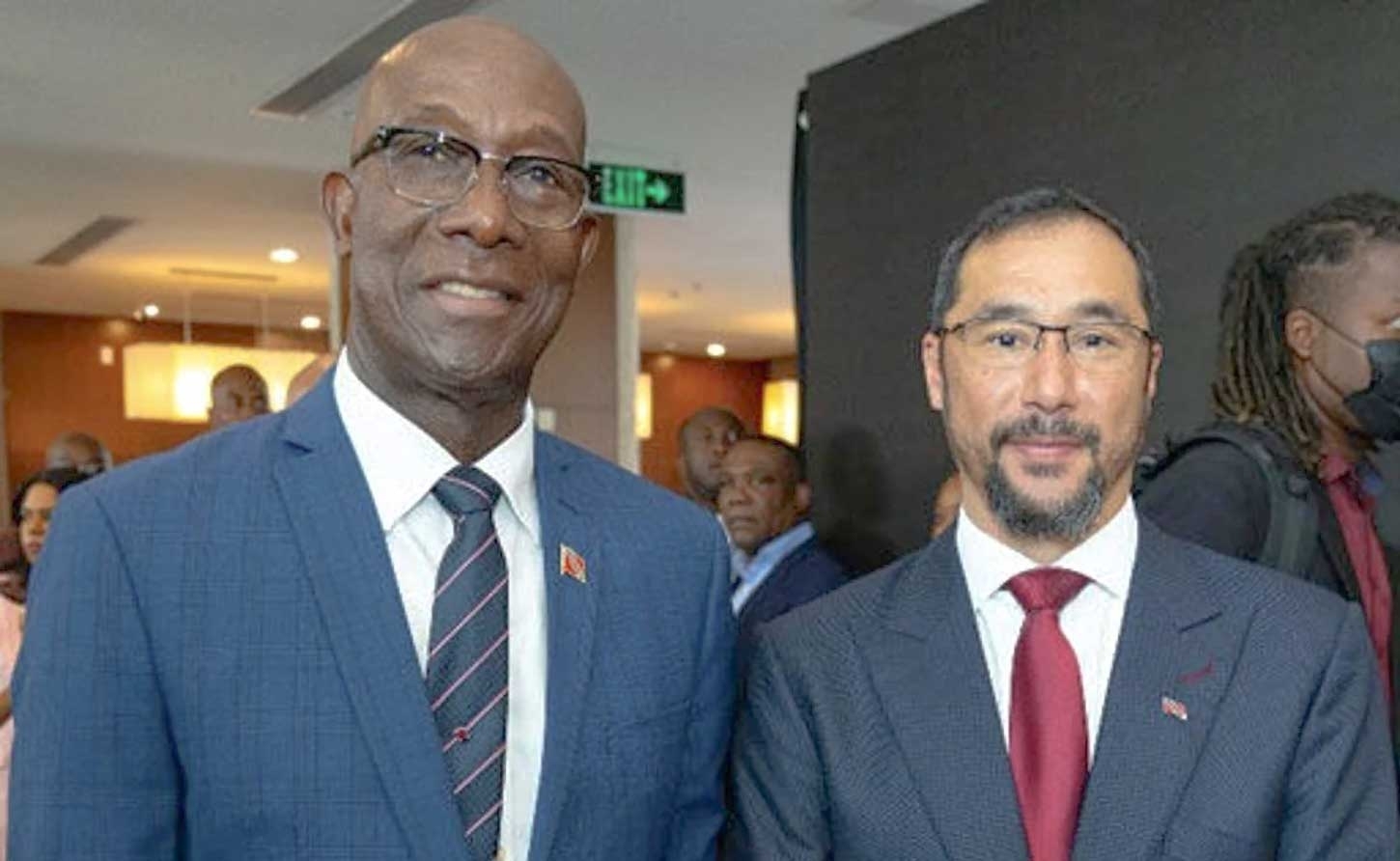
Fortmer Prime Minister Dr Keith Rowley, left, and former PM Stuart Young at the Guyana Energy Conference and Supply Chain Expo 2024 in Georgetown, Guyana.
A foreign government’s complaint, 985 diplomatic passports, and a “cry baby” jibe — Trinidad and Tobago’s passport purge has reopened the wound of political transition.
PORT OF SPAIN, Trinidad & Tobago | By Calvin G. Brown | July 4, 2026 — Prime Minister Kamla Persad-Bissessar has moved to strip former prime ministers Dr Keith Rowley and Stuart Young of their diplomatic passports, declaring that Trinidad and Tobago’s system for issuing the coveted red booklets has been abused on a staggering scale — and dismissing Young’s cries of victimisation as “cry baby, beh-beh behaviour.”
The numbers behind the decision are eye-watering. Responding to questions from the Express, Persad-Bissessar disclosed that a review — requested, she said, by an unnamed foreign government — found that 985 persons currently hold Trinidad and Tobago diplomatic passports, “despite most of these persons not meeting the criteria for holding these passports.”
“The Government was requested by our foreign counterparts to look into the issuance and abuse of Trinidad and Tobago-issued diplomatic passports,” the Prime Minister said. Under the revised policy, both former prime ministers will be issued official passports instead — documents that carry special benefits but none of the diplomatic immunities reserved, under Vienna Convention accreditation, for those formally representing the State abroad.
A Call Out of the Blue
Young fired the opening salvo. In a video statement posted to social media on Thursday, the former prime minister — who served 42 days in office before the April 2025 general election — revealed he had been telephoned and told to surrender the diplomatic passport issued to him on May 2 last year.
“I didn’t ask for it,” Young said. “Get a call out of the blue: return the passport.”
That claim is now under strain. Guardian Media has since reported that on April 30, 2025 — two days after the PNM lost the general election, and one day before Persad-Bissessar was sworn in — a state official requested that a letter be prepared, the same day, to facilitate Young’s application for a diplomatic passport as a former prime minister. If accurate, the revelation cuts directly against Young’s insistence that the document arrived unbidden.
He has refused to comply without a formal written demand, telling Guardian Media he would deal with the matter “in accordance with the law at the appropriate time.” He cast the request as part of a pattern of “political victimisation and political persecution” he described as “unprecedented in Trinidad and Tobago,” pointing to the legislation the UNC administration passed last year to block his prime ministerial pension and gratuity — a law he and the Opposition branded as targeted at one man.
Rowley, contacted abroad, was characteristically blunt. “I have a diplomatic passport which I used today,” he messaged Guardian Media.
Persad-Bissessar was unmoved. Diplomatic passports, she said, must be returned when a holder’s posting ends, they retire, or they leave qualifying office. “He is retired and he is not representing the country in an official capacity. Therefore, he should not be in possession of a diplomatic passport.”
The Law, and the Grievance
On the strict legal question, the Government appears to stand on firm ground. The custom of according former prime ministers diplomatic passports is precisely that — a custom, an administrative courtesy extended across successive administrations, not a right conferred by law.
Under the Immigration Act, Chap. 18:01, the power to issue and revoke passports rests exclusively with the Minister of National Security, and Guardian Media could locate no constitutional or statutory entitlement permitting former prime ministers to retain diplomatic passports after demitting office.
What one government grants by convention, another may withdraw by the same instrument.
But law is not the whole story. The passport recall is only the latest entry in a ledger the Opposition has been keeping since May 2025. Both men lost their personal security details in July of that year — Young’s within a day of Parliament stripping his pension, a sequence the Homeland Security Minister insisted was “just coincidental” and grounded in a police threat assessment.
That same month, Rowley was flagged on an Interpol watch list during a stopover in Antigua, an episode he denounced as “state-sponsored slander” and for which no official explanation was ever offered.
Each measure arrives with a facially neutral justification; together, they read either as overdue housekeeping or as the methodical dismantling of two political careers’ residual privileges. Which one depends largely on where you sat on April 28, 2025.
“When some people get used to preferential treatment, equal treatment seems like discrimination to them.”— Prime Minister Kamla Persad-Bissessar
Persad-Bissessar insists it is nothing of the sort. “This is not a downgrade or any indication of wrongdoing by anyone who is being affected. It is simply corrective action being taken,” she said.
The Opposition is having none of it. PNM chairman Marvin Gonzales accused the administration of pursuing “revenge, pettiness” and political victimisation in place of governance, arguing that Young’s service as prime minister could not be erased and that withdrawing his diplomatic passport would do nothing to diminish his legacy.
The Caribbean Is Watching
The timing carries regional weight. The Prime Minister departs this weekend for the 51st Regular Meeting of the Conference of CARICOM Heads of Government in St Lucia, running July 5–8 under incoming chairman Philip J. Pierre. The Caribbean has long prided itself on transitions of power free of retribution; how Port of Spain treats its former leaders will not go unnoticed in capitals where governments change hands with the same regularity.
Two questions now demand answers. Who are the 985 — and how did a small republic come to issue nearly a thousand diplomatic passports? And when the written demand Young awaits finally arrives, will it settle the matter — or open the next front in Trinidad and Tobago’s increasingly rancorous politics of transition?
The passports may be surrendered. The grievances, plainly, will not be.
— 30 —
