The Papal Bull - Dum Diversas: How Rome Weaponised Heaven Against Africa — and Africa Refused to Bow
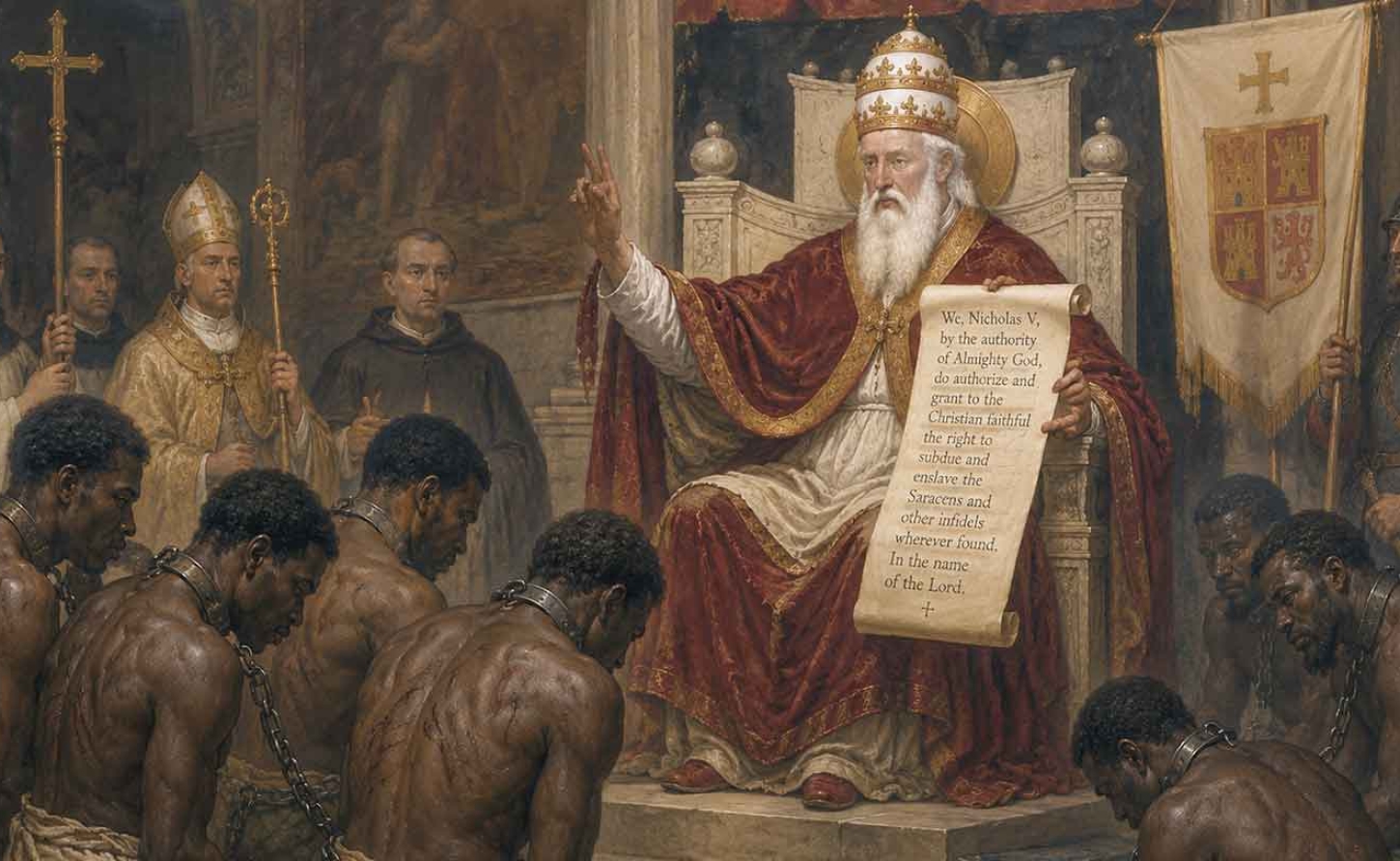
Pope Nicholas V, born Tommaso Parentucelli, was head of the Catholic Church and ruler of the Papal States from 6 March 1447 until his death in March 1455.
In 1452, a Pope signed a document that gave Europe’s kings divine licence to enslave the African continent. What history rarely tells you is what Africa did next.
MONTEGO BAY, Jamaica, June 2, 2026 -By Calvin G. Brown | It was an ordinary summer day in Rome — June 18, 1452 — when Pope Nicholas V dipped his quill and changed the world forever. Not with a declaration of war, or a treaty of peace, but with a Papal Bull: a formal ecclesiastical decree bearing the authority of God’s earthly representative.
The document was addressed to King Alphonso V of Portugal. Its title was Dum Diversas — Latin for “While different.” What it authorised was the most monstrous enterprise in human history.
The language was cloaked in piety. The Pope wrote of “Saracens and pagans and any other unbelievers” to be reduced to “perpetual slavery.” He gave Alphonso — and by extension all the crowned heads of Christendom — the legal and spiritual authority to invade Africa, seize its people, and enslave them in perpetuity. God, in the calculus of 15th-century Rome, had no objection. Indeed, God apparently approved.
But this story did not begin with ink on parchment. It began eight years earlier, on the sun-scorched coast of Portugal.
Lagos, 1444: The Market That Damned a Continent
In August 1444, a Portuguese mariner named Lançarote de Freitas sailed into the port of Lagos, on the southern coast of Portugal, with six vessels and a cargo that had never been seen before in Europe.
Below the decks of those ships were 235 African men, women, and children — the first large cohort of sub-Saharan Africans to be trafficked to Europe as enslaved people. They had been seized in raids along the West African coastline, ripped from their villages, their families, their entire world.
A Portuguese chronicler, Gomes Eanes de Zurara, recorded what he witnessed that day. The enslaved Africans were herded into a field outside the city and sorted like livestock — separated from one another, families torn apart, mothers screaming for their children.
Zurara wrote with discomfort about the spectacle but concluded it was ultimately a favour, since the enslaved were being introduced to the True Faith. The Pope would later agree.
What Alphonso saw in Lagos was not a tragedy. It was a business model. He wanted more — many more. And he wanted heaven’s blessing to get them.
“God, in the calculus of 15th-century Rome, had no objection. Indeed, God apparently approved. Africa was to be plundered in His name.”
The First Resistance: Arrows, Militias and Refusal
What Dum Diversas could never do was compel Africa to cooperate. From the earliest Portuguese coastal raids, Africans resisted with everything at hand — and the record shows they were formidably effective.
The English slaver Sir John Hawkins — one of England’s first trafficking merchants — discovered this at savage personal cost. In the late 16th century, raiding the coast near Cape Verde, Hawkins watched as 160 of his crew were cut down by local Africans who met his ships with poisoned arrows. It was not a skirmish. It was a defeat, delivered with lethal clarity.
Across the continent, communities organised against the raiders with sophisticated local militias. Writing about his native Igboland in what is today southeastern Nigeria, the anti-slavery campaigner Olaudah Equiano recorded a society on permanent war footing: “Our whole district is a kind of militia: on a certain signal given, such as the firing of a gun at night, they all rise in arms and rush upon their enemy.”
Young men underwent years of military training specifically to resist the slave raiders. Villages relocated inland. Coastal communities refused to provision slave ships. Some fled to islands and established free communities beyond the reach of European guns.
These are not minor footnotes. They are evidence of a continent-wide refusal — imperfect, sometimes overwhelmed, but never extinguished.
Royal Defiance: The Kingdoms That Said No
Not every act of resistance was fought with a spear. Some of the most powerful pushback came from the throne rooms of Africa’s great kingdoms — sovereign monarchs who deployed diplomacy, economics, and political cunning against Portugal’s advance.
The Kingdom of Benin — one of the most sophisticated states in West Africa, renowned for its bronzes, its governance, and its military power — looked at the Portuguese slave trade and made a strategic decision. After 1516, the Oba of Benin banned the export of male slaves outright. Where Portugal had hoped for an endless human pipeline, it found a wall.
Benin instead channelled its trade into ivory, pepper, and exquisitely woven cloth. When Portugal, frustrated by both the slave ban and Benin’s repeated rejection of Christian missionaries, eventually abandoned the kingdom entirely, Benin did not mourn the departure. It pivoted, found new European partners in the Dutch and English, and traded on its own terms.
Further south, in the Kingdom of Kongo, resistance took the form of one of the most remarkable pieces of diplomatic correspondence in African history. King Afonso I — baptised as a Christian, supposedly a “brother” of the Portuguese king — wrote to King João III of Portugal in 1526 with unconcealed fury. His kingdom was being depopulated, he said.
Portuguese traders and their African collaborators were kidnapping free citizens, dragging them to the coast, and selling them across the sea. “The merchants,” Afonso wrote, “are taking every day our natives, sons of the land and the sons of our noblemen and vassals and our relatives.” He demanded it stop. His successors made similar appeals, with similar results: Portugal ignored every one of them.
But Kongo did not only write letters. The monarchy maintained a strict ban on the enslavement of free-born Kongolese citizens for much of the 16th and 17th centuries and went to extraordinary lengths to enforce it. When hundreds of Kongolese were captured and shipped to Brazil during a period of internal conflict, King Alvaro I negotiated their return.
Under King Pedro II, following a Kongolese military victory over Portuguese forces at Mbanda Kasi in 1623, over a thousand enslaved Kongolese were brought back from Brazil as part of the peace terms. This was not the act of a passive, helpless people. This was statecraft in defence of human dignity.
Queen Nzinga: The Woman Who Made Portugal Bleed
If Dum Diversas had a single most formidable opponent, her name was Nzinga Mbandi — Queen of Ndongo and Matamba, in what is today Angola. She was born around 1583 into the royal family of the Mbundu people, into a world already being torn apart by Portuguese slave raiding. By the time she died in 1663 at the age of roughly 80, she had fought them for four decades without surrender.
Her entrance onto the diplomatic stage was itself an act of theatre and defiance. Sent to Luanda in 1622 as her brother’s ambassador to negotiate a peace with Portuguese Governor João Correia de Sousa, Nzinga arrived to find that no chair had been provided for her — a deliberate slight designed to place her in a subordinate position before the Governor.
She responded by directing one of her attendants to kneel on all fours and used the person as her throne, conducting the entire negotiation from a position of regal authority. The Portuguese got the message.
When Portugal inevitably betrayed the peace treaty, Nzinga did not weep. She organised. She trained her armies in guerrilla warfare — hit-and-run attacks on Portuguese supply lines and settlements that disrupted their operations and drained their resources.
She opened her capital, Matamba, as a sanctuary for runaway slaves and Portuguese-trained African soldiers, building a formidable fighting force from the people the slavers had discarded. She adopted the kilombo military system, raising militias of communally-trained youth who owed allegiance to the state, not to any family or clan that could be picked off and divided.
Nzinga also understood that the enemy of her enemy was her ally. When the Dutch seized Luanda from Portugal in 1641, she immediately forged a military pact with them. Their combined forces defeated a Portuguese army in 1647.
Even when the Dutch subsequently withdrew from Central Africa, leaving her exposed, Nzinga — now in her mid-sixties — personally led troops in battle. The Portuguese could never quite finish her.
She fought for thirty years. Portugal fought back, and for thirty years it could not win. A peace treaty was eventually concluded in 1657, its terms hard-fought and bearing the imprint of Nzinga’s unyielding negotiation.
She died in 1663, having outlasted many of the men who had sought to enslave her people. In Angola today, she stands in bronze in the heart of Luanda — not as a footnote, but as the nation’s founding ancestor.
“She opened her capital as a sanctuary for runaway slaves and forged military alliances with European rivals of Portugal. Nzinga understood that resistance required strategy, not just courage.”
Agaja of Dahomey: The King Who Attacked the Forts
Nzinga was not alone among African monarchs who went on the offensive against the slave trade’s infrastructure. Agaja Trudo, King of Dahomey from 1708 to 1740, took resistance to its logical extreme. He did not merely decline to trade in slaves — he banned the trade outright and then attacked the European coastal forts from which it operated.
Here was a West African king who looked at the architecture of the slave trade along his coastline and decided to physically dismantle it.
Agaja’s campaign was not ultimately successful in ending the trade — too many other African rulers and European powers had too much invested in its continuation — but his actions remain a striking example of organised, state-level resistance. He understood that the slave trade was not simply a commercial arrangement; it was a system of destabilisation, and the forts on his coastline were its anchors.
The Middle Passage: Resistance on the Water
For those who could not resist capture on land, the fight continued at sea. The Middle Passage — the nightmarish transatlantic crossing — was imagined by slave traders as a period of enforced passivity in which the humanity of the captives was to be systematically destroyed. Africa had other ideas.
Scholars now estimate that approximately one in every ten transatlantic slave ships experienced some form of organised African resistance. The rate was even higher for ships loading captives in Senegambia, a region where many of those taken were experienced warriors.
The resistance took multiple forms: hunger strikes that forced crews to deploy brutal mechanisms to force-feed captives; jumping overboard rather than completing the crossing; and armed rebellion — sudden, violent, desperate attempts to seize control of the vessel.
The very architecture of slave ships evolved in response to African resistance. Barricades were erected across the decks to separate groups of captives. Iron nets were strung along the railings to prevent people from leaping into the sea. The ships were made more expensive, more complex, and more militarised — not because African captives were passive, but precisely because they were not. Every engineering modification was a tribute, in its perverse way, to African defiance.
The most famous instance of shipboard rebellion — the Amistad of 1839 — is well known. But it was not exceptional. It was the most documented example of a practice that spanned the entire 350-year history of the trade, from the first Portuguese slave ships to the last illegal trafficking vessels caught by the British Royal Navy.
Palmares: Africa Rebuilt in the New World
Those who survived the Middle Passage and arrived in the Americas did not stop resisting. In Brazil, enslaved Africans who escaped the sugar plantations of Pernambuco in the late 16th century did something remarkable: they built a sovereign state in the mountains and forests of northeastern Brazil. They called it Palmares.
At its height, Palmares had a population of at least 10,000 people — possibly far more. It was organised and governed by a king, its political traditions drawn from Central Africa. It had agriculture, governance, diplomacy, and military organisation. It was, in every meaningful sense, an African republic in the Americas, existing in direct, existential defiance of the colonial order that Dum Diversas had authorised.
Palmares repelled Dutch invasion. It repelled Portuguese invasion. For nearly 90 years — from its founding around 1605 to its final destruction in 1694 — it endured. It was not defeated through simple military superiority.
It took years of sustained Portuguese military campaigns, considerable resources, and ultimately the betrayal of its legendary leader Zumbi, who was captured and executed in 1695. Palmares was destroyed. But it had existed for nearly a century, a living refutation of the argument that Africans had accepted their condition.
The Caribbean Continuum: From Hispaniola to Haiti
The Caribbean was not merely a destination for enslaved Africans. It became a theatre of unrelenting resistance. The very first Africans transported to the Spanish colony of Hispaniola are recorded as having rebelled and escaped almost immediately. That pattern never broke.
In Jamaica, there were seven major slave rebellions between 1673 and 1686 alone. The Maroons — free African communities established in the island’s interior mountains — fought the British to a standstill across two wars, ultimately securing a formal peace treaty in 1739 that recognised their freedom and their territory.
Nanny of the Maroons, a woman of extraordinary military genius, held the British at bay in the Blue Mountains with a combination of guerrilla tactics and, according to tradition, powers that transcended the merely physical. She is today a National Hero of Jamaica.
In Antigua, Nevis, and the Danish Virgin Islands, rebellions flared through the 18th century. In Cuba, hundreds of small maroon settlements — palenques — were fortified with ditches, stakes, and secret paths, their locations known only to those who lived within them. Across the region, wherever the machinery of slavery reached, resistance followed.
But perhaps the most decisive single act of resistance in the entire British Caribbean came not from a battlefield, but from a decision. On December 27, 1831, an enslaved man named Samuel Sharpe — a Baptist deacon from Montego Bay, Jamaica — issued an ultimatum as simple and as shattering as any declaration of war: if the enslaved were not paid wages by the day after Boxing Day, they would lay down their tools and stop working.
What followed was the Sam Sharpe Rebellion — also known as the Baptist War — the largest slave uprising in Jamaican history. Enslaved workers torched approximately 900 sugar estates across the island’s western parishes. The economic destruction was catastrophic for the planter class, and the moral shock reverberated all the way to Westminster. Sharpe was hanged in Montego Bay on May 23, 1832 — but his rebellion had already done its work.
The testimonies gathered for the British House of Commons in the aftermath of the uprising provided the moral and political ammunition that led directly to the Slavery Abolition Act of 1833, which ended chattel slavery across the British Commonwealth.
Samuel Sharpe had understood something that decades of petitions and parliamentary debates had failed to achieve: that the system would not reform itself — it had to be broken. He is today a National Hero of Jamaica.
And then came Haiti.
In 1791, the enslaved people of the French colony of Saint-Domingue launched the Haitian Revolution — the only successful slave revolution in recorded history. Beginning in a ceremony at Bois Caïman, where the leader Boukman and others called on the African spirits for strength and justice, the revolution burned for thirteen years. It defeated the French colonial army. It defeated a British expeditionary force. It defeated Napoleon Bonaparte’s most experienced generals, including his own brother-in-law, General Leclerc. In 1804, Saint-Domingue became Haiti — the first Black republic in the world, the first state in the Western Hemisphere to permanently abolish slavery.
From the market at Lagos in 1444 to the mountains of Saint-Domingue in 1804: 360 years of resistance, ending in a republic. Pope Nicholas V had given Europe’s kings a Bull. Africa had given history an answer.
“The Haitian Revolution defeated the French, the British, and Napoleon’s finest generals. In 1804, Saint-Domingue became Haiti — the first Black republic on earth. Africa had answered Rome.”
The Verdict of History
The canonical telling of the transatlantic slave trade has too often positioned Africa as victim — passive, acted upon, overwhelmed. This version of history serves a purpose: it erases the record of African agency and resistance, leaving only suffering where there was also strategy, courage, and defiance.
The record demands revision. Benin’s refusal to trade in enslaved men is statecraft. Afonso I’s letters to Lisbon are diplomacy. Nzinga’s thirty-year war is military history of the highest order. Palmares is nation-building. Haiti is revolution. These are not footnotes. They are the main event.
Dum Diversas gave Europe a legal and theological framework for the enslavement of Africa. What it could not give was Africa’s consent. That was never on offer. From the moment the first Portuguese raiding vessel appeared off the West African coast, the response was the same — in village militias and palace correspondence, in the water and in the mountains, in Angola and in Jamaica and in Brazil and in Haiti: resistance, perpetual and unconquerable.
Pope Nicholas V signed his Bull on June 18, 1452. Africa was still fighting on January 1, 1804, when Jean-Jacques Dessalines declared Haitian independence and tore the white from the French tricolour, leaving only red and blue — a new flag for a free people.
The Pope had his document. Africa had its answer.
— 30 —
