CARICOM | Trump Targets Antigua and Dominica: When Double Standards Replace Diplomacy
CARICOM | Trump Targets Antigua and Dominica: When Double Standards Replace Diplomacy
Washington lectures small island nations about selling citizenship while running its own billion-dollar visa program, the hypocrisy isn't just glaring—it's insulting
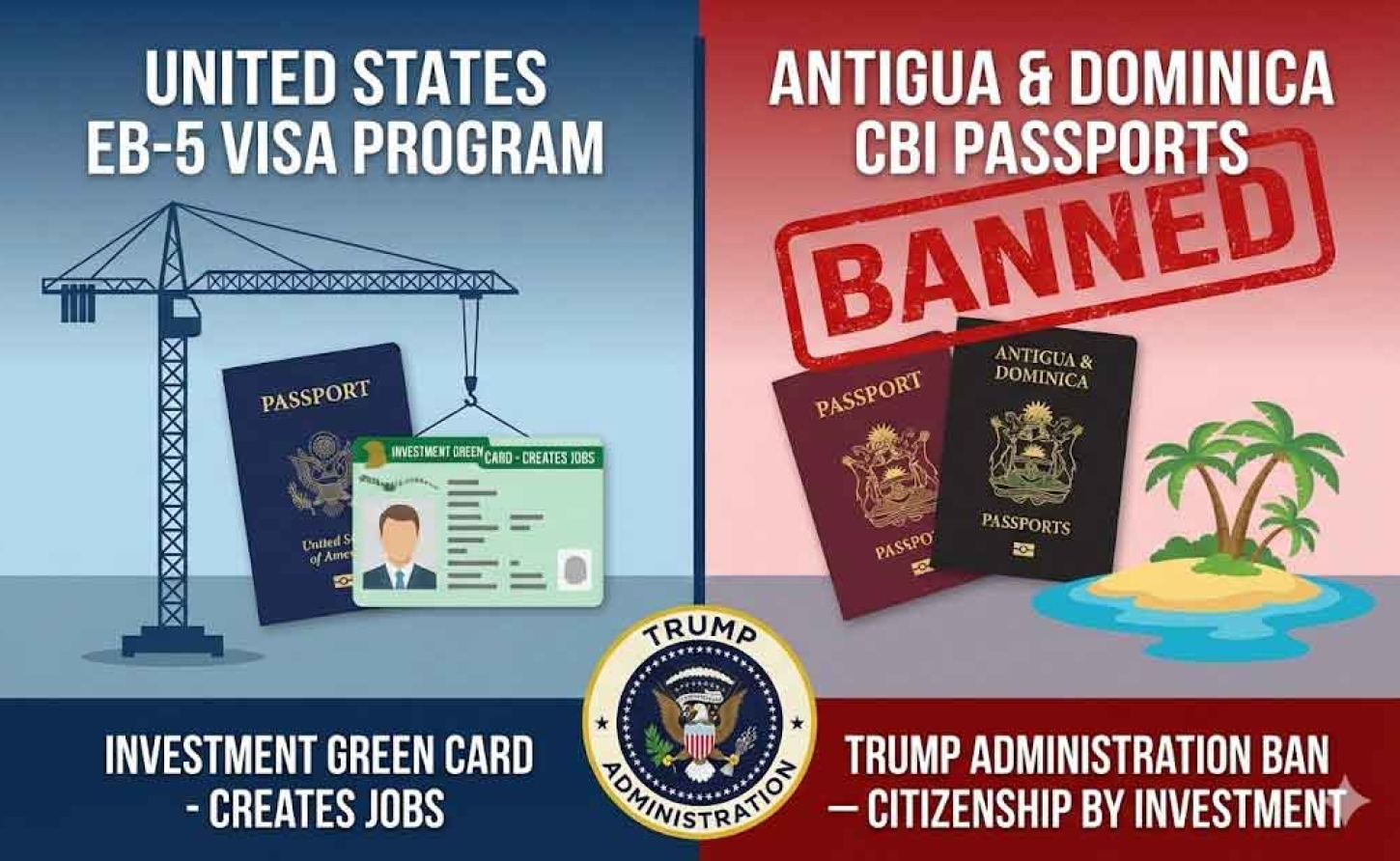
On December 16, 2025, President Donald Trump signed a proclamation that relegated Antigua and Barbuda and Dominica to a list of countries whose citizens face severe restrictions on entering the United States.
The measures, set to take effect January 1, 2026, place these two CARICOM nations—with their combined population barely exceeding 250,000—alongside countries like Syria, Niger, and Mali on Washington's expanded travel ban list. The stated justification? Concerns about their Citizenship by Investment programs.
The irony would be laughable if the consequences weren't so devastating.
The CBI Pretext: A Convenient Fiction
United States President Donald Trump
This framing presents Caribbean investment programs as security threats—shadowy schemes enabling nefarious actors to obtain alternative passports and bypass restrictions.
But strip away the national security rhetoric, and a uncomfortable question emerges: How exactly does this differ from what the United States itself has been doing for decades?
Enter the EB-5 visa program—America's own golden ticket to residency and citizenship. For investments ranging from $800,000 to $1.05 million, foreign nationals can purchase their way into US permanent residency, with a pathway to full citizenship after five years.
The program requires no prior relationship to the United States, no cultural ties, no language proficiency at the time of investment—just money. And while there are nominal "job creation" requirements, the program has been repeatedly criticized for fraud, abuse, and serving primarily as a mechanism for wealthy foreign nationals to buy American status.
So when Washington condemns Caribbean nations for offering citizenship through investment, it's worth asking: What exactly is the difference, beyond the price tag and the power dynamics?
One Rule for Giants, Another for Islands
The double standard is breathtaking in its audacity. The United States operates multiple investor visa programs—the EB-5, the E-2 treaty investor visa, various regional center programs—all designed to attract wealthy foreigners by offering residency and citizenship pathways in exchange for capital.
These programs have welcomed tens of thousands of foreign nationals, many from countries with far more complex geopolitical relationships with the United States than tiny Caribbean islands could ever present.
Yet when Antigua and Barbuda or Dominica—nations with economies smaller than a single American city's annual budget—operate similar programs to generate desperately needed development capital, suddenly it's a national security crisis requiring travel bans.
The message is clear: When powerful nations commodify citizenship, it's savvy economic policy. When small Caribbean nations do the same thing, it's a threat to global security.
The Questions Trump Won't Answer
Why these two nations specifically? What security threat do the citizens of Antigua and Barbuda—a country of roughly 95,000 people—pose that justifies lumping them alongside nations experiencing active armed conflicts? What intelligence failure or terrorist incident involving Dominican nationals necessitates these restrictions?
The proclamation offers no specific incidents, no pattern of security breaches, no documented cases of Caribbean CBI passports being used for terrorism or significant criminal activity.
Instead, it traffics in vague concerns about "information-sharing deficiencies" and "identity verification"—problems that could be addressed through diplomatic cooperation rather than collective punishment.
The broader pattern is impossible to ignore: This administration has consistently targeted Black and Brown majority nations while maintaining friendly relations with predominantly white countries operating similar programs.
The travel ban list reads like a map of the Global South, with Caribbean nations now joining African and Middle Eastern countries in facing American restrictions.
Sovereignty Under Siege
This is about more than travel restrictions. It's about whether small Caribbean nations have the right to manage their own economic development without facing punitive measures from a superpower that operates its own version of the exact programs it condemns.
CARICOM must respond with unified clarity: These restrictions are unacceptable, the double standards are transparent, and Caribbean sovereignty is not negotiable. If Washington wants to discuss CBI program standards, let's have that conversation—but let's include America's EB-5 program in the discussion.
Until then, the question remains: Whose security is really being protected here—or is this simply about reminding small nations who holds the power?
-30-
