CUBA | No Fuel, No Light, No Mercy: Cuba Turns to Solar as US Economic Warfare Deepens
CUBA | No Fuel, No Light, No Mercy: Cuba Turns to Solar as US Economic Warfare Deepens
And the Caribbean is being asked to help light the way
Somewhere in Havana tonight, a student is trying to study by the light of a solar lamp. Not by choice. By necessity. Cuba's power grid — already gasping before Donald Trump signed his Executive Order on January 29 — is now barely breathing, and for millions of ordinary Cubans, the sun has become not a symbol of hope, but a lifeline. The scramble is real, it is urgent, and it is heartbreaking in its ingenuity.
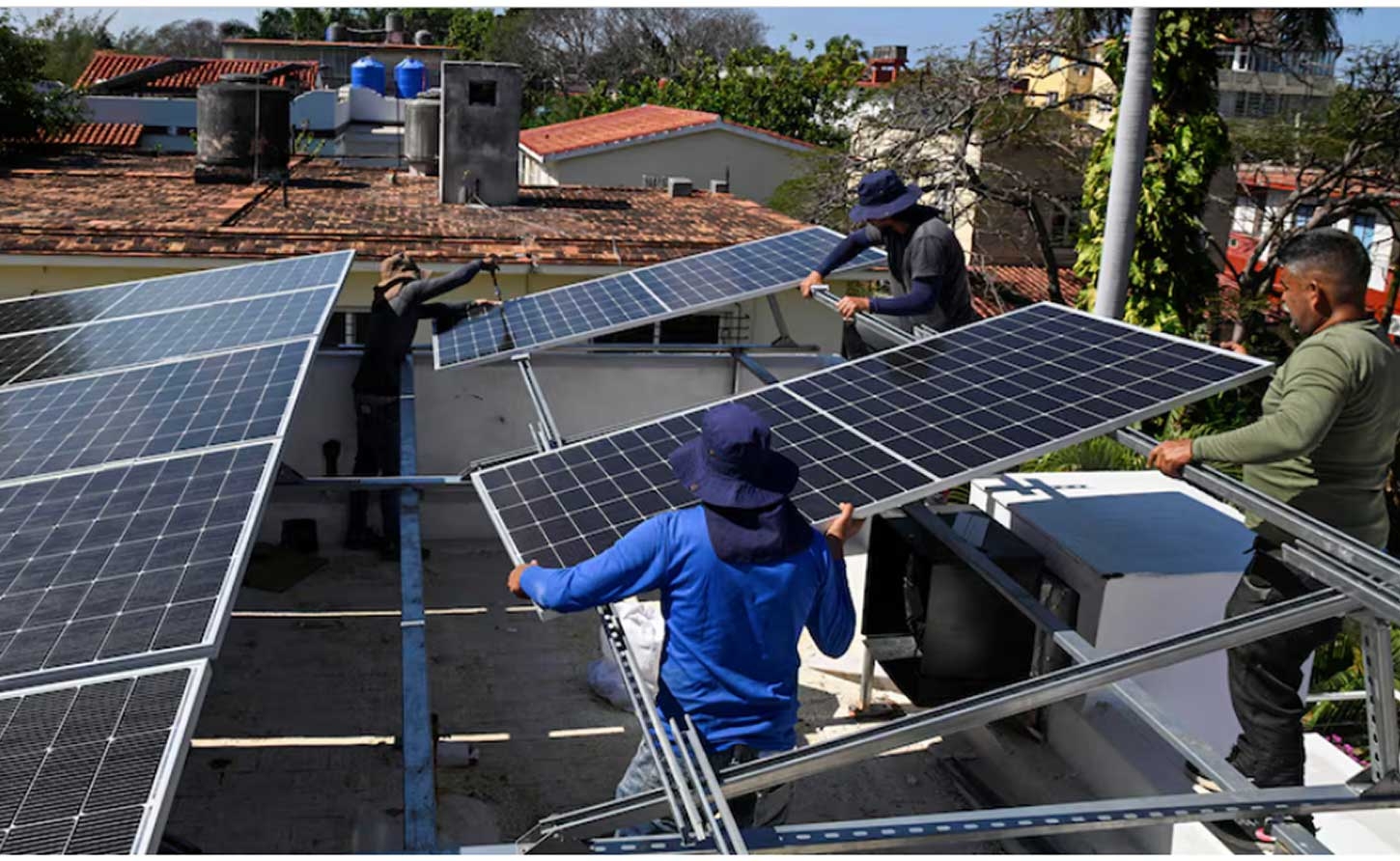
According to Reuters correspondents on the ground in Havana, Cubans who can afford it are rushing to install solar panels — on their rooftops, in their shops, and in one particularly striking image of Caribbean resourcefulness, on the roof of a tricycle-taxi.
Raydel Cano, a solar panel installer working across the Cuban capital, told Reuters that demand has exploded as fuel has dried up in recent weeks, rendering gas and diesel generators effectively useless. "Private businesses see themselves obligated to install panels," he said. The alternatives, he noted, have mostly become obsolete.
But here is the brutal irony: the panels are imported, sold in dollars, and far beyond the reach of most Cuban families. They remain the preserve of a small and growing class of private entrepreneurs and those lucky enough to receive remittances from relatives abroad.
For everyone else — including the children trying to read their textbooks after dark — the blackouts are just a fact of life. Extended, grinding, hope-sapping blackouts that can swallow most of the day.
This is why humanitarian organizations and concerned individuals across the Caribbean and its diaspora are now being called upon to step in where governments cannot. The ask is straightforward and urgent: donate solar panels, solar lights, and related equipment so that Cuban families — especially students — are not left entirely in the dark.
Every panel matters. Every solar light that reaches a child's desk is an act of defiance against economic cruelty.
Cuba's government, with Chinese financing and equipment donations, has installed over 1,000 megawatts of solar generation capacity in the past year and has pledged to double that figure. New measures announced just last week would waive personal taxes for up to eight years for entrepreneurs investing in renewable energy projects.
But government capacity only stretches so far when the fuel blockade tightens daily and the grid continues to falter. The gap between what the state can provide and what communities desperately need is precisely where solar donations can make an immediate, tangible difference.
The political context is impossible to separate from the human one. A group of former Caribbean Heads of Government — including former Prime Ministers of Jamaica, Trinidad and Tobago, Barbados, Grenada, Dominica, and St. Lucia, and the former President of Guyana — have issued a stinging joint statement condemning Trump's Executive Order as "economic warfare" and a "weapon of mass destruction" against 11 million civilians.
They have called on the international community to provide Cuba with desperately needed humanitarian assistance and urged Washington to rescind what UN Human Rights Experts have already declared a violation of international law.
Their statement carries the full weight of Caribbean history. It was in 1972 that the Prime Ministers of Barbados, Guyana, Jamaica, and Trinidad and Tobago defied hemispheric pressure to establish diplomatic relations with Cuba — an act of sovereign courage that defined Caribbean independence on the world stage.
For over five decades since, Cuba has stood with the region: sending doctors, offering scholarships, providing disaster relief, asking nothing in return. The former leaders' message is unambiguous: the Caribbean will not now look away.
The White House, for its part, is unmoved. Press Secretary Karoline Leavitt declared last week that it was in Cuba's "best interest to make very dramatic changes very soon." The UN has warned that if energy needs go unmet, a full humanitarian crisis is imminent. The island is already rationing food, fuel, and medicine.
Against that grim backdrop, solar panels are more than technology. They are resistance. They are the difference between a café staying open or shuttering, between a family eating a warm meal or not, between a child completing her homework or surrendering to the darkness.
If you can donate — panels, lights, equipment, funds — the time is now. Cuba cannot wait for Washington's mercy. History suggests it was never coming anyway.
-30-
