
NIGERIA | Christmas Missiles in the Sahel: When 'Saving Christians' Masks Strategic Desperation
![People gather at the site of the US air strike in Jabo Garin Maigari village in northern Nigeria [Reuters]](/images/2025/12/28/Jabo-Garin-Maigari-village-[Reuters]_large.jpg)
People gather at the site of the US air strike in Jabo Garin Maigari village in northern Nigeria [Reuters]
US strikes on Muslim-majority Sokoto State reveal Washington's scramble to maintain African foothold after regional expulsions
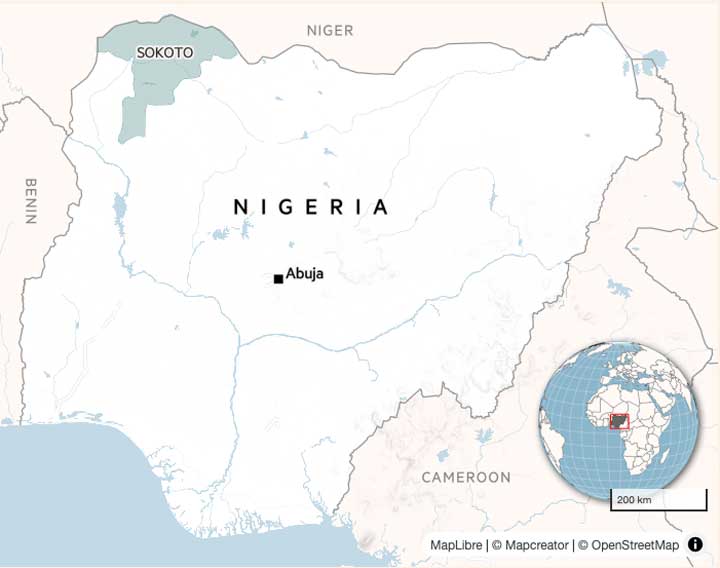
ABUJA, Nigeria, December 28, 2025 - Twelve Tomahawk cruise missiles streaked through the Christmas night sky over Sokoto State, northwest Nigeria, slamming into what US President Donald Trump called "ISIS Terrorist Scum" camps. The reality on the ground told a different story: residents of the predominantly Muslim village of Jabo watched projectiles hit empty farmland, causing no casualties in an area that hadn't seen militant attacks in two years.
"Glory be to God, there was no loss of life," one resident told Arise News, surveying burnt metal fragments scattered across fields. Trump's theatrical claim that strikes "decimated" terrorist camps targeting Christians "at levels not seen for many years, and even Centuries" dissolves upon contact with basic geography and data.
Sokoto State is more than 99 percent Muslim. The supposed epicenter of "Christian genocide" has virtually no Christian population to persecute.
PHOTO STORY: Relics of explosive materials in Jabo village of Sokoto State after the US precision strikes on ISIS terrorists in North-West West Nigeria late Thursday.
— LEADERSHIP NEWS (@LeadershipNGA) December 26, 2025
Villagers troop out to catch a glimpse and report no casualties. pic.twitter.com/hzfOsO8k8e
The Numbers Don't Lie
Armed Conflict Location & Event Data Project tracking reveals that between January 2020 and September 2025, attacks targeting Muslims in Nigeria killed 417 people compared to 317 Christians. Nigerian Foreign Minister Yusuf Tuggar explicitly rejected Washington's religious framing: "It is a regional conflict. It is not a Nigeria Christian-Muslim conflict."
Security analyst Victoria Ekhomu questioned why strikes targeted northwestern Sokoto rather than northeastern Borno State, the actual epicenter of Nigeria's armed insurgency. "If you're going to strike, then it should not be the least affected areas," she told AFP.
An Al Jazeera reporter captured the absurdity: "Sokoto State is probably the last place many Nigerians would think" Christian persecution is happening.
Yet Trump delayed the strikes one day specifically to "give a Christmas present" to terrorists, according to Politico—a detail exposing the operation's primary audience as American evangelicals, not Nigerian security.
The Sahel Strategy
US carries out airstrikes against Isis targets in north-west Nigeria
Since 2020, military juntas in all three countries have systematically ejected French and American forces. The Alliance of Sahel States formed in September 2023 represents a direct repudiation of Western military presence. France completed withdrawals from Mali (2022), Burkina Faso, and Niger (2023). The US abandoned its $100 million Agadez drone base—the largest in Africa—in August 2024.
Niger alone produces five percent of global uranium output, extracted primarily by French conglomerate Orano under contracts Nigerien officials describe as neo-colonial. Mali potentially holds some of the world's largest lithium reserves. The region's mineral wealth—gold, uranium, phosphates—combined with its geographic position makes it strategically invaluable.
Western counterterrorism operations paradoxically correlated with increased terrorism. Between 2011 (NATO's Libya intervention) and 2021 (Mali's first recent coup), Burkina Faso, Mali, and Niger soared from positions 114, 40, and 50 respectively on the Global Terrorism Index to 4, 7, and 8. Forty-three percent of all global terrorism deaths in 2022 occurred in the Sahel—after a decade of French Operation Barkhane and extensive US involvement.
Sokoto State itself contains phosphate deposits with uranium concentrations of 65 parts per million, comparable to commercially viable sources. Nigeria hosts identified uranium reserves in seven states, with exploration potential considered "favourable" by international mining assessments.
The Sovereignty Question
![People read newspapers reporting on US air strikes against ISIL (ISIS) fighters in Nigeria, according to US President Donald Trump and the US military, in Lagos, Nigeria, December 26, 2025 [Sodiq Adelakun/Reuters]](/images/tinabu-700.jpg)
People read newspapers reporting on US air strikes against ISIL (ISIS) fighters in Nigeria, according to US President Donald Trump and the US military, in Lagos, Nigeria, December 26, 2025 [Sodiq Adelakun/Reuters]
Former Nigerian official Princess Grace Iye Adejoh called the intervention an "indictment" rather than victory: "Foreign intervention of this magnitude is not a victory; it is an indictment. It tells the world that Nigeria is struggling to contain threats from within."
Nigerian analyst Auwal Musa Rafsanjani was blunter: "Muslims are being killed and harassed every day by the same criminals. This conversation should be about human life, not religion or geography."
One Nigerian commentator captured the broader pattern: "Foreign military intervention (especially America's) is more dangerous than any insurgency because it doesn't end at 'one strike.' It escalates. It embeds. It rebrands itself as 'security.' Then it becomes policy."
With the Sahel's resource-rich corridor now firmly aligned with Russia and China, Nigeria represents Washington's last significant foothold in the region. Trump's Christmas theatrics about protecting Christians obscure a more fundamental calculation: securing strategic positioning in a region where Western influence is collapsing.
The missiles that struck empty Sokoto farmland on Christmas night weren't aimed at ISIS camps. They were aimed at relevance.
-30-
