
CARICOM | Splitting CARICOM: Divide and Rule and the Secrecy Washington Demanded
CARICOM | Splitting CARICOM: Divide and Rule and the Secrecy Washington Demanded
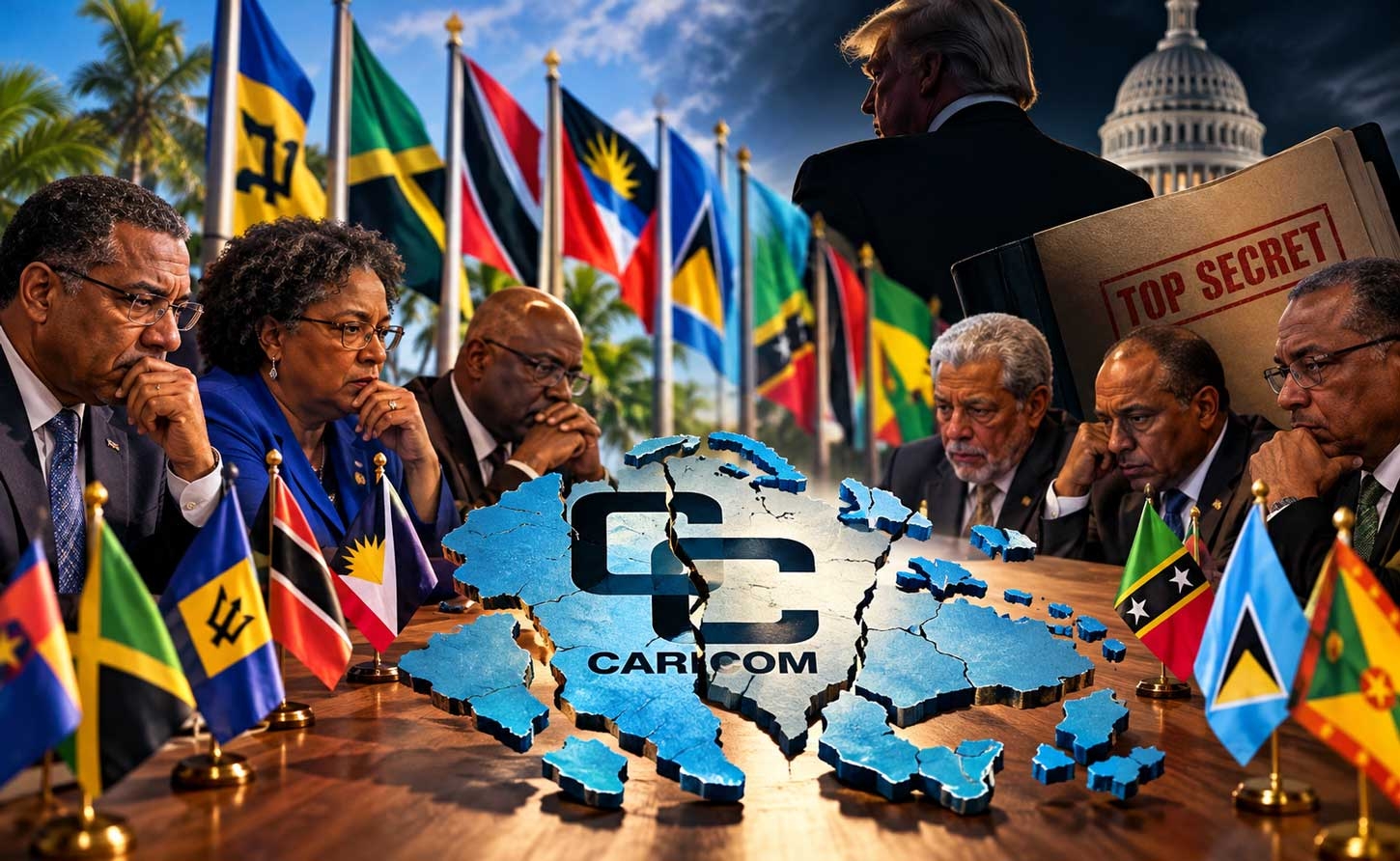
Every CARICOM state was handed its own deportee deal, in its own room, under its own seal. The Revised Treaty of Chaguaramas was written to stop exactly this.
MONTEGO BAY, Jamaica October 13, 2026 - Op Ed by Calvin G Brown | The planters of the Caribbean understood something about power that our governments seem to have forgotten. Control did not depend only on the whip. It depended on separation. Africans from the same nation were scattered across different estates. Movement between plantations required a pass. Drums were banned because drums carried messages. Gatherings were broken up. The enslaved were to be dealt with one estate at a time, each kept ignorant of what was happening across the cane fields, because people who cannot speak to one another cannot act together.
Nearly two centuries after emancipation, the method has returned, in a suit and tie, carried in diplomatic pouches. It is called the third-country nationals arrangement. And CARICOM is walking into it one member at a time.
Separate drafts, separate rooms
Look at how this was done. According to Antigua and Barbuda's Ambassador to Washington, Sir Ronald Sanders, every CARICOM member state received its own draft agreement from the United States, and at least five had signed by May. Not a regional proposal tabled before the Community. Not a framework negotiated with the Council for Foreign and Community Relations. Fifteen separate papers, delivered to fifteen separate capitals.
Then came the seal. In Jamaica, Foreign Affairs Minister Senator Kamina Johnson Smith said in July that talks with Washington would be needed before the memorandum of understanding (MOU) could be released, observing that agreements between two countries are "not usually released".
By September the Government had decided it would not be released at all. The Gleaner, in an editorial on September 22, put it plainly: the Americans want the document kept concealed, and Kingston has accepted that demand — after a Cabinet minister had promised in June that it would be made public.
The result is precisely what the planters would have wanted. When CARICOM heads of government met in St Lucia in July, Chairman Philip J. Pierre was asked about the region's position. His answer should alarm every citizen of the Community: "Right now, we are not clear." The leaders of fifteen nations had to agree, as a formal outcome of their summit, merely to share information with each other about what they had each signed.
Think about that. The region does not know what the region has agreed to.
People who cannot speak to one another cannot act together. The planters knew it. Washington knows it. Does CARICOM?
Fifteen hands, played alone
Kept apart, each state has settled for whatever terms it could extract alone. Antigua and Barbuda has spoken of about ten people a year, insists on approving every case individually, and refuses to accept anyone until compensation is secured. Jamaica has agreed to as many as 25 deportees every fortnight, with the first flight imminent and no published budget.
St Kitts and Nevis drew its own line by excluding Haitians. St Lucia agreed to take a handful. Dominica struck a deal on refugees. Guyana and Belize are named in Antigua's own White Paper among those that have signed or acknowledged MOUs.
Barbados, meanwhile, has not signed at all; as recently as January its Foreign Affairs Minister, Kerrie Symmonds, said Washington had not even approached it, and that it was in no hurry to be.
Each of these governments may believe it has negotiated well. But no one can judge, because no one can compare. That is the purpose of the seal. A small state that does not know what its neighbour obtained cannot ask for the same. A region that cannot see all the cards cannot play them together.
Washington is not short of money for these arrangements. A February 2026 report by Democrats on the US Senate Foreign Relations Committee found the Trump regime had paid more than US$32 million to five countries for roughly 300 deportees — US$7.5 million to Rwanda for seven people. Imagine what fifteen Caribbean states, negotiating as one, might have demanded.
What the Treaty requires
This is not merely a matter of good tactics. It is a matter of treaty obligation.
Article 6 of the Revised Treaty of Chaguaramas sets out the Community's objectives. Sub-paragraph (g) commits the region to achieving "a greater measure of economic leverage and effectiveness of Member States in dealing with third States". Sub-paragraph (h) commits it to "enhanced co-ordination of Member States' foreign and [foreign] economic policies". The United States is, in the language of the Treaty, a third State.
Article 16 gives the Council for Foreign and Community Relations — the region's foreign ministers — the job of making that real. Under Article 16(3)(b), it is to establish measures to co-ordinate the foreign policies of member states and seek Community positions on major hemispheric issues. Under Article 16(3)(e), it is to co-ordinate Community policy in close consultation with member states, in order to arrive at common positions in relation to third States.
And Article 9 binds every member to abstain from any measure that could jeopardise the Treaty's objectives. A secret bilateral deal, the terms of which a member will not disclose even to its partners, is difficult to reconcile with that undertaking.
The machinery for a common front exists. It was built for exactly this moment: a superpower, a contested demand, and small states that are strong together and weak apart. It has not been used.
The empty chair
There is a further fracture, and it runs through Port of Spain.
In December 2025, Trinidad and Tobago's Prime Minister Kamla Persad-Bissessar declared that CARICOM had "clearly lost its way" and was not a reliable partner. She has distanced her Government from regional statements critical of Washington, backed US military strikes in the region, and campaigned for the removal of the Secretary-General, reminding the bloc that Trinidad pays roughly 22 per cent of its budget. Former Foreign Minister Dr Amery Browne has noted that she had not attended a single in-person CARICOM meeting since her election.
On the deportee question, Port of Spain has been silent. Has Trinidad and Tobago received a US draft? Has it signed? Rejected it? The public does not know, and, it seems, neither do its partners.
Persad-Bissessar would argue, with some justification, that her first duty is to Trinidad and Tobago's security and its relationship with Washington, and that no treaty obliges her to follow a regional consensus she believes is wrong. That is her sovereign right. But when the anchor economy of the southern Caribbean steps away from the table, the leverage of everyone left at it shrinks. Divide and rule does not require the ruler to do all the dividing. It is easier when someone has already pulled up their chair.
The other side of the ledger
Fairness demands the counter-argument be heard. Immigration is a national competence; the Treaty does not forbid bilateral arrangements on it. Washington did not single out CARICOM — Antigua's Government has noted that more than a hundred countries were approached. And governments across the region argue, not unreasonably, that a quiet, capped yes protects visas, security co-operation and trade with the island's most important partner, at a time when the Trump regime has shown it will punish refusal.
There is a harder truth, too. Washington did not break CARICOM's door down. It found the door open. The Council for Foreign and Community Relations could have been convened the moment the first draft arrived. It was not. The region's leaders could have insisted on sharing texts before anyone signed. They did not. If this is divide and rule, the divided have been accomplices to their own division.
What must happen now
It is not too late. CARICOM should convene an emergency meeting of the Council for Foreign and Community Relations. Every member that has received a US draft should share it — and every signed MOU — with its partners. The region should agree a common floor: hard caps, funding secured before arrivals, proper criminal-record vetting, suspension triggers, and the right to refuse. And each government should commit to tabling its agreement in its own Parliament.
Antigua has already shown that a small state can negotiate with Washington in the open, through a White Paper and a parliamentary resolution, and still be taken seriously. What one island can do, fifteen can do with far greater force.
Talking across the estates
The plantation system did not fall because the planters relented. It fell, in part, because the enslaved found ways to talk across the estates. Sam Sharpe's Christmas Rebellion of 1831 was organised across western Jamaica through networks the planters could not see and could not break. Coordination was the weapon the system feared most.
The Revised Treaty of Chaguaramas was meant to institutionalise that lesson: that Caribbean people, scattered across small islands, are only strong when they speak to one another. Washington's secrecy is a test of whether we still believe it.
Our governments should stop whispering separately to Washington and start talking openly to each other. The planters are long gone. Their playbook, it seems, is not.
— 30 —
