
OP-ED | Even Kamla's Critics Don't Blame Race for Her CARICOM Quarrel
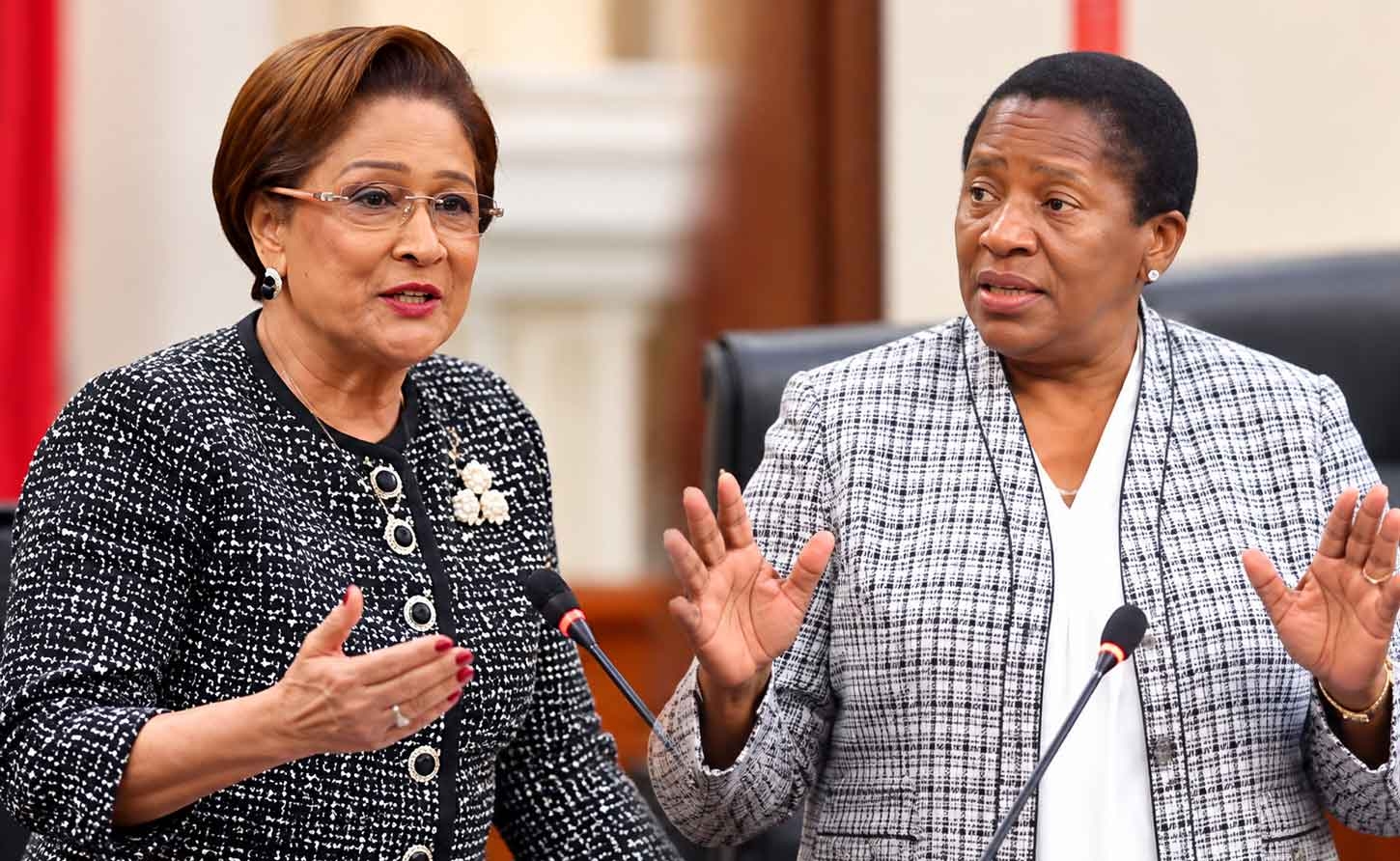
UNC leader and prime minister Kamla Persad Bissessar and The Opposition Leader of Trinidad and Tobago the PNM's Pennelope Beckles-Robinson
Race built Trinidad and Tobago's two-party system, and the 2025 election cracked its arithmetic without dissolving it. But Kamla Persad-Bissessar is not edging out of CARICOM — she is in, defiant and threatening to pay less — and no one on the record, including her fiercest opponents, says race is driving her regional policy. Reading it that way lets the region off too lightly.
TRINIDAD AND TOBAGO, October 16, 2026 - By Calvin G Brown | On Wednesday 15 April 2026, Kamla Persad-Bissessar posted a statement to her official Facebook page with a screenshot attached. It showed the WhatsApp group CARICOM's foreign ministers use to talk to one another.
“The leadership at Caricom, particularly at the Secretariat, is dysfunctional, dishonest and incompetent,” she wrote. The reappointment of Secretary-General Dr Carla Barnett had been “surreptitious, corrupted and flawed”.
Then the line that matters. Trinidad and Tobago, she said, “will not be exiting the organisation”. “We helped build this organisation and will be a part of fixing it to benefit all the people of CARICOM.”
I came to this story with two questions. Does the old Afro–Indo divide still govern Trinidad and Tobago's two-party system? And is a Prime Minister whose party, in a Trinidad Express editorial's words, “draws most of its support from Indian-descent voters” hesitant about CARICOM because of it?
The second has a plain answer. She is not hesitant. She is in, she is defiant, and she has threatened to pay less. And I found no one on the record — not her government, not the People's National Movement, not a regional head of government, not an academic, not an editorial writer — who argues that ethnic electoral politics drives her regional policy.
The first question is harder, because in Trinidad and Tobago race is so often the right answer.
The floor race laid
Indentured immigration from India ran from 1845 to 1917. By the 1958 federal elections the pattern was visible: the Democratic Labour Party took six of Trinidad's ten seats — mostly, the US Library of Congress country study records, where East Indians held an absolute majority.
The one great cross-ethnic experiment did not last. The National Alliance for Reconstruction took 33 of 36 seats in 1986. “Its ethnic unity was short-lived, however,” the political scientist Ralph Premdas wrote; by 1991 the NAR held two seats, both in Tobago. After the PNM and the United National Congress tied 17–17 in 1995, Premdas concluded that “to an overwhelming degree, ethnic identity determined voter choice”.
A generation on, the pattern was still measurable. Setting the 2020 results against 2011 census data, the pollster Nigel Henry found “a 92 per cent correlation between the proportion of Afro-Trinidadians in each constituency and the PNM's vote share”, and 98 per cent between the Indo-Trinidadian share and the UNC vote — both for Trinidad only. That is a pattern across constituencies, not a count of individual ballots.
Underneath sits near-parity. The 2011 census counted 35.4 per cent East Indian and 34.2 per cent African; the Mixed–African/East Indian category, popularly called “dougla”, was 7.7 per cent of the whole population. There has been no census since, so every ethnic share quoted today is 15 years old. An Express editorial in the 2025 campaign drew the consequence: “The country's demographics mandate that both major parties must get votes across racial boundaries to win office.”
2025: the floor held, the walls moved
On 28 April 2025 the UNC won 26 seats, the PNM 13 and the Tobago People's Party two. The Elections and Boundaries Commission's published report puts the UNC on 54.04 per cent and the PNM on 36.19, on a turnout of 53.93 per cent — down from about 58 per cent in 2020.
The UNC held all 19 of its seats and took seven from the PNM. Two of them, Point Fortin and La Brea, had been PNM since 1961 except for the 1986 landslide. Trade unionists won both; in Point Fortin the OWTU's Ernesto Kesar pointed to the “shutdown of Trinmar and Petrotrin”. No public source gives the ethnic make-up of either seat. The honest description is “historically PNM”.
Whether PNM voters crossed over or stayed home is disputed. “The base did not shift. It wasn't that they went to the UNC,” said the political scientist Dr Bishnu Ragoonath, blaming the party's “disrespecting the rank-and-file membership in the selection of the Prime Minister”. Dr Shane Mohammed said both happened: “Some angry, traditional PNM voters withheld their ballots, and swing voters turned to the UNC.”
The Commission's own figures lean toward Mohammed. On WiredJA's reading of the EBC's 2020 preliminary and 2025 results, turnout fell, the PNM vote fell and the UNC vote rose in all seven flipped seats. About 7,600 fewer votes were cast there than in 2020, but the PNM lost about 19,200 and the UNC gained about 10,000. Abstention alone does not cover that gap — though aggregates cannot prove that any individual switched. Turnout also fell sharply in PNM safe seats: Laventille West went from 43.7 to 35.20 per cent.
A Guardian Media poll of 10–13 April 2025, analysed by Professor Hamid Ghany, had 20.5 per cent of Afro-Trinidadian respondents in Trinidad backing the UNC coalition, against 55 per cent for the PNM. No sample size was published, and a poll is not a result. But the UNC went into the vote with a fifth of Afro-Trinidadian respondents behind it.
The PNM's own explanation is not about race. Its post-mortem found the party “disconnected” from the ground, and I found no post-mortem statement blaming race. Tobago, meanwhile, has long sat outside the two blocs — the DAC took its seats in 1976 and 1981 — and in 2025 the PNM lost both Tobago seats to the TPP, with the UNC fielding no one there.
So my answer to the first question: the divide still sets the floor of Trinidad and Tobago's politics, but it no longer decides elections by itself. In 2025 the oil-belt seats went to trade unionists campaigning on lost jobs, part of the PNM's base sat on its hands, and Tobago went its own way, as it has before.
Governing with race in the room
The floor has been loud since. During the campaign Stuart Young, then Prime Minister and PNM chairman, accused the UNC of “using black Trinidadians to try and sell this because they think we are stupid”. In office, Persad-Bissessar wrote on X during the first state of emergency that “the PNM -an Afro-dominated party- continues to block action by the security services”. After the Senate threw out the government's ZOSO crime bill on 27 January 2026, her Minister of Public Utilities, Barry Padarath, said: “The race card has been played cynically and irresponsibly.”
On 11 June the PNM's Kareem Marcelle told a party meeting in Laventille West, where he is MP: “They hate African people, they hate black people, they hate people from Beetham.”
On 31 August she sent an Independence message to her “UNC family” about enduring “lagoons, cane fields and oilfields” under the PNM. Keith Rowley, the former prime minister, called it “naked racism and the worst form of divide and rule”. She replied: “Rowley needs to stop behaving bitter like a jammette (not the expensive kind) who can't get customers.” Vijay Maharaj, Secretary General of the SDMS, said: “I don't think it's appropriate at any point in time to appeal to one racial group.”
That is how this government governs — with race in the room, and the Prime Minister's own words among those filling it. Nobody in that ledger comes out well.
CARICOM: where the lens fails
Set beside all that, the CARICOM record is striking for what it lacks.
The break began with Washington. After the first US strike on an alleged drug boat in September 2025, she said “the US military should kill them all, violently.” At the UN she said the notion of a Caribbean “zone of peace” “has become a false ideal”. On 18 October CARICOM heads reaffirmed it, “Save in respect of Trinidad and Tobago who reserved its position.” Venezuela then suspended a gas agreement — Maduro cited Trinidad and Tobago's reception of a US warship — and its National Assembly declared her persona non grata. In December she called CARICOM “not a reliable partner at this time”.
The second grievance is electoral. When Gonsalves, then St Vincent's prime minister, alleged UNC interference in his country's November 2025 election, she answered on 21 November that, with prime ministers interfering in other states' elections, “it is only a matter of time before Caricom implodes”. She repeated the charge at the St Kitts summit in February, and on 15 April complained that key CARICOM posts go to “friends, party hacks, relatives of politicians and affiliates of regional sister parties”. Those are partisan grievances. They are not ethnic ones.
Heads reappointed Barnett at a retreat after she left St Kitts on 25 February. Her Foreign Minister, Sean Sobers, was not there either. Trinidad and Tobago says he was “disinvited” by a WhatsApp message to the foreign ministers' group — the chat she would screenshot in April. CARICOM says he never confirmed attendance.
In March she told the Express: “Trinidad and Tobago is not going to continue funding Caricom at the current levels that we are providing.” By her government's figure it pays 22 per cent of the budget, which the Express called the largest share. By the account of CARICOM's then chair, Dr Terrance Drew — an interested party — no Trinidad and Tobago representative attended the emergency heads meeting of 10 April, though it had been called on Trinidad and Tobago's concerns. In May: “They are free to expel us from CARICOM if they wish to do so.”
In July a 22-page letter argued that only 10 of 15 states approved the reappointment, short of the 12 she says are required — “It is neither personal nor political.” Heads agreed to seek an advisory opinion from the Caribbean Court of Justice. “I have always said Trinidad and Tobago remains committed to CARICOM,” she said on 8 July. A Gleaner editorial said in August that her government had “raised the prospect of reducing its financial contribution to the secretariat” and would abide by the court's opinion. WiredJA found no report of a cut; the CARICOM line in the FY2027 budget, presented on 12 October, has not been checked.
Her stated reasons are consistent: trafficking, Venezuela, the US alliance, illegal migration — her reason for deferring free movement — Secretariat governance and election interference. India appears twice: in a list of trade partners, and in May, when her government's representatives cited a visit by India's External Affairs Minister, Dr S. Jaishankar, together with parliamentary business, for her and Sobers' absence from a virtual CARICOM meeting. Neither carries ethnic framing.
Her critics do not reach for race either. “This is the first time this country has had a Prime Minister who is overtly against the Caribbean Community,” said the PNM's Dr Amery Browne. The Express blamed “her penchant for mimicking American President Donald Trump”. The nearest exception is Rowley: “She undermines the reparation effort at CARICOM with her most recent foolish drivel.” That sets a race charge beside a CARICOM charge. It does not claim ethnic politics drives her regional policy — and Rowley, a former PNM leader, is an interested party.
Guyana is the control case. President Irfaan Ali faces the same neighbour — “Every single day, the Venezuelan government attacks me personally, attacks this country” — yet kept the zone-of-peace frame and did not reserve in October 2025. Guyana did join Trinidad and Tobago in reserving on a May 2026 foreign ministers' statement on Cuba, but on the zone of peace and on CARICOM itself, same threat, different posture.
What the race lens gets wrong
What follows is my view. Reading her CARICOM policy as an ethnic project would be a reflex, not a finding. It is also a convenient reflex for the region: a quarrel dismissed as tribal is a quarrel nobody has to answer.
The heads did not treat it that way. They agreed to ask the CCJ for an advisory opinion on the Barnett reappointment. Jamaica wrote on 5 July that it was “not by this letter seeking to overturn the decision taken in February 2026” — but said the February process “constituted a departure from not only previous practice, but from the Rules of Procedure established by the conference”, and that it “has neither resolved the matter nor promoted the spirit and goals of the Revised Treaty of Chaguaramas”. Kingston, in other words, accepted that Port of Spain had a point on procedure.
None of that excuses her method. Siding with Washington against the regional consensus, arguing by screenshot and by threats to the budget, has coincided with a suspended Venezuelan gas deal and, on Drew's account, an empty chair at a meeting called on her own concerns. Professor Andy Knight has asked the question she has not publicly answered: “The real question is what Trinidad and Tobago obtains in substantive policy terms.”
What CARICOM should take from this is narrower and harder. Answer the governance complaint through the court the heads have already chosen. Answer the security argument on its merits. And leave the race reading where the evidence puts it — in Trinidad and Tobago's ballot boxes and its domestic quarrels, where her own words are part of the record too.
-30-
