
DIASPORA | Carrot, Cudgel and the Closing Door: The Fading Mystique of the US Visa
DIASPORA | Carrot, Cudgel and the Closing Door: The Fading Mystique of the US Visa
For generations, a US visa stamp was a passport to prestige across the Caribbean. Under the Trump regime it has become both bribe and bludgeon — and a growing number of travellers, and even Americans themselves, are deciding the price is too high.
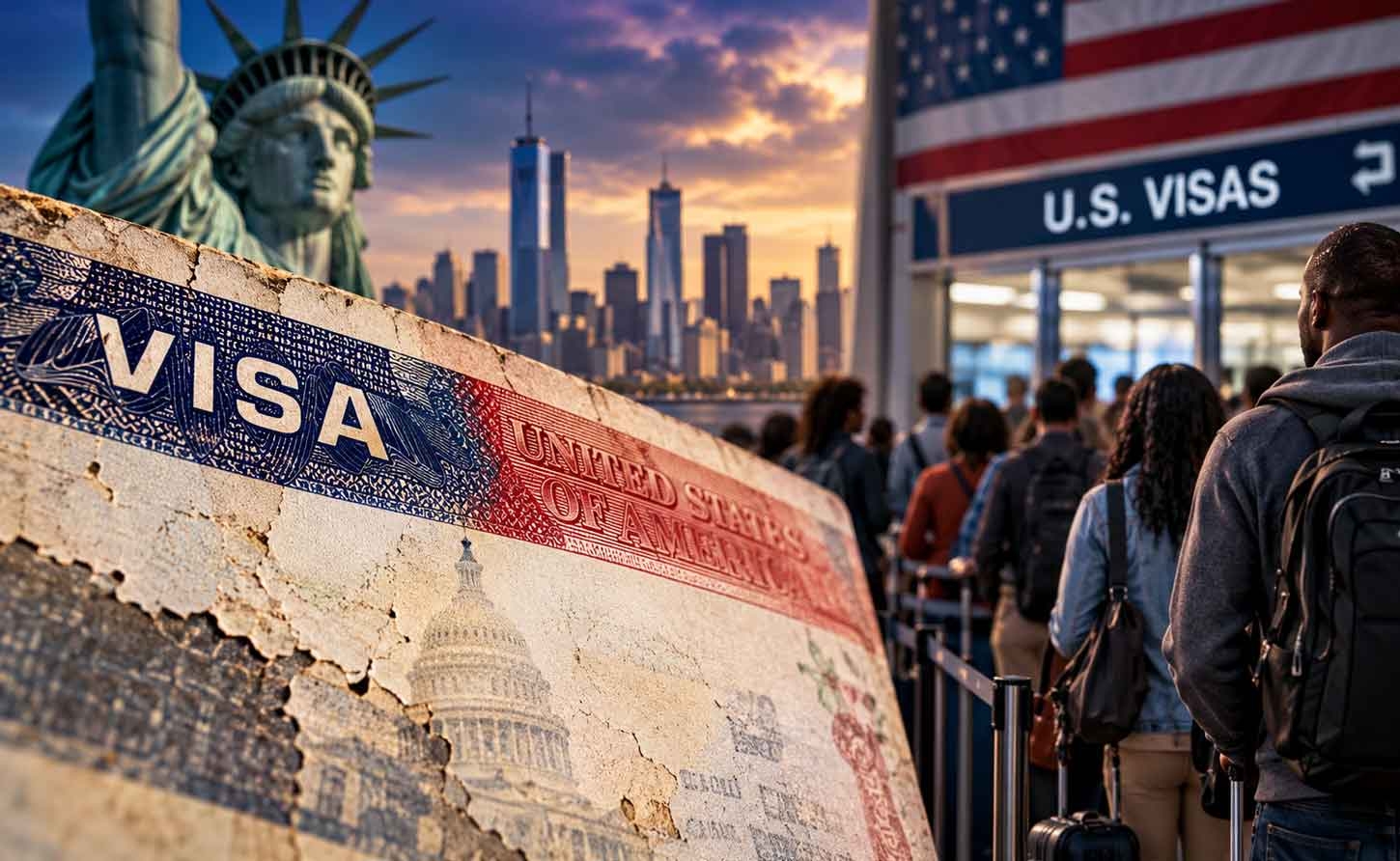
MONTEGO BAY, Jamaica, October 5, 2026 - Calvin G Brown | Stand on Old Hope Road before the sun has cleared the Blue Mountains and you will see it: the queue. Shirts ironed the night before, folders of bank statements clutched like scripture, job letters, land titles, a pastor’s reference for good measure.
Few documents in Caribbean life carry the quiet authority of that small, foil-stamped page. It has been proof of respectability and the ticket to the wedding in Brooklyn, the graduation in Atlanta, the funeral in Fort Lauderdale. Grant it, and a man walks taller in his district. Revoke it, and the whisper travels faster than any newspaper. Washington has always understood the power of that whisper.
Carrot in one hand, cudgel in the other
Let us be fair: the visa as an instrument of statecraft did not arrive with Donald Trump. Administrations of both parties have dangled it and withdrawn it. Corruption designations have barred officials across the hemisphere, while entry to the Visa Waiver Program has been handed out as a reward to favoured allies — Israel’s admission in 2023, under a Democratic president, being only a recent example.
What the Trump regime has done is swing the cudgel with fewer apologies and a wider arc.
In February 2025, Secretary of State Marco Rubio expanded visa restrictions to reach foreign government officials deemed complicit in Cuba’s overseas medical programme — the very doctors and nurses who helped carry this region through COVID-19. Washington’s case is that the programme enriches Havana and amounts to forced labour. The Caribbean’s most memorable reply came from Barbados, where Prime Minister Mia Mottley told Parliament she was prepared to lose her own visa rather than abandon the Cubans. For once, the threat of a cancelled stamp met a leader who refused to blink.
The door narrows
Then came the bans. Haitians now face a full suspension of visas. From January 1, 2026, Antigua and Barbuda and Dominica joined the list of partially restricted countries, their citizenship-by-investment programmes treated as a security weakness. Critics, including researchers at the London School of Economics, have warned that such passports can become a back door. Both governments have pushed back, with Dominica suggesting the move may reflect miscommunication within Washington itself.
For those still allowed to apply, the price of admission keeps climbing. A new $250 Visa Integrity Fee lifts the cost of a standard visitor’s visa to roughly US$435. A pilot programme demands refundable bonds of $5,000 to $15,000 from applicants from designated countries — a deposit that, across much of the Global South, exceeds a year’s wages, simply to be trusted to go home.
A visa wielded as a cudgel teaches the region that respect is not a stamp in a passport.
Voting with their wallets
Here is the twist the architects of this policy did not anticipate: people have choices, and they are making them.
International visits to the United States fell 5.5 per cent in 2025 to 68.3 million — the first decline since the pandemic — even as global tourism grew. In April 2026, overseas arrivals plunged 14.1 per cent, in a year meant to belong to the World Cup and America’s 250th birthday. Caribbean travel to the US slipped 3.4 per cent in the first five months of 2026, with analysts pointing to higher costs, tighter visa procedures and stronger regional competition.
Consider the humble shopping run. For generations, island people flew to Miami or New York not to marvel at the empire but to raid its bargain racks — school uniforms, sneakers, a fridge shipped home in a barrel. That arithmetic no longer works. When the visa alone costs US$435 before a single shirt is bought, the empire is no longer a bargain, and the shine comes off with the price tag.
Meanwhile, the Canadian dollars that once flew to Florida are landing in Cayman, Jamaica and the Dominican Republic. Money, like water, finds the path of least resistance — and least humiliation.
A proud people, not supplicants
Underneath the visa debate lies an old and insulting assumption: that the Caribbean traveller is a would-be dependant, angling to stay and live off the American state. The record says otherwise.
My own paternal grandfather, M.G. Brown, was of that breed. In the 1920s he left Jamaica, where he wore the stripes of a police corporal, for the textile trade of Manhattan’s garment district. Like so many Jamaicans before and after him, he saw America as a land of opportunity unlike any other — and he was not naïve about it. The racism of that era was rampant and open. He held his nose, tolerated the bad smell, worked, and raised a family. My father was one of his three children born in Harlem — American by birth, every one of them. And yet they all came home to Jamaica. Endurance was the price of the opportunity, never an acceptance of the insult. Men like him helped to build America; they did not take from it, and they were proud of what they gave. America was where he earned; Jamaica was where he belonged.
Caribbean people go north to work. They stay as long as there is a decent job, and they send the money home. Jamaicans abroad remitted a record US$3.49 billion in 2025, two-thirds of it from the United States, a flow worth more than 15 per cent of GDP and larger than tourism receipts. That is not the profile of a people seeking handouts. It is the profile of a people carrying two economies on their backs.
The irony is sharp. On the eve of the November midterms, Mr Trump dangles a one-off US$5,000 “Trump Dividend” before American citizens — payable, he says, if voters keep his party in control of Congress. Call it what it looks like: filthy lucre for the ballot box. In the same breath, his regime courts millionaires with multimillion-dollar residency cards. The Caribbean migrant never came for a cheque. He came for wages, and he built the barrel culture, the remittance lifeline and much of the diaspora’s quiet prosperity with them. Proud, self-reliant and resilient, he was always a bargain for America — more than America has lately been for him.
Americans heading for the exit
The most striking shift, however, is on the other side of the counter. Americans themselves are reconsidering the bargain.
Some 4,889 people renounced US citizenship in 2025, and 1,781 more did so in the second quarter of 2026 alone, putting this year on pace to challenge the 2020 record. Last November, one in five Americans told Gallup they would like to move abroad permanently. Many renunciations are driven by America’s habit of taxing citizens wherever they live, and wishing to leave is not leaving. But the direction of travel is unmistakable.
Blaxit and the long road home
For Black Americans, the conversation carries a deeper ache. Ghana has spent years inviting the diaspora to come home — through the Year of Return in 2019 and Beyond the Return since. In November 2024, 524 members of the diaspora, mostly Black Americans, were granted Ghanaian citizenship in a single ceremony. Nigeria and Senegal are courting the same longing. Across Africa’s 54 nations, the welcome mat is being dusted off.
The numbers are still hundreds, not hundreds of thousands, and returnees will speak frankly of land disputes, bureaucracy and the gap between dream and dusty road. Yet the symbolism is seismic. Descendants of those carried out through the Door of No Return are walking back in by choice, while the country that claimed them argues over who deserves to enter at all.
The queue is shorter, not gone
None of this makes the American visa worthless. The line on Old Hope Road will form again tomorrow; the diaspora ties are too deep, the opportunities too real. But the mystique — that sense of a door to paradise guarded by benevolent gatekeepers — is fraying.
A visa wielded as a cudgel teaches the region a lesson Washington may come to regret: that respect is not a stamp in a passport, and that the Caribbean, with its own shores, its own ancestral Africa and its own options, can learn to say “no, thank you.”
The mystique was always borrowed power. It is now being repaid — with interest.
— 30 —
