
JAMAICA | History cannot be rewritten in Jamaica’s Parliament
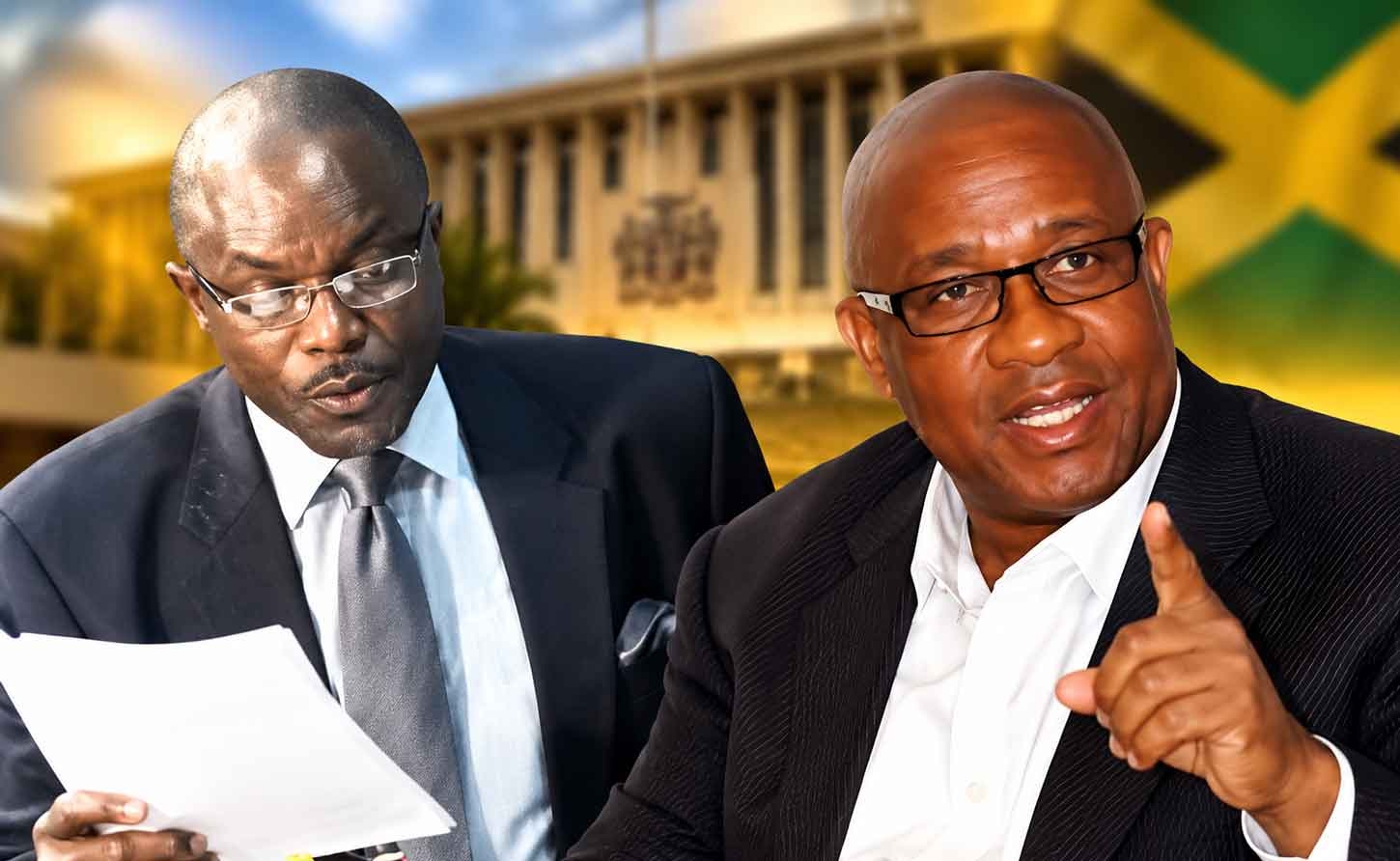
From left, JLP Member of Parliament for Southwestern, St. Catherine C. Everald Warmington and Ambassador General Global Afrikan Congress Cikiah Thomas
LETTER TO THE EDITOR, WIREDJA
THE EDITOR, Sir:
The Global Afrikan Congress (GAC) writes in response to statements made in the House of Representatives by C. Everald Warmington, Member of Parliament for St Catherine South Western, during debate on Jamaica’s petition to His Majesty King Charles III and its referral to the Judicial Committee of the Privy Council.
This is not a quarrel between political parties. Our concern is history, truth, the dignity of millions of African and African-descended people, and Jamaica’s responsibility to understand its own past and pursue justice.
What was said
Mr Warmington told the House: “My roots are here in Jamaica and not in Africa.” He described the Government delegation’s recent visit to London — a mission of his own Jamaica Labour Party administration — as an embarrassment, saying: “I’m embarrassed at the spectacle of the photo ops in London.” Likening the mission to the nursery rhyme Pussycat, Pussycat, he concluded: “I left a petition on the empty chair.”
Turning to substance, he said: “We keep on speaking of the buyers of the slaves, but nobody speaks of the sellers of the slave.” He went on: “The white man didn’t go to Africa and pick up enslaved people and take them across here. They were caught by black people who sold them to the white man to come here.” He asked why Jamaicans speak of “the white man who bought the slaves” but not “the black man in Africa who sold the slave to the white man”, adding: “They didn’t go there and catch slaves.”
The problem with that account
The GAC respects Mr Warmington’s right to his own interpretation of history. But that interpretation echoes a colonial framing long used to deflect European responsibility, and no parliamentarian has licence to rewrite the historical record.
The problem is not that he raised African involvement in the slave trade. It is that he reduced an enormously complex system — European invasion, military coercion, commercial expansion, warfare, forced transportation, plantation enslavement, colonial law and racial ideology — to a simple transaction between African sellers and European buyers.
That market did not arise on its own. European demand created it, European credit financed it, and European firearms and trade goods fuelled the wars and raids through which millions were captured. Much of what is described as “selling” took place under duress, in conflicts that European traders inflamed and armed. To present it as an ordinary exchange between equal parties is not only inaccurate; it reflects how deeply some of us have internalised the coloniser’s version of our own history.
The trade cannot be understood by asking only who physically captured an individual and who paid for that person. Larger questions must be asked:
- Who created the enormous transatlantic demand for enslaved labour?
- Who organised the Atlantic commercial system built on African labour?
- Who financed and insured the voyages of European ships and their human cargoes?
- Who controlled the ships and shipping networks?
- Who established and protected the plantation economy?
- Who wrote the colonial laws that defined Africans and their descendants as property?
- Who accumulated wealth from the system — and where is that wealth today?
- Who defended slavery through colonial governments and legislatures?
- Who maintained the system through military and imperial power?
None of these questions can be answered by saying that Africans sold Africans.
African participation in context
Participation is not the same as consent, and coercion is not the same as voluntary responsibility. European powers built fortified trading posts, commercial networks and military alliances along the African coast and steadily penetrated African political and economic systems. African societies resisted; many were devastated in the process, and countless Africans were killed. Others were compelled at gunpoint to supply captives.
Where Africans collaborated in exchange for European goods, that conduct deserves study in its specific historical circumstances. None of it, however, absolves the European powers that turned the trafficking of human beings into a vast transatlantic commercial and plantation system.
The House itself drew this distinction. Responding to Mr Warmington, Damion Crawford, MP, contrasted African involvement, which was not state-sanctioned, with a British trade sanctioned by Parliament and enforced by law and state policy. That distinction deserves serious consideration. The real issue is the structure of power that created, institutionalised and sustained racialised chattel slavery — a system whose effects persist today in economic inequality, underdevelopment, and the collective psychology and self-esteem of African-descended people.
Read Britain’s own record
Before making further pronouncements, we urge Mr Warmington to read the British parliamentary record: the debates on the slave trade, the Parliamentary Papers, the testimony on slavery, and the debates on abolition and emancipation. He will find British parliamentarians discussing British merchants, British ships, British capital, British plantations and colonial legislation. This history need not be reconstructed from the writings of African-descended activists alone. Britain’s own archive speaks volumes, and every Jamaican has a right to read it.
Who controlled the system
The GAC has no interest in replacing one simplistic history with another. We reject both the denial of African agency and the denial of European imperial responsibility. Mr Warmington’s intervention placed extraordinary weight on African sellers while removing from view the Crown, the state, and the military, commercial and legal structures that made the Atlantic system possible at the scale it reached and sustained it for centuries. A system with many participants can still have identifiable centres of power. That is why Britain’s responsibility cannot be dismissed by pointing to African involvement.
A legal question, properly put
Mr Warmington called the petition an embarrassment. It is unclear what is embarrassing about asking a court to answer legal questions. The petition, filed on September 7, 2026, asks whether the seizure, transportation and enslavement of Africans in Jamaica was ever lawful under English law; whether it was, and is, a breach of international law; and whether the United Kingdom is legally obliged to provide a reparatory remedy to the people of Jamaica. The King has since referred those questions to the Judicial Committee of the Privy Council.
One may disagree with the Government’s strategy, question the petition’s legal basis, or argue for another course. None of that justifies reducing its historical foundation to the claim that Africans sold Africans. The matter is now before a court, and the least a parliamentarian can do is allow due process to take its course and the evidence to be heard.
The weight of a parliamentarian’s words
Mr Warmington has served many years in Parliament. When he speaks in the House on Africa, slavery and Jamaica’s history, he speaks not as a private citizen but as a representative of the people, and his words travel across Jamaica, the Caribbean, Africa and the diaspora. Millions of African-descended people still live with the consequences of the slave trade, plantation slavery, colonialism and anti-Black racism — in employment, housing, policing and beyond. Remarks that offer a distorted account as the principal explanation for one of history’s greatest crimes deserve to be challenged.
What we ask
The GAC calls on Mr Warmington to take two steps.
First, correct the record and apologise. Acknowledging that his remarks gave an incomplete and misleading account of the transatlantic trade and plantation slavery would not diminish him; it would restore respect. Only the intellectually and politically secure can correct themselves.
Second, undertake what we call historical self-repair. The answer to colonial miseducation is not another slogan but reading, research, comparison of sources and serious study. We suggest he begin with:
- Eric Williams — Capitalism and Slavery
- Walter Rodney — How Europe Underdeveloped Africa
- Walter Rodney — The Groundings with My Brothers
- Hilary Beckles — Britain’s Black Debt: Reparations for Caribbean Slavery and Native Genocide
- C.L.R. James — The Black Jacobins
- Hugh Thomas — The Slave Trade: The Story of the Atlantic Slave Trade, 1440–1870
- Olaudah Equiano — The Interesting Narrative
- Mary Prince — The History of Mary Prince
- Richard Hart — writings on Jamaican slavery, resistance and emancipation
- Kamau Brathwaite — writings on Caribbean society and colonial history
- Derek Walcott — poetry and essays on Caribbean history, colonialism and identity
- John Henrik Clarke — writings on African and African-diaspora history
— together with the original British parliamentary debates and papers on the slave trade, slavery and emancipation. Read the evidence; then make the argument.
The GAC stands ready to help. Through our networks in Canada, we can seek the participation of scholars in history, Black studies, African studies and Caribbean studies, including educators associated with Dalhousie University, the University of Toronto and Toronto Metropolitan University, and can identify accessible online courses elsewhere. This is not an attempt to dictate Mr Warmington’s politics, but a sincere offer to ensure that when he speaks on this subject, he speaks from evidence.
Jamaica deserves better
The history of African enslavement is not someone else’s history. It is Jamaican history. It is Caribbean history. It is African history. It is the history of the African diaspora. Jamaicans deserve a parliamentary debate informed by evidence rather than inherited colonial assumptions and hearsay.
If, after study, Mr Warmington still opposes the reparations initiative, he has every right to say so — but from knowledge rather than assumption, and with respect for the people whose history is being debated.
History is a responsibility. Jamaicans deserve nothing less from their parliamentarians.
CIKIAH THOMAS
Ambassador General
Global Afrikan Congress
[Email / city — required by most editors for verification]
