
OP-ED | Spineless: Jamaica Abandons Cuba at the UN
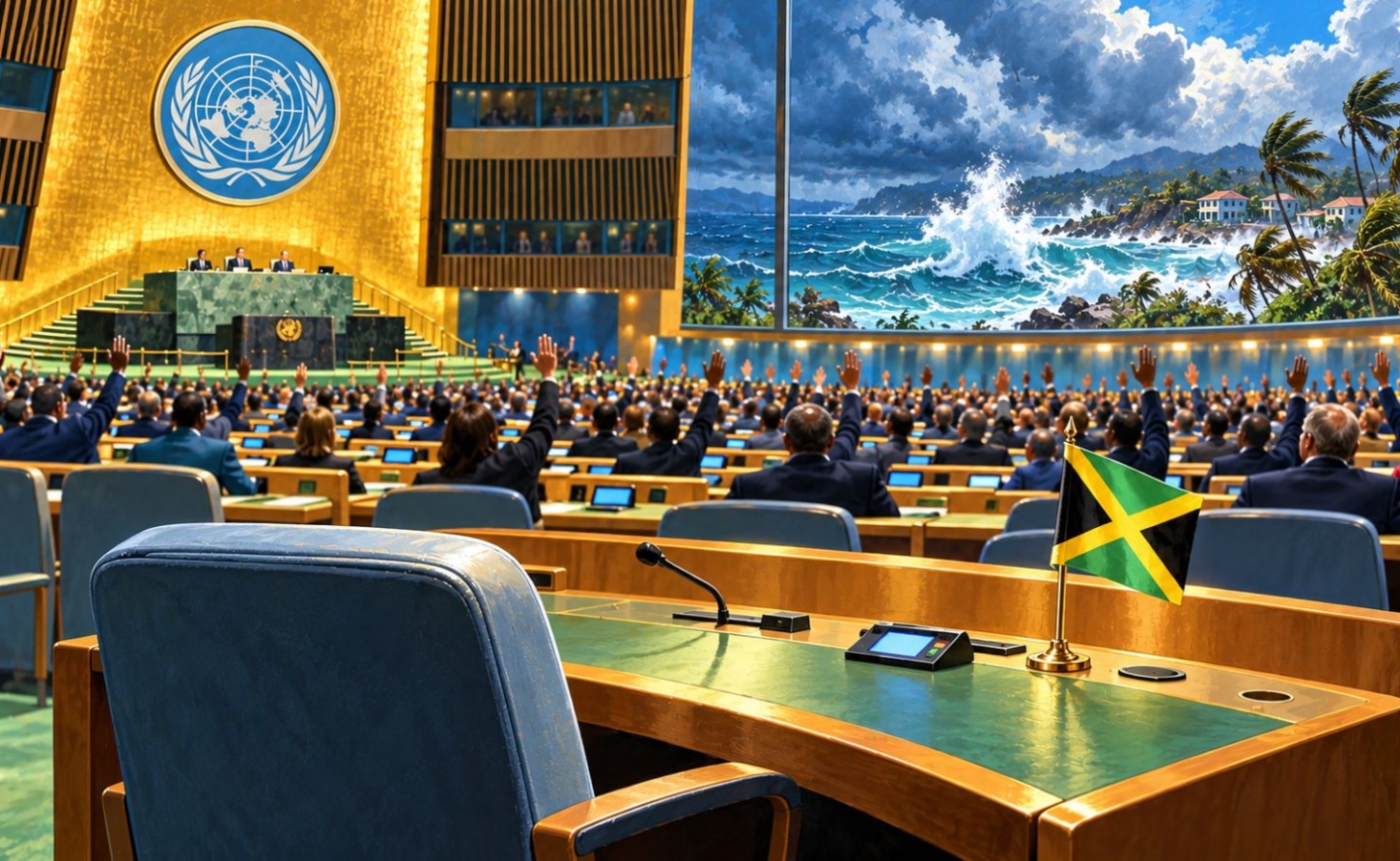
Illustration: an empty delegate seat with a Jamaican flag in the UN General Assembly hall
One year after Hurricane Melissa, Jamaica abandoned a position held by every government since 1972 — and would not even say why in plain words.
MONTEGO BAY, Jamaica, October 28, 2026 - Calvin G. Brown | One year ago today, Hurricane Melissa tore the roofs off Hanover and Westmoreland and St Elizabeth, the strongest storm ever to strike this island. Cuba, next in its path, was hit the following night. Two small islands, bleeding together, as they have for half a century.
Twelve months later, to the day, Jamaica walked into the General Assembly of the United Nations and, when asked whether the oldest economic siege in modern history should finally end, declined to answer.
I have been a Jamaican for every day of my life. I have never, until this Wednesday, been ashamed to say so.
The numbers are plain. One hundred and thirty nations voted to end the United States embargo against Cuba. Seventeen voted to keep it, Trinidad and Tobago among them, the first CARICOM state in the thirty-four-year history of this resolution to side with the blockade. Twenty-five abstained. Jamaica was one of them, alongside Guyana and Haiti, and alongside Germany, Poland and the Netherlands, who have at least the excuse of being far away.
We do not have that excuse. Cuba is ninety miles from our north coast.
Let no one call this a technical adjustment. Foreign Minister Kamina Johnson Smith herself told reporters on Wednesday that this was "a shift in policy," one the Government had been reflecting on for some time. Reflecting. For three decades and more, governments of both parties, Patterson and Golding, Simpson Miller and, until this week, Holness, stood up every year and said what the rest of the world said: this blockade is wrong. No reflection was required. It was simply what Jamaica did, because it was simply what Jamaica believed.
What changed? Not Cuba. Not the law. Not the Charter of the United Nations. Only the pressure, and our capacity to withstand it.
Four days before the vote, twelve former Caribbean heads of government, men who spent their careers on opposite sides of their nations' political divides, Bruce Golding and P.J. Patterson chief among them, published an open letter "to all nations of the world." They did not mince words. The embargo, they wrote, "is contrary to international law and every civilised precept of life and living." Washington's refusal to heed three decades of UN votes shows it "ignoring the clear voice of the international community." The unilateral measures against Havana "represent the law of the jungle." And then the line that should be read aloud in every classroom on this island: "Cuba is not a threat to any nation or any person on planet Earth!"
A Jamaica Labour Party prime minister and a People's National Party prime minister signed the same page. Their successor could not bring himself to press a button.
The minister's explanation deserves a hearing, so let us hear it. Jamaica, she said, remains concerned about the humanitarian suffering in Cuba. Jamaica supports dialogue between Washington and Havana. Jamaica reaffirms its solidarity with the Cuban people.
Solidarity. The word has a meaning. It means that when your neighbour is being strangled, you do not stand in the road discussing the merits of dialogue between the strangler and the strangled. The humanitarian crisis the minister is concerned about is not a weather event. It is the designed, intended, openly stated product of the policy she declined to condemn. One cannot lament the fever while abstaining on the question of the poison.
And here is what makes the abstention not merely wrong but cowardly: it is designed to be deniable. A "no" vote, as Port of Spain cast, is at least honest. An abstention is a vote cast with the hand over the face, so that Washington sees the gesture and Kingston can tell its own people it did not happen. We are to be grateful, apparently, that we did not do worse. Let us not dress it up. What the Government of Jamaica did today was a spineless act of cowardice. Look how far we have fallen.
But honesty is not honour. It was in Port of Spain, in October 1972, that four stalwart Caribbean leaders agreed to defy Washington and recognise Cuba. Kamla Persad-Bissessar has now brought shame on that ground, and on the memory of Eric Williams, who sat at that table, and on Keith Rowley, her own predecessor, who put his name to last week's letter.
Remember what Cuba did when it had less than we have now. Remember December 8, 1972, when Michael Manley, Eric Williams, Forbes Burnham and Errol Barrow defied an entire hemisphere to recognise Havana. Remember the Cuban doctors in our rural clinics, the nurses, the eye-care programme that gave sight back to thousands of Jamaicans who could never have paid for it, the scholarships that made engineers and physicians out of children from Grange Hill and Lucea. Remember that none of that was lent. It was given.
The Government will say that Jamaica must look after Jamaica, that there are visas and trade preferences and security partnerships to think about, that a small island cannot afford principles it cannot pay for. Perhaps. But then say so. Stand at the podium and tell the Jamaican people that our foreign policy is now available to the highest bidder, and that the price of our conscience was met. Do not dress it in the language of "reflection" and "dialogue" and expect us to applaud the costume.
Because the thing about sovereignty, the thing Manley understood and this Cabinet appears to have forgotten, is that it is not a possession. It is a practice. You keep it by using it. A country that will not say "no" to a blockade it has condemned for thirty years has not been pressured into silence. It has volunteered.
One hundred and thirty nations found their voice on Wednesday. Jamaica, land we love, found a reason not to.
The Cuban people will survive this, as they have survived everything else. The question is whether Jamaica survives it, whether the country that voted on October 28, 2026, is still the country that recognised Havana on December 8, 1972, or merely a place that shares its name.
Today, I am not certain. And that is the shame of it.
-30-
