
JAMAICA | The UN Cuban Embargo Vote Jamaica Could Have Cast
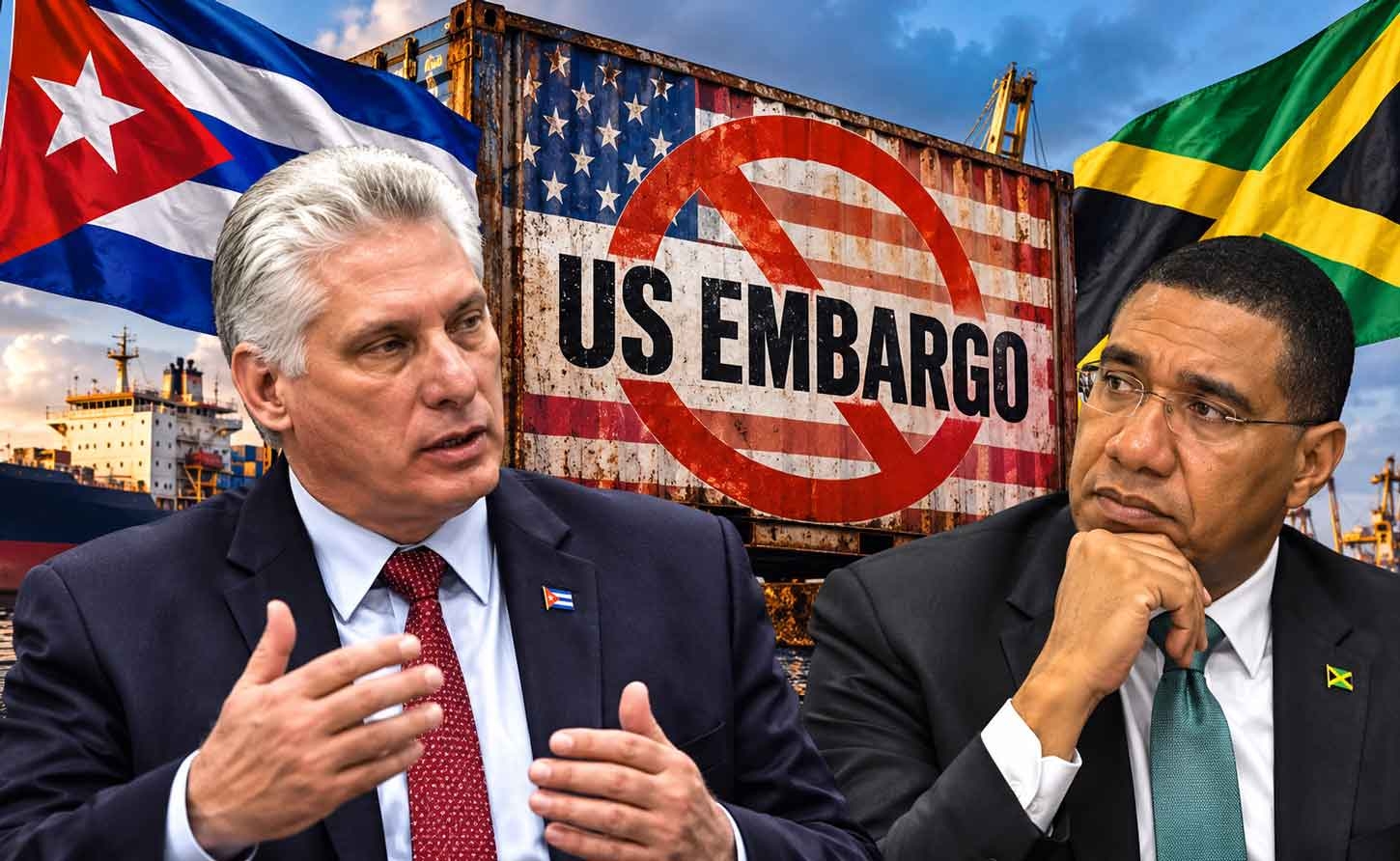
Cuban President Miguel Díaz-Canel Bermúdez and Jamaican Prime Minister Andrew Holness
After thirty-four years of demanding an end to the US blockade of Cuba, Kingston abstained — on the morning the resolution recorded its weakest support in three decades. The Government could have voted yes and called for reform in the same breath. It chose not to.
MONTEGO BAY, Jamaica, October 30, 2026 | Calvin G. Brown | Opinion | Even the proverbial blind man could see it. For thirty-four consecutive Octobers, Jamaica rose in the United Nations General Assembly and said yes: yes, the United States embargo against Cuba must end. On Wednesday, Jamaica sat on its hands. One hundred and thirty nations voted to condemn the blockade, seventeen voted to keep it, and twenty-five — Jamaica among them, alongside Guyana and Haiti — abstained. It was the weakest showing for the resolution in three decades, and Kingston chose that morning, of all mornings, to go quiet.
Foreign Minister Kamina Johnson Smith called it “a shift in policy.” That is one way of putting it. Another is that a country that spent a generation demanding Washington lift its boot from a neighbour’s neck looked down on Wednesday, saw the boot still there, and decided the neighbour should first tidy his house.
What the embargo was built to do
Let us dispense with the fiction that this is about human rights. The embargo was never designed as a lever for Cuban democracy. It was designed as a punishment, and we know this because the men who built it wrote it down.
On 6 April 1960, fifteen months after the revolution swept Fidel Castro to power and stripped American corporations of the sugar mills, refineries and utilities they had treated as their own, Deputy Assistant Secretary of State Lester Mallory sent a memorandum to his superior. He conceded that most Cubans supported Castro and that no effective opposition existed. His recommendation, therefore, was to weaken the island’s economy so as to bring about “hanger, desperation and overthrow of government.” His superior initialled “yes.”
By the definition Washington itself signed, the embargo is genocide. Not a metaphor. Not Havana’s rhetoric. A sixty-six-year policy that meets the test of a treaty the United States helped write.
That memo was declassified in the 1990s. Washington has never repudiated it. It has instead spent sixty-six years perfecting it — the Torricelli Act of 1992, the Helms-Burton Act of 1996 that reaches across oceans to punish third-country firms for daring to trade with Havana, and this year, under the Trump regime, a renewed campaign to choke Cuba’s fuel supply and threaten tariffs against any nation that sells the island a barrel of oil.
Call it what it is. The 1948 Genocide Convention, to which the United States is a party, defines the crime to include “deliberately inflicting on the group conditions of life calculated to bring about its physical destruction in whole or in part.” Mallory’s memo prescribes precisely that: conditions of life — hunger, desperation — deliberately inflicted on a people in order to break them. By the definition Washington itself signed, the embargo is genocide. Not a metaphor, not Havana’s rhetoric: a sixty-six-year policy that meets the test of a treaty the United States helped write.
This is sixty years of revenge — revenge for the embarrassment of a small island that took back what was its own — and the people of Cuba have survived it, which is the one outcome the memo never contemplated.
The minister’s case, fairly stated
Johnson Smith deserves to have her argument heard as she made it. Jamaica, she said, did not vote against the resolution because it does not support unilateral coercive measures. It did not vote for it because backing the same text year after year, while the humanitarian crisis deepens, “does not serve the benefit of the Cuban people.” The resolution, she said, offered “no scope to adjust the language.” It did not address domestic economic reform, human rights, or constructive engagement between Havana and Washington. So Jamaica abstained.
The day before, the Government had piloted a motion through the House on the “economic and humanitarian situation in Cuba.” It spoke of dialogue and mutual respect and Cuba’s integration into the world economy. It did not call for the embargo to be lifted. Read the two documents together and the choreography is plain: Tuesday’s motion was Wednesday’s alibi.
Why it does not hold
Here is the question the minister has not answered, and which every Jamaican should put to her: why could Jamaica not vote yes and call for reform?
Nothing stopped it. The General Assembly provides a formal mechanism — the explanation of vote — precisely so that a state can cast its ballot and then say, for the record, everything it wishes to add. Jamaica’s ambassador delivered an explanation of vote on Wednesday morning. Every word about human rights, institutional reform and dialogue could have been spoken in that statement after a yes. The language of the resolution was no obstacle; Kingston simply chose not to.
To condition one’s opposition to the strangulation on the victim’s conduct while being strangled is not nuance. It is the logic of the man holding the rope.
The deeper flaw is circular. The Government says Cuba must address the suffering of its people before Jamaica will keep demanding an end to the embargo. But the embargo is the engine of that suffering — by design, by Washington’s own admission. To condition one’s opposition to the strangulation on the victim’s conduct while being strangled is not nuance. It is the logic of the man holding the rope.
Who was the vote for?
Jamaica did not arrive at this position in a vacuum. In the weeks before the vote, Secretary of State Marco Rubio — a man whose political identity was forged in the Cuban exile politics of Miami — personally lobbied heads of government. Cuba’s foreign minister called it blackmail. Rubio was reported to have warned embassies that criticism of the blockade would “create friction in our bilateral relations.” US Ambassador Mike Waltz openly called on countries to vote no. Havana said Washington was also urging the hesitant simply to abstain.
Then came Wednesday. Colombia, Argentina, Costa Rica and Ecuador voted no. Trinidad and Tobago — Trinidad, with its own long history with Havana — voted no for the first time in thirty-three years. Jamaica, Guyana and Haiti slid from yes to abstain. Information Minister Dana Morris Dixon insists no foreign pressure was involved. Jamaicans may weigh that denial against the calendar.
CARICOM, which in 1972 made history when Manley, Barrow, Williams and Burnham together recognised Cuba in defiance of Washington, this week fractured along exactly the line the State Department drew for it.
What Jamaica owes
Michael Manley understood that solidarity is not a sentiment; it is a debt honoured in the open. Cuba repaid Jamaica’s recognition with doctors and nurses in our clinics, with scholarships for our children, with the G.C. Foster College of Physical Education and the José Martí Technical High School, with eye surgeries for thousands of Jamaicans who would otherwise have gone blind. That cooperation continues today. When the hurricane comes, the Cuban brigade is often on the ground before the aid conference convenes.
On Wednesday, Jamaica repaid that debt with silence — on the one day a year when the world is asked to say whether starving a people is acceptable.
Johnson Smith called the Cuban people’s suffering a matter of “deep concern.” Concern is cheap. Thirty-four times, Jamaica expressed its concern with a vote. This time, it expressed its concern by withholding one.
The Government could have voted yes and said everything it wanted to say about reform in the same breath. It chose not to. The question that remains is not whether Jamaica’s policy shifted — the minister admits it did — but towards whom, and in exchange for what.
— 30 —
