
CARICOM | Caribbean States Buckle Under Trump Administration Pressure on Third-Country Deportees
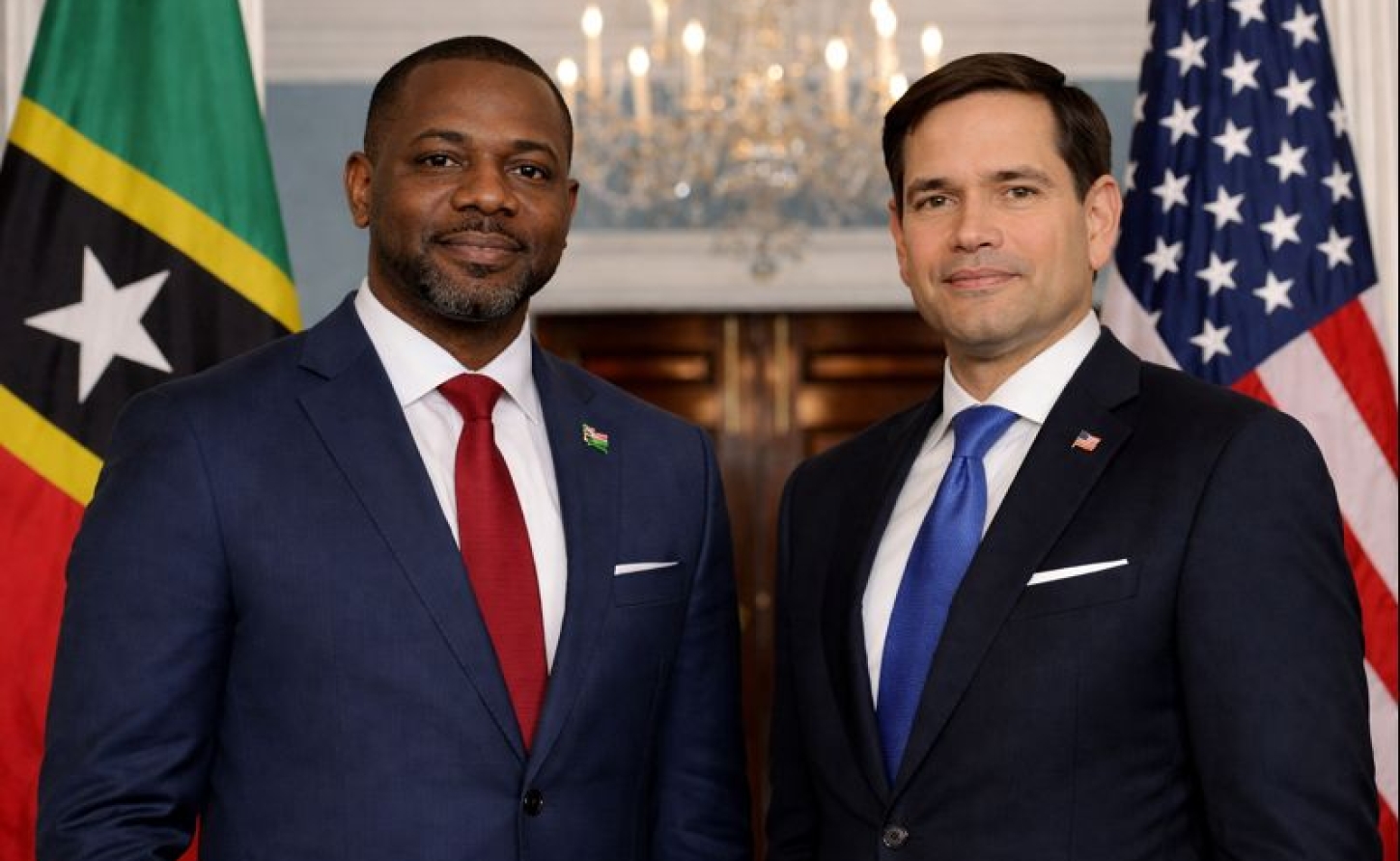
Prime Minister Terrence Drew and US Secretary of State Marco Rubio
CARICOM Chair Drew Excludes Haiti from US Agreement, Citing Security Concerns — Critics Point to ‘Moral Contradictions’ in Regional Policy
BASSETERRE, St. Kitts | WiredJa Staff | January 19, 2026 - In a dramatic illustration of Washington’s renewed leverage over the Caribbean, at least four CARICOM member states have signed Memoranda of Understanding with the Trump administration to accept third-country deportees from the United States, with several more in advanced negotiations.
The agreements, reached amid what regional leaders describe as intense diplomatic pressure, have exposed deep fault lines within the Caribbean Community — none more glaring than CARICOM Chairman Terrance Drew’s explicit exclusion of Haitian nationals from St. Kitts and Nevis’s arrangement.
The cascade of announcements over the past two weeks marks the most significant shift in Caribbean-US migration policy in decades. Antigua and Barbuda, Dominica, St. Lucia, and St. Kitts and Nevis have all confirmed signed agreements, while Guyana remains in what officials describe as “advanced discussions.”
Barbados, notably, has not been approached by Washington, according to Foreign Minister Kerrie Symmonds.
The Haitian Question
Prime Minister Drew’s announcement on January 8 sent shockwaves through the region. Speaking at a roundtable with journalists, the CARICOM Chair stated unequivocally that his country’s agreement with Washington “does not include Haiti.”
“This does not involve anybody outside of CARICOM,” Drew explained. “This is in keeping with our character. And I will further say that because of security matters, it does not include Haiti at this time.”
Drew reiterated Haiti’s exclusion three separate times during the briefing, making his position unmistakable. The decision marks the first public acknowledgment by a CARICOM member state of explicit limits on accepting nationals from a fellow member — and it comes from the very leader meant to champion regional unity.
Following regional criticism, the St. Kitts and Nevis government issued a formal clarification, arguing the exclusion “reflects national capacity realities rather than a withdrawal of compassion or regional solidarity.” Officials claimed the federation has “reached a threshold beyond which it cannot sustainably absorb additional inflows without placing undue strain on essential systems.”
Critics have seized on what they describe as “moral contradictions” — CARICOM positions itself as Haiti’s advocate and is currently leading discussions about the country’s political transition after February 7, yet excludes Haitians from practical policy implementation. Haiti remains excluded from CARICOM’s Single Market and Economy, and member states continue to deny Haitian nationals visa-free travel.
Washington’s Leverage
The agreements did not emerge in a vacuum. Both Dominica and Antigua and Barbuda had visa bans and travel restrictions imposed on them by the United States effective January 1, 2026 — ostensibly over concerns about their Citizenship by Investment programmes. From January 21, citizens of both nations must post travel bonds of between $5,000 and $15,000 merely to apply for a US visa.
The timing has fuelled speculation that the visa restrictions served as leverage for the deportee agreements. Former St. Vincent and the Grenadines Prime Minister Ralph Gonsalves, now Opposition Leader, warned that Caribbean countries are “being picked off one by one” to their detriment.
Washington has also been pressing regional governments to allow the US Southern Military Command to establish high-grade radar facilities in their territories — a request meeting significant resistance from opposition parties and civil society groups across the region.
What the Agreements Include
While details remain sparse, the broad outlines of the MOUs are becoming clear. All participating countries have stipulated that they will only accept individuals without violent or sexual criminal backgrounds. The United States will bear all costs associated with relocation and integration of transferred individuals.
Antigua and Barbuda has been most transparent about its conditions. Prime Minister Gaston Browne confirmed a strict cap of no more than 10 deportees per year, with the government retaining “absolute right to reject any individual proposed by the United States.” Browne insisted the MOU is non-binding and emphasised that the arrangement “was not a concession, nor an attempt to trade people or curry favour.”
For context, the Trump administration has set a record-low ceiling of just 7,500 refugee admissions for fiscal year 2026, down from 125,000 under the Biden administration.
Guyana: A Different Calculus
Guyana’s negotiations appear to follow a different logic. Foreign Secretary Robert Persaud has described the talks as “very unique” and linked them to private-sector requests for skilled labour. The oil-rich nation faces an estimated skills gap of up to 80,000 workers amid rapid economic expansion.
“This is not a case where the US would be dumping people in Guyana,” Persaud told the Miami Herald, emphasising that preference would be given to skilled individuals without criminal records.
The Guyanese opposition has demanded full transparency and parliamentary oversight before any agreement is finalised. The APNU+AFC coalition warned that Guyana’s infrastructure is already under significant strain from thousands of Venezuelan refugees and cannot cope with additional influx without proper planning.
Regional Fragmentation
The OECS Heads of Government held an emergency meeting on January 14 in St. Lucia to address “Urgent Regional and Geopolitical Matters.” St. Vincent and the Grenadines’ Deputy Prime Minister St. Clair Leacock indicated that his country has not made a decision and believes the matter requires a collective OECS response.
But collective action appears elusive. The bilateral nature of the negotiations has prevented Caribbean nations from presenting a united front. As one regional commentator noted, “divide and conquer is a strategy as old as time.”
Gonsalves warned that accepting even small numbers of foreign deportees could have “catastrophic effects” on small island nations, suggesting that a handful of problematic individuals could connect with local criminal enterprises. He claims to have told American officials directly that this policy risks creating “six other Haitis” in the Caribbean.
The Road Ahead
The deportee agreements represent a new chapter in Caribbean-US relations — one marked by asymmetric power dynamics and the willingness of Washington to use economic pressure to achieve immigration policy objectives. For CARICOM, the episode has exposed the limits of regional solidarity when individual states face bilateral pressure from the hemisphere’s dominant power.
Haiti’s explicit exclusion by the CARICOM Chairman himself raises uncomfortable questions about the region’s commitment to its most vulnerable member state. As one observer noted, it is difficult to lead discussions about Haiti’s political future while simultaneously barring Haitians from regional arrangements.
Whether these MOUs will result in significant transfers remains to be seen. But the message has been sent: in Trump’s second term, small Caribbean states will be expected to fall in line or face consequences.
-30-
WiredJa is a Caribbean news publication covering regional politics, economics, and investigative journalism.
