CARICOM | CARICOM and Washington: Neighbours, But Who Sets the Terms 50 Years Later?
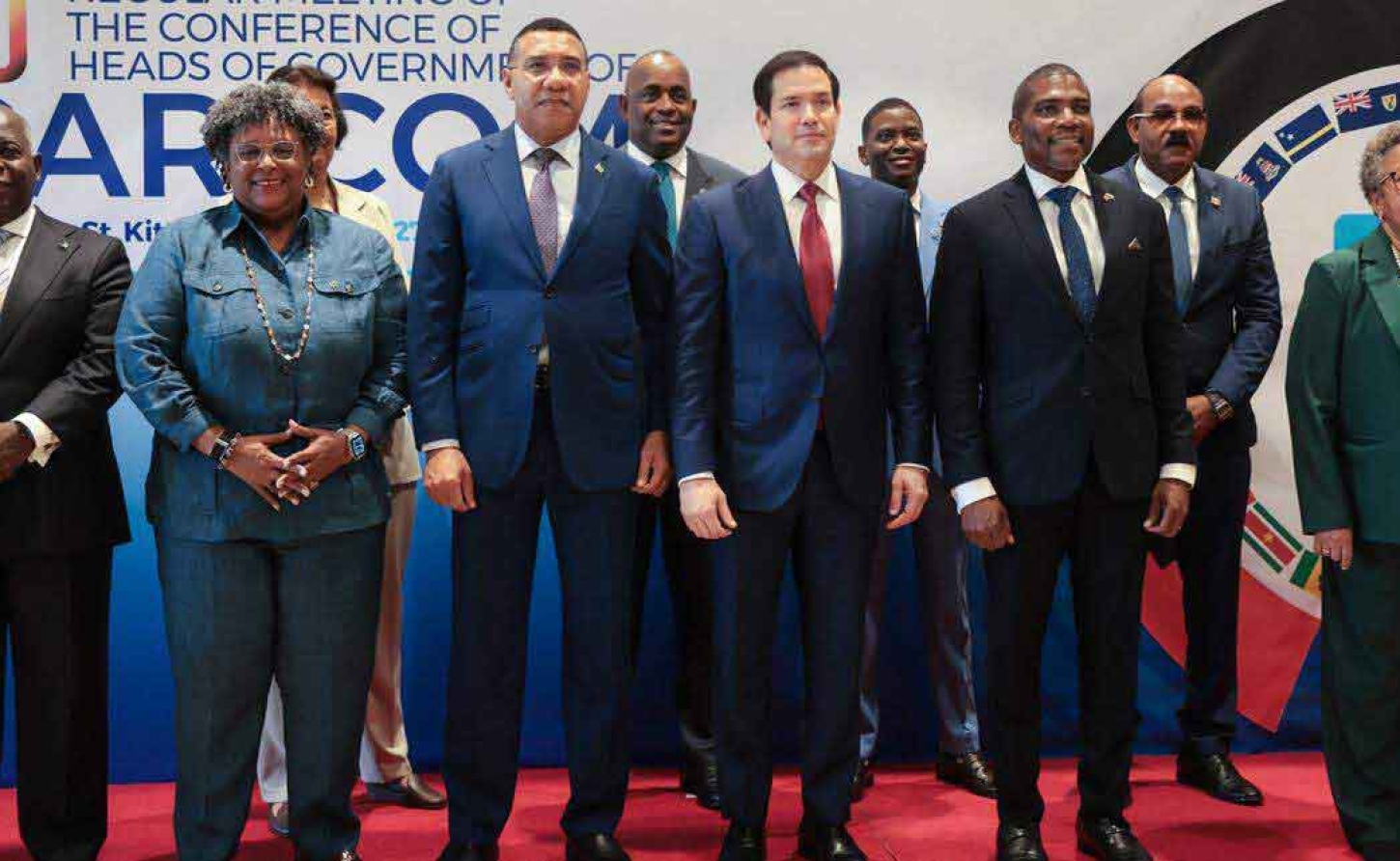
U.S. Secretary of State Marco Rubio participates in a group photo with Caribbean Community (CARICOM) heads of government in Basseterre, Saint Kitts and Nevis, on Wednesday, Feb. 25, 2026. JONATHAN ERNST POOL/AFP via Getty Images
By WiredJa | February 27, 2026 - There is something deeply symbolic about Marco Rubio touching down in the Caribbean — the son of Cuban immigrants, now the most powerful diplomat on earth, arriving as envoy of an administration that has made no secret of its desire to reassert American dominance in this hemisphere.
His meeting with CARICOM Heads of State and Government at Basseterre, St. Kitts, on the occasion of the Community's 50th Regular Meeting, was billed as a new chapter in regional engagement. But as the joint statement makes clear, the Caribbean must read every line of this chapter with unflinching care.
The statement opens warmly — almost too warmly. "Strong historical, diplomatic, familial and economic ties," it declares. "A stronger, safer, more secure and prosperous neighbourhood." Diplomatic language at its smoothest.
Yet buried within these carefully chosen words is a confession that should give every Caribbean leader pause: the last serious, coherent engagement between CARICOM and Washington was "almost 50 years ago under President Reagan." Fifty years.
Half a century during which the United States sanctioned, destabilised, blockaded, and largely ignored its Caribbean neighbours whenever it suited American interests. And now, suddenly, Washington wants to talk — and the Caribbean is expected to come to the table smiling.
The Framework: Opportunity or Obligation?
At the heart of the Basseterre encounter is the agreement to develop a "Cooperation Framework appropriate to the 21st century." The six pillars outlined — a structured Migration Programme, security cooperation, trade and investment, disaster recovery, human development, and technical assistance — read like a generous menu. But menus in diplomacy are rarely without hidden costs.
Consider "security cooperation." In the Caribbean context, this phrase carries enormous historical weight. It has previously meant U.S. coastguard patrols in sovereign waters, intelligence-sharing arrangements that compromise regional autonomy, and the creeping militarisation of what should be civilian governance priorities.
CARICOM nations must demand crystal clarity on what security cooperation means in the Trump era — particularly given Washington's aggressive posture toward migration enforcement and drug interdiction across the wider Caribbean basin.
The "structured Migration Programme" is perhaps the most sensitive pillar of all. The Trump administration's migration agenda has been defined by walls, deportations, and the deliberate weaponisation of immigration enforcement as political theatre.
What "structure" does Washington envision for Caribbean migration — and does it respect the dignity and rights of the hundreds of thousands of Caribbean nationals who form the backbone of American service industries, healthcare systems, and academic institutions?
THE BLOOD ON THE STATEMENT: RUBIO'S DEAFENING SILENCE ON AMERICAN GUNS
Search the joint statement issued after Rubio's meeting with CARICOM Heads carefully. Read every line, every pillar, every diplomatic flourish. You will not find a single word about the illegal guns flowing from the United States into Caribbean communities and turning our streets into killing fields. Not one sentence. Not one acknowledgement. This is not an oversight. It is a choice — and it is an unconscionable one.
The facts are not in dispute. According to the United States' own Bureau of Alcohol, Tobacco, Firearms and Explosives (ATF), of 7,399 guns recovered from Caribbean crime scenes and traced between 2018 and 2022, fully 73 percent — nearly 5,400 weapons — came directly from the United States.
Caribbean nations manufacture no firearms of their own. Every illegal gun that has ever killed a Jamaican child, a Trinidadian father, a Barbadian grandmother, entered this region from somewhere else. And the data shows, overwhelmingly, it entered from America.
The scale of the resulting carnage is staggering. Violent death rates across the Caribbean approach three times the global average, with guns implicated in up to 90 percent of homicides — all in societies where civilian gun ownership is strictly controlled by law.
In 2021 alone, Caribbean nations accounted for six of the world's ten highest national murder rates, according to the United Nations. Regional officials estimate that approximately 90 percent of Caribbean murder weapons are purchased legally by so-called "straw buyers" in the United States — primarily in Florida, Georgia, and Texas — and then smuggled into our islands concealed in washing machines, cereal boxes, bags of rice, and household water heaters.
And the weaponry is becoming more lethal. Cheap "conversion devices," available in the United States for as little as fifteen dollars, can transform an ordinary handgun into an automatic weapon. These devices are flooding Caribbean ports.
CARICOM-IMPACS officials have described the trend as "frightening." AK-47-type rifles are increasingly showing up at Caribbean crime scenes. Barrett .50-calibre military-grade rifles — weapons designed for warfare — have been intercepted in shipping containers headed for Haiti from Miami.
Marco Rubio stood before CARICOM Heads of Government and spoke of safety, security, and a prosperous neighbourhood. He said nothing about any of this. He offered no apology, no acknowledgement, no commitment to address the source of a crisis that has devastated Caribbean families across generations.
He spoke of migration — of Caribbean people moving toward America — to legally work and support their families back home, while remaining silent about the American weapons moving toward Caribbean people and killing them.
This asymmetry is not incidental. It reflects a fundamental imbalance in how Washington frames its relationship with the Caribbean. When people flow northward, it is a crisis demanding immediate American action.
When guns flow southward and pile up bodies in our streets, it is — apparently — not even worth a paragraph in a joint diplomatic statement. The Caribbean must name this hypocrisy plainly and refuse to let any Cooperation Framework take shape without a binding, enforceable commitment from Washington to stem the flow of American weapons into our region.
The Cuba Question: CARICOM's Tightrope
Nothing in the joint statement is more delicate — or more revealing — than the section on Cuba. The statement acknowledges a "growing humanitarian crisis" and notes that CARICOM, "cognisant of its very close relationship with both Cuba and the USA," is willing to participate in efforts to benefit the Cuban people "while maintaining regional stability."
This is CARICOM walking a geopolitical tightrope — and doing so publicly, under Rubio's watch. Cuba's relationship with the Caribbean is not merely diplomatic; it is deeply human. Cuban doctors have staffed regional hospitals.
Cuban teachers have educated Caribbean children. Cuban solidarity was real and tangible long before Washington paid attention. Any framework that positions CARICOM as a useful conduit for U.S. pressure on Havana — however dressed in humanitarian language — risks betraying foundational principles of Caribbean solidarity and non-interference that have defined the Community since the Treaty of Chaguaramas.
CARICOM should be clear-eyed: it can advocate for the Cuban people without becoming Washington's instrument. The difference between those two positions is everything.
The Reagan Ghost and the Sovereignty Question
The acknowledgment that serious U.S.-Caribbean engagement effectively died with Reagan is both an indictment and a warning. The 1980s saw the Caribbean Basin Initiative — an American economic strategy that prioritised U.S. export interests and security concerns over genuine Caribbean development.
It also saw the invasion of Grenada, a defining moment of American unilateralism that sent an unmistakable message to every small island state in the region: sovereignty is conditional on American approval.
Four decades on, CARICOM has matured. The Community has deepened intra-regional trade, expanded its diplomatic voice, and demonstrated that small states can punch well above their weight on the global stage — from climate negotiations to international health responses.
This is not the Caribbean of 1983. Any Cooperation Framework must reflect that reality. The Caribbean must negotiate not as supplicants grateful for Washington's attention, but as sovereign equals whose strategic geographic position, natural resources, and democratic traditions represent genuine value in any partnership.
A Partnership of Equals — Or Else?
The joint statement is careful to speak the language of mutual benefit. But language is not policy. The Caribbean must insist that whatever framework emerges from this engagement is genuinely reciprocal — that it addresses Caribbean development priorities rather than merely American strategic interests; that it respects regional judicial and constitutional sovereignty; and that it is accompanied by binding commitments, not aspirational language.
And chief among those binding commitments must be this: the United States must accept responsibility for the rivers of blood flowing through Caribbean communities from American-sourced weapons.
No Cooperation Framework worthy of the name can be built on a foundation that ignores 73 percent of the murder weapons in our region. CARICOM Heads have seized a historic moment. But they must not leave Basseterre without having forced this issue onto the table — loudly, on the record, and without diplomatic apology.
Fifty years is a long time to be ignored. It is also long enough to know that Washington engages the Caribbean on Washington's terms, until the Caribbean insists otherwise. The time to insist is now.
WiredJa | Caribbean-Centred News & Analysis | wiredja.com
-30-
