Its Venezuelan Oil, Not Justice: CARICOM Silent as Trump Attacks, Kidnaps Maduro
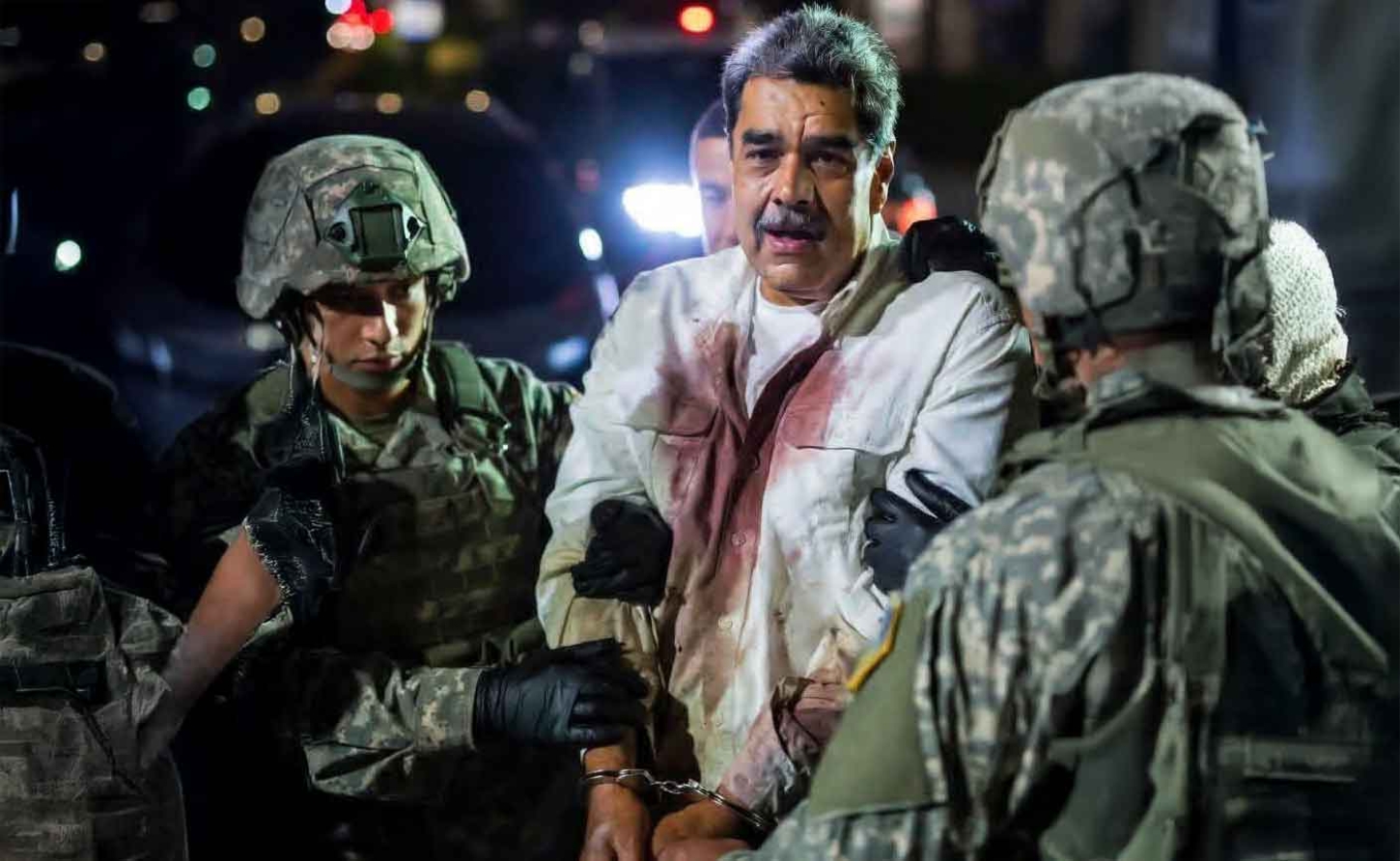
Venezuela President Nicolas Maduro being kidnapped by United States soldiers in Venezuela
When bombs fell on Caracas, Caribbean leaders mastered the art of saying nothing
MONTEGO BAY, Jamaica, January 3, 2026 - In the early hours of Saturday, January 3, 2026, the United States military bombed multiple locations across Venezuela—including the capital Caracas and the states of Miranda, Aragua, and La Guaira. President Nicolás Maduro and his wife Cilia Flores were kidnapped from their residence at the Fort Tiuna military installation and spirited out of the country to face charges in New York.
Let's be clear about the language: this wasn't a "capture" as Western media sanitizes it—this was the abduction of a sovereign nation's head of state through military aggression.
Venezuela's government, in its official communiqué, stated the truth plainly: "The objective of this attack is none other than to seize Venezuela's strategic resources, particularly its oil and minerals, in an attempt to forcibly break the political independence of the nation."
Three hundred and three billion barrels. That's Venezuela's proven oil reserves—the largest in the world. Larger than Saudi Arabia. Larger than Canada. Larger than Iraq. That's what this invasion is actually about. Not drugs. Not terrorism. Not democracy. Oil.
But you wouldn't know any of this from reading CARICOM's response.
The Most Neutral Statement in History
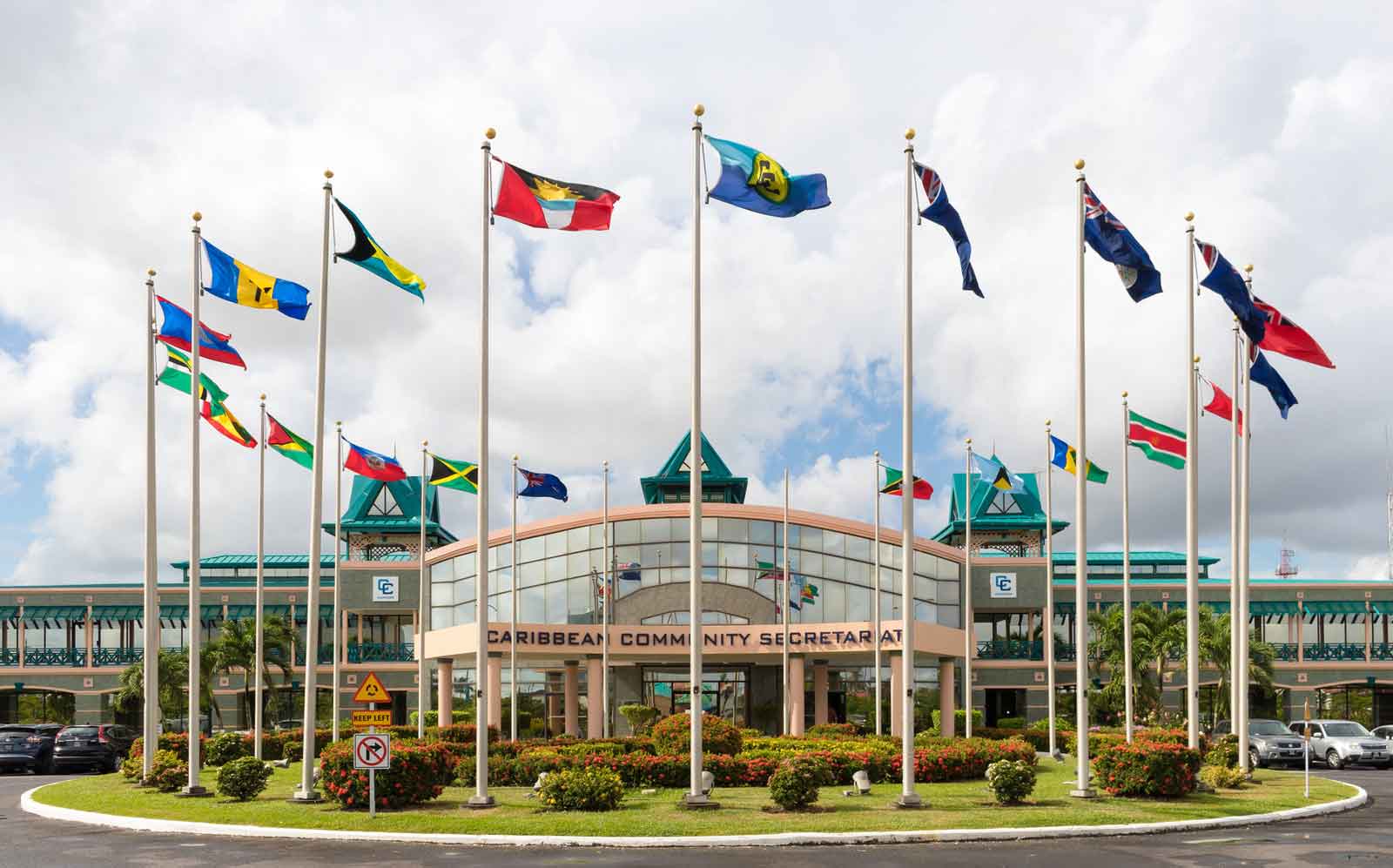
CARICOM Headquarters in Georgetown, Guyana
"The Conference of Heads of Government of CARICOM met very early on 3 January following reports of military action in Venezuela. CARICOM is actively monitoring the situation which is of grave concern to the Region with possible implications for neighbouring countries. CARICOM will continue to update the people of the Region as more information is received."
That's it. Monitoring. Grave concern. Possible implications. They will update us.
What's conspicuously absent? Any mention of invasion. Any reference to sovereignty. Any acknowledgment of international law violations. Any citation of the UN Charter. Any invocation of the Zone of Peace doctrine that CARICOM leaders were trumpeting just months ago. Any use of the word "oil." Any recognition that a neighboring state was bombed and its president kidnapped.
Nothing. CARICOM perfected the art of the "fenky fenky" statement—neither supporting nor condemning, neither here nor there, standing for absolutely nothing while appearing to say something.
The World Responded—CARICOM Didn't
Compare CARICOM's non-statement to how the rest of the world reacted:
Brazil's President Luiz Inácio Lula da Silva condemned the strikes and kidnapping as "a very serious affront to the sovereignty of Venezuela and an extremely dangerous precedent to all the international community."
Mexico's President Claudia Sheinbaum "strongly condemns and rejects" the military action, explicitly stating it breaches Article 2 of the United Nations Charter—the prohibition on the use of force against territorial integrity.
Colombia's President Gustavo Petro called it "bombing with missiles," demanded emergency UN Security Council and OAS meetings, deployed troops to the Venezuelan border, and rejected "the aggression against the sovereignty of Venezuela and of Latin America."
Cuba's President Miguel Díaz-Canel denounced "the criminal attack" and called for urgent international condemnation of what he described as "State terrorism against the brave Venezuelan people."
Russia's Foreign Ministry condemned "an act of armed aggression against Venezuela," calling any justifications "untenable."
Iran's Foreign Ministry issued a strong condemnation, describing the attack as "a blatant violation of the country's national sovereignty and territorial integrity."
Even the UN Special Rapporteur on Human Rights and Counterterrorism, Ben Saul, slammed Washington's "illegal aggression against Venezuela" and the "illegal abduction" of its president.
Some Republican US senators questioned the operation's constitutionality. Senator Mike Lee initially asked what could "constitutionally justify this action in the absence of a declaration of war." Senator Ruben Gallego stated bluntly: "This war is illegal."
The entire world saw an invasion and kidnapping. CARICOM saw something to "monitor."
The Oil They Won't Mention
Venezuela's communiqué was explicit about what's actually happening: "The objective of this attack is none other than to seize Venezuela's strategic resources, particularly its oil and minerals, in an attempt to forcibly break the political independence of the nation."
The Venezuelan government even invoked historical memory: "When foreign powers bombed our coasts in 1902, President Cipriano Castro proclaimed: 'The insolent foot of the foreigner has desecrated the sacred soil of the Homeland.'" That 1902 bombardment was also about resources—European powers demanding debt payment and access to Venezuela's wealth.
This is the pattern of empire: fabricate a justification, invade, seize resources.
In 1989, the US invaded Panama, arrested Manuel Noriega on drug charges, and secured control over the Panama Canal.
In 2003, the US invaded Iraq over fabricated weapons of mass destruction claims—Iraq happened to have the world's second-largest oil reserves.
In 2011, NATO bombed Libya to remove Muammar Gaddafi the dictator—Libya happened to have Africa's largest oil reserves.
In 2026, the US bombs Venezuela to arrest Nicolás Maduro the narco-terrorist—Venezuela happens to have the world's largest proven oil reserves.
Notice the pattern? CARICOM apparently doesn't.
Or perhaps they do, and that's precisely why they won't name it.
The Zone of Peace That Died This Morning
The bitter irony is that CARICOM leaders have spent months proclaiming their commitment to the Caribbean as a "Zone of Peace."
In October 2025, ten former Caribbean prime ministers—including Trinidad's Keith Rowley, Jamaica's P.J. Patterson and Bruce Golding, and St. Lucia's Kenny Anthony—signed a joint declaration titled "Our Caribbean Space: A Zone of Peace on Land, Sea & Airspace where the Rule of Law Prevails." The statement expressed concern over increased military buildup and the presence of nuclear vessels in the Caribbean, urging regional governments to resist being drawn into external conflicts and uphold international law.
In December 2025, Jamaica's Prime Minister Andrew Holness, as outgoing CARICOM chairman, reaffirmed "the region's commitment to remaining a Zone of Peace, grounded in respect for international law, the peaceful settlement of disputes, and the de-escalation of conflict." He emphasized CARICOM's "unequivocal support for the sovereignty and territorial integrity of all member states."
The Zone of Peace doctrine has deep roots. It was first championed by Grenada's Prime Minister Maurice Bishop in 1979, who told the UN General Assembly: "We join with our sister Caribbean nations in re-emphasising our determination to preserve the Caribbean as a zone of peace, free from military intimidation. We demand the right to build our own processes in our own way, free from outside interference, free from bullying and free from the use or threat of force."
In 2014, the Community of Latin American and Caribbean States (CELAC)—which includes every independent nation in the Americas except the US and Canada—unanimously adopted the Havana Declaration proclaiming Latin America and the Caribbean as a Zone of Peace. Trinidad and Tobago's then-Prime Minister Kamla Persad-Bissessar led her country's delegation to that conference. Today, her government has broken ranks with CARICOM to support US pressure on Venezuela.
The Zone of Peace doctrine was always about preventing exactly this—foreign military intervention in regional affairs, particularly when motivated by resource seizure. It was about small Caribbean nations asserting sovereignty in the face of great power ambitions.
On January 3, 2026, when that doctrine was tested by the most blatant military aggression in the Caribbean region since Grenada 1983, CARICOM produced a statement that didn't even mention the words "Zone of Peace."
The doctrine died this morning—killed not by American bombs, but by Caribbean leaders who lack the courage to defend it when it matters most.
The Complicit Leadership Class
Why the silence? Why the careful neutrality? Why "monitoring" instead of condemnation?
The answer lies in examining CARICOM's recent behavior toward Venezuela. Prime Minister Holness, as CARICOM chair, delayed an urgent meeting on the US military buildup in the Caribbean in 2025, effectively giving tacit approval to Washington's escalation. Trinidad's Persad-Bissessar openly broke with CARICOM to support US pressure on Venezuela—Trinidad maintains extensive military cooperation agreements with the United States.
Jamaica, Trinidad and Tobago, and Guyana have positioned themselves as what critics call "compliant partners" of US policy in the region. When economic dependence on Washington runs deep, when military cooperation agreements bind you to metropolitan power, when you're seeking US favor for reconstruction aid or investment, suddenly it becomes very difficult to call invasion what it is.
This is the comprador class at work—regional leaders who talk about sovereignty in conference rooms but choose silence when empire actually violates it. They can issue strongly worded statements about climate finance and trade disputes, but when bombs fall on a neighboring state, they "monitor with grave concern."
The pattern reveals itself: CARICOM's principles are negotiable depending on who's doing the violating.
What "Monitoring" Means While They Loot
Let's be clear about what CARICOM is actually "monitoring."
They're monitoring while US forces seize control of Venezuela's oil infrastructure.
They're monitoring while a democratically elected president—whatever one thinks of his governance—is kidnapped and rendered to a foreign jurisdiction.
They're monitoring while international law is shredded.
They're monitoring while the UN Charter's prohibition on the use of force becomes meaningless.
They're monitoring while the principle of sovereignty dies.
And what are these "possible implications for neighbouring countries" that CARICOM mentions?
Guyana has massive new oil discoveries—among the largest finds in recent decades. Are they "monitoring" the precedent that oil-rich states can be invaded?
Trinidad and Tobago has substantial oil and gas reserves. Are they "monitoring" what happens when the United States decides your resources are too important to leave in your hands?
Jamaica sits in a region where the United States has now demonstrated it will use military force to achieve regime change. Are they "monitoring" their own vulnerability?
The message CARICOM sends to Washington is clear: You can violate sovereignty for resources. You can bomb capital cities. You can kidnap heads of state. We will express "grave concern" and continue "monitoring."
Venezuela Named It—CARICOM Ignored It
Read Venezuela's communiqué again. The government stated this was an attempt "to impose a colonial war to destroy the republican form of government and force a 'regime change', in alliance with the fascist oligarchy."
They invoked Article 51 of the UN Charter—the right to self-defense against armed aggression.
They called on "the peoples and governments of Latin America, the Caribbean, and the world to mobilize in active solidarity against this imperial aggression."
They referenced their history: "Since 1811, Venezuela has faced and defeated empires."
This is the language of anti-imperialism, of sovereignty defense, of resistance to resource colonialism.
CARICOM's response mentioned none of this. Wouldn't engage with Venezuela's framing. Couldn't acknowledge that a neighboring government explicitly named this as resource imperialism.
Why? Because acknowledging Venezuela's analysis means acknowledging the nature of the relationship between small Caribbean states and metropolitan power. It means admitting vulnerability. It means recognizing that principle and dependence are in tension.
So instead, CARICOM issues statements that say nothing, mean nothing, and stand for nothing.
Conclusion: The Template for Caribbean Subjugation
Make no mistake about what happened on January 3, 2026, and what it means for the Caribbean.
The United States invaded a sovereign nation that happens to have the world's largest proven oil reserves. The pretext was drugs and terrorism. The reality is 303 billion barrels of oil and vast mineral wealth.
Venezuela's government named it correctly in their communiqué: "The objective of this attack is none other than to seize Venezuela's strategic resources."
The rest of the world saw it. Brazil condemned it. Mexico condemned it. Colombia condemned it. Cuba condemned it. Russia condemned it. Iran condemned it. Even the UN Special Rapporteur on Human Rights called it "illegal aggression" and "illegal abduction."
CARICOM? CARICOM is "monitoring the situation" with "grave concern."
This isn't neutrality. This is complicity dressed in diplomatic language. This is cowardice wrapped in careful wording. This is the death of regional solidarity in real time.
The Zone of Peace that Maurice Bishop envisioned, that ten former prime ministers endorsed just months ago, that Andrew Holness reaffirmed in December, died this morning. Not because the United States violated it—we always knew empire would test it. But because when tested, CARICOM couldn't even bring itself to name the violation.
The template is now established. When the United States comes for Guyana's oil, or Trinidad's gas, or when any Caribbean state finds itself in Washington's crosshairs, we already know what CARICOM will do.
They will convene an emergency meeting "very early." They will issue a statement. That statement will express "grave concern." It will mention "monitoring the situation." It will note "possible implications."
It will say absolutely nothing. It will condemn absolutely nothing. It will defend absolutely nothing.
Venezuela called it an invasion, a kidnapping, an attempt to seize their resources. They were right.
CARICOM called it something to "monitor."
History will record which one was telling the truth. And history will judge which Caribbean leaders had the courage to stand for sovereignty when it mattered, and which ones perfected the art of the "fenky fenky" statement—the masterpiece of saying nothing while appearing to speak.
The Zone of Peace is dead. CARICOM killed it with silence. And when empire comes for the rest of us, we'll have no one to blame but the leaders who chose "monitoring" over solidarity when Venezuela burned.
-30-
