
CUBA |“I Can Do Anything I Want With It”: Trump’s Cuba Declaration and the Death of International Law
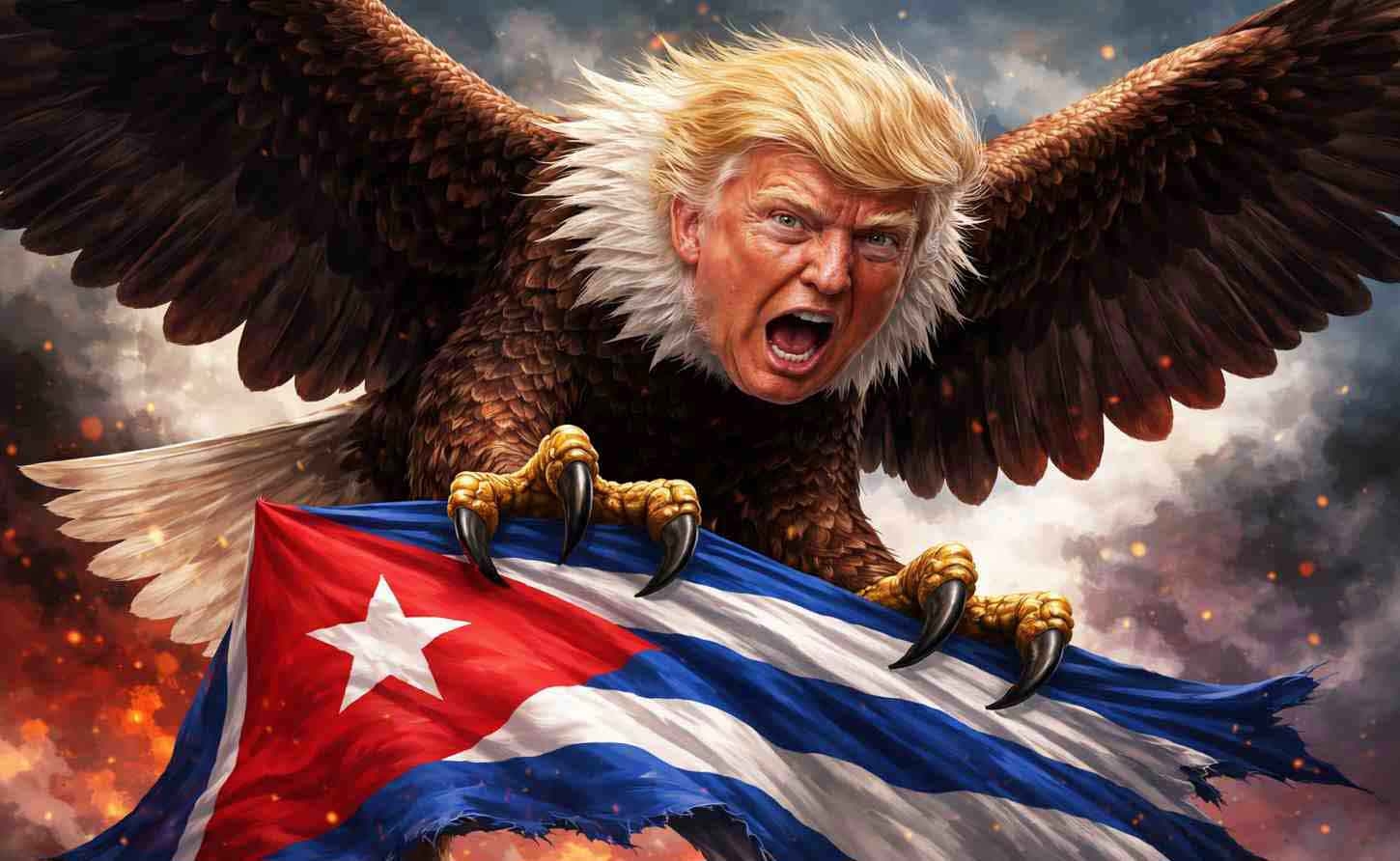
Cuba :“I think I can do anything I want with it. They’re a very weakened nation right now.” — Donald Trump, Oval Office, March 16, 2026
As Cuba’s power grid collapses under a US oil siege and 10 million people are plunged into darkness, Donald Trump’s brazen threat to “take” a Caribbean neighbour lays bare what the region has long suspected — that for Washington, sovereignty is a privilege reserved for the powerful, not a right guaranteed to all.
By Calvin G. Brown | March 17, 2026
On Monday, March 16, 2026, the lights went out across Cuba — all of them. The island’s national electricity grid suffered a complete collapse, leaving 10 million people in total darkness. Hospitals went to backup power. Refrigerators holding what little food families had went silent. And in the Oval Office of the White House, just 90 miles away, Donald Trump told reporters he believed he would have “the honour of taking Cuba.”
“Whether I free it, take it — I think I can do anything I want with it,” the President of the United States declared. “They’re a very weakened nation right now.”
That is not a misquote. That is the sitting president of the world’s most powerful nation, speaking from the world’s most powerful office, announcing his intention to seize a sovereign Caribbean state — and boasting about it.
“I think I can do anything I want with it. They’re a very weakened nation right now.” — Donald Trump, Oval Office, March 16, 2026
THE SIEGE
Monday’s blackout did not happen by accident. It was the foreseeable result of a deliberate, methodical strangulation campaign. Since January 9, Cuba has received no oil shipments — a consequence of Trump’s executive order threatening tariffs against any nation that dares sell fuel to the island. On January 29, Trump formally declared Cuba “an unusual and extraordinary threat” to US national security and imposed what amounts to a full energy blockade.
The effects have been catastrophic. Blackouts now consume most of the day in Cuban cities. Hospitals have been forced to postpone procedures. Food spoils. Airline flights have been curtailed. Monday’s total grid collapse was the third island-wide blackout in four months.
The United Nations has warned that Cuba is inching toward humanitarian collapse. Cuba’s Deputy Foreign Minister summed it up without diplomatic restraint: “Officials in the US government must be feeling very happy by the harm caused to every Cuban family.”
This is not a sanctions regime. This is a siege.
THE WORLD HAS ALREADY SPOKEN
The international community’s position on the US blockade of Cuba is not ambiguous. It never has been. For 33 consecutive years — without interruption — the United Nations General Assembly has adopted resolutions calling for an end to the US embargo. In October 2025, just five months ago, 165 member states voted in favour of the latest such resolution. Only seven voted against. The world’s verdict is overwhelming and consistent.
Cuba’s Foreign Minister Bruno Rodríguez Parrilla told the Assembly that the blockade is “a flagrant, massive and systematic violation of the human rights of our people” and the most comprehensive unilateral sanctions regime ever imposed on any country. He was not wrong. And Washington’s response to 33 years of near-universal international condemnation has been, in effect, silence — and escalation.
The Trump administration did not merely ignore the October 2025 resolution. Its UN ambassador actively lobbied sovereign nations to change their votes, with Cuba’s foreign minister describing “a brutal and unprecedented deployment of pressure, intimidation and toxicity” by the US State Department to coerce smaller nations.
CAN THE SECURITY COUNCIL ACT?
Here is the brutal structural reality: no. The UN Security Council, the body with actual enforcement power under international law, cannot meaningfully act against the United States because the United States holds a permanent veto. Any resolution to censure Washington, demand an end to the blockade, or refer the matter for international adjudication would be dead on arrival — killed by the same country whose actions are under scrutiny.
This is not a technicality. It is a fundamental design flaw in the post-World War II international order, and it is being exploited in real time against a Caribbean nation of 10 million people. The UN Charter’s Article 2(4) prohibits the threat or use of force against the territorial integrity of any state.
Trump’s public declaration that he intends to “take” Cuba — after capturing Venezuela’s president in a military operation, and while simultaneously waging war against Iran — is not merely bellicose rhetoric. It is a threat against a sovereign state, made without consequence, because the enforcer of international law is also the aggressor.
The enforcer of international law is also the aggressor. That is the crisis the Caribbean must now name clearly and without apology.
THE CARIBBEAN IN THE CROSSHAIRS
CARICOM leaders cannot afford to regard this as Cuba’s problem alone. The Venezuela precedent should have removed any lingering doubt. In January 2026, US forces captured Venezuelan President Nicolás Maduro in a military operation on Venezuelan soil. The governments of Brazil, Chile, Colombia, Mexico, Uruguay, and Spain condemned the action as “an extremely dangerous precedent for peace and regional security.” CARICOM largely equivocated.
Now, while CARICOM leaders were meeting in St. Kitts, US Secretary of State Marco Rubio’s advisers were conducting back-channel negotiations with members of the Castro family — on the sidelines of the same summit — to engineer a government transition in Havana.
The Caribbean’s own conference was, in effect, a venue for American regime-change diplomacy.
Trump has also, since September 2025, conducted at least 44 aerial strikes on maritime vessels in the Caribbean Sea and eastern Pacific Ocean, killing nearly 150 people. Families in Colombia and Trinidad and Tobago have come forward to identify the dead as fishermen and informal workers. The Caribbean is not merely watching a crisis unfold in Cuba. The Caribbean is already inside it.
THE VERDICT
What Trump said on Monday was not complicated. He said a sovereign nation in this region is so weakened that he can do whatever he wants with it. He said this proudly, publicly, and without consequence. That is a declaration of imperial impunity — and it demands a response equal to its gravity.
CARICOM must move beyond diplomatic threading of needles. The bloc must issue a unified, unequivocal statement condemning the blockade, the military threats, and the documented campaign of coerced diplomacy — and it must do so in the language of international law, not the language of deference to a superpower.
The Cuban people did not build a medical cooperation framework that spanned the Caribbean, trained tens of thousands of doctors across the Global South, and stood with Caribbean nations through every natural disaster of the last six decades, to be abandoned now because their neighbours fear a tariff.
The lights are out in Havana tonight. The question for the Caribbean is whether we have the courage to say, clearly and without ambiguity, that we can see what is happening — and that we refuse to look away.
-30-
