
CARIBBEAN | Enslaved Africans Were Neither Savages Nor Brutes — John Wesley Proved It in 1774
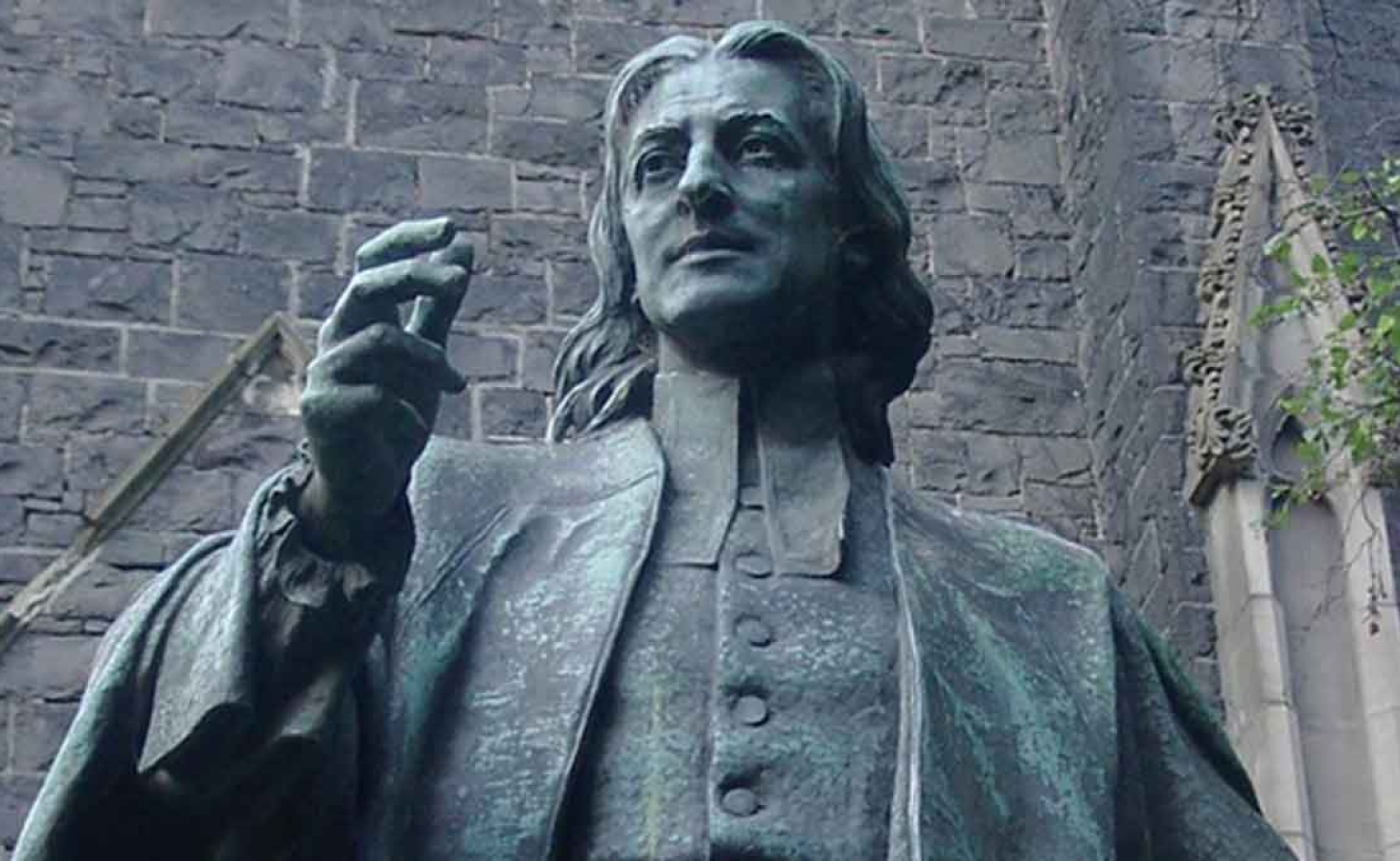
John Wesley is depicted as a young preacher in this sculpture by Adam Carr located in Melbourne, Australia. Public domain photo by Adam Carr/Wikipedia.
How John Wesley’s “Thoughts Upon Slavery” demolished 250 years of colonial propaganda — and why Ambassador David Comissiong wants the Caribbean to use it to win the reparations argument. In 1774, John Wesley posed seven questions about the transatlantic slave trade and answered each one with the testimony of travellers, jurists, and scripture.
Together, they constitute the most systematic demolition of slavery propaganda ever assembled in a single document. Ambassador David Comissiong’s 2026 Sarah Ann Gill Memorial Lecture invites the Caribbean to use them as weapons in the reparations campaign. Here is the full weight of that arsenal.
MONTEGO BAY, Jamaica, May 30, 2026 |Calvin G. Brown | History & Culture | The word most commonly attached to enslaved Africans in the literature of the Atlantic slave trade was “savage.” It appeared in legal documents, parliamentary debates, plantation manuals, newspaper advertisements, and the journals of ships’ captains.
It appeared so often, and was repeated so consistently across two centuries of European writing, that it ceased to be perceived as propaganda and settled instead into the comfortable status of received wisdom — a “fact” that required no evidence because everyone already knew it to be true.
John Wesley knew it was a lie. And in 1774, at the height of the British slave trade’s profitability, he sat down and proved it — methodically, citation by citation, question by question — in a 30-page pamphlet called Thoughts Upon Slavery.
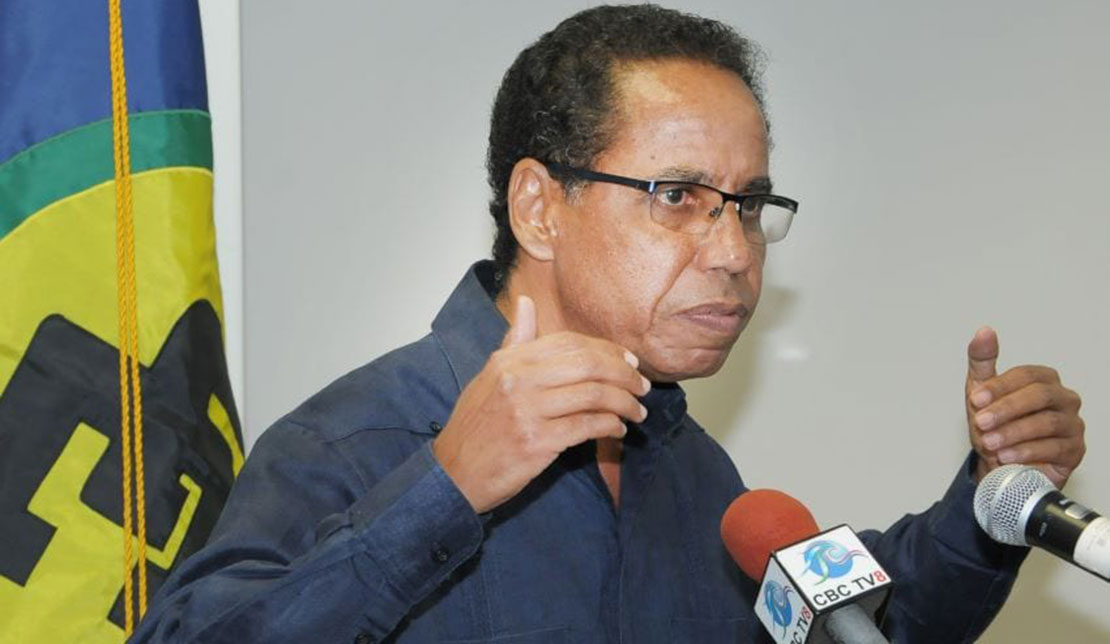
Ambassador David Comissiong argued that Wesley’s seven questions and their answers remain among the most powerful instruments available to the Caribbean reparations campaign.
Question One: What Kind of Country Were Africans Taken From?
The foundational myth of the slave trade required Africa to be a wasteland — a dark, barren, ungoverned space populated by people who had contributed nothing to human civilisation and who might therefore, in the twisted logic of European empire, be “rescued” from it. Wesley dismantled this construction at its base.
Drawing on the accounts of European traders, explorers, and missionaries who had no motive to flatter Africa, Wesley described the Senegal coast as a land whose interior was “the more fruitful and well-improved,” abounding in crops, vast meadows, large herds of cattle, and villages so numerous as to demonstrate a well-peopled country.
The Gold Coast and Slave Coast he described as “exceedingly fruitful and pleasant.” The kingdoms of Benin, Congo, and Angola received identical assessments. His conclusion was unambiguous: “Guinea in general is far from a horrid, dreary, barren country, but is one of the most fruitful, as well as the most pleasant countries in the known world.”
What Wesley was documenting was the world of the West African empires and kingdoms that had flourished for centuries before the first European slave ship arrived. The Ghana Empire, which dominated trans-Saharan trade in gold and salt from the 4th to the 13th century.
The Mali Empire, home to Mansa Musa, whose 1324 pilgrimage to Mecca distributed so much gold that it caused inflation across the Middle East and North Africa. Timbuktu — a city of 100,000 people and a centre of Islamic learning whose Sankore University housed an estimated 700,000 manuscripts.
The Songhai Empire, the largest in African history, with a sophisticated legal system, professional army, and standardised weights and measures. The Kingdom of Kongo, with a population of over two million and a centralised government with appointed provincial governors.
These were not the societies of brutes. They were the societies of builders, traders, scholars, farmers, and statesmen. The slave trade did not rescue people from poverty and chaos. It tore them from prosperity and civilisation, shackled them in its own chaos, and then had the audacity to call the theft a mission of mercy.
Question Two: What Kind of People Were the Africans?
This is the question that most directly confronts the “savage brute” fallacy, and Wesley’s answer, drawn from the firsthand accounts of European travellers, is devastating precisely because it cannot be dismissed as African self-promotion.
Of the peoples of the Senegal coast, Wesley recorded: “The people are of a quiet and good disposition: and so well instructed in what is right that a man who wrongs another is the abomination of all.” They were industrious farmers who cultivated their land with care, supported “all that are old, or blind, or lame among themselves,” and practised multiple trades — smiths, saddlers, potters, weavers.
Every town and village had a place of public worship. And — in a detail that should shame every society that later claimed to be more civilised — “there are no Beggars among them: Such is the care of the chief men, in every city and village to provide some easy labour even for the old and the weak.”
“Upon the whole, the Negroes who inhabit the coast of Africa are so far from being the stupid, senseless, brutish, lazy barbarians, the perfidious savages they have been described. On the contrary, they are represented by those who have no motive to flatter them as remarkably sensible… And are far more mild, friendly and kind to strangers than any of our Forefathers were.”
— John Wesley, Thoughts Upon Slavery, 1774
That last clause demands to be read slowly: the Africans were “far more mild, friendly and kind to strangers than any of our Forefathers were.” Wesley was writing to an English audience, reminding them that their own ancestors — the painted, warring tribes of ancient Britain — were by the same standard considerably less civilised than the Africans being branded on the chest and shipped across the Atlantic in chains.
The historical scholarship of subsequent centuries has only deepened the indictment. The Yoruba people built Ile-Ife as one of the world’s great urban centres before the year 1000. Their bronze and terracotta sculptures demonstrate a mastery of representational art that had no European parallel at the same period. The Asante developed a system of constitutional monarchy with separation of powers.
The Swahili Coast cities — Kilwa, Mombasa, Zanzibar — were international trading metropolises that Ibn Battuta described in the 14th century as among the most beautiful cities in the world. The Great Zimbabwe, a city of stone towers and walls built without mortar, was so far beyond what 19th-century European scholars expected that for decades they attributed it to Phoenicians rather than accept the evidence of African architectural genius.
The people kidnapped, branded, and sold were not savages. They were engineers, farmers, artists, traders, lawmakers, and healers of some of the most sophisticated societies on earth. The savage brute was a fiction invented to make theft feel like charity.
Question Three: How Were Enslaved Africans Procured?
The slave trade’s apologists constructed a self-exonerating mythology: Africa was already full of slavery when Europe arrived; Africans sold each other; Europeans merely participated in an existing system. This argument — which persists in distorted forms to this day — was addressed directly and demolished by Wesley two and a half centuries ago.
Wesley identified three methods of European procurement. The first was direct kidnapping: “Captains of Ships from time to time have invited Negroes to come on board, and then carried them away.” The second was armed raid: “The Christians landing upon their coasts, seized as many as they found, men, women and children, and transported them to America.”
The third — and this obliterates the “Africans sold each other” defence — was manufactured warfare. Wesley wrote: “Till then they seldom had any wars: but were in general quiet and peaceable. But the white men first taught them drunkenness and avarice, and then hired them to sell one another.”
The inter-African conflict that produced enslaved captives was, in substantial measure, a conflict that European slavers deliberately created, financed, and armed. To then point to that manufactured violence as evidence that Africans were inherently barbarous was the crowning lie of an entire system of lies.
Wesley also addressed the canard that African parents sold their own children: “That their parents sell their own children is utterly false: Whites, not Blacks, are without natural affection!” He inverted the accusation entirely, placing the charge of unnatural inhumanity precisely where the evidence supported it.
Question Four: How Were Enslaved Africans Transported?
England was sending approximately one hundred thousand enslaved Africans across the Atlantic every year. At least ten thousand died in the crossing. A further quarter died in what slave traders called “the Seasoning” — the period of forced acclimatisation after arrival in the Caribbean. One in three, in other words, did not survive long enough to be put to work. Their deaths were an accounting line.
Before boarding, the enslaved were examined naked by ship surgeons — men and women alike, “without any distinction” — and those approved were branded on the chest with a burning iron bearing the company’s mark. They were stripped of every garment they possessed. Several hundred were loaded into a single vessel and “stowed together in as little room as it is possible for them to be crowded.”
The historical record of the Middle Passage fills in what Wesley could only suggest. Enslaved people were chained lying down in shelves less than eighteen inches high for voyages lasting six to twelve weeks. They lay in their own waste.
Those who refused to eat were force-fed with an iron device used to pry open the mouth. Those who attempted suicide were punished with particular savagery; their death represented a financial loss. It was a floating factory of human misery, operated with bureaucratic efficiency, underwritten by banks, insurance companies, and investors whose names filled the ledgers of the most respectable commercial houses in Bristol, Liverpool, and London.
Question Five: Under What Conditions Did the Enslaved Live in the Americas?
Wesley described plantation conditions in language drawn from colonial observers: “Banished from their country, from their friends and relations for ever, from every comfort of life, they are reduced to a state scarce any way preferable to that of beasts of burden.
In general a few roots are their food, and two rags. Their sleep is very short, their labour continual and frequently above their strength: so that death sets many of them at liberty before they have lived out half their days.”
From the testimony of Sir Hans Sloane, Wesley recorded the specific tortures used as punishment and as terror: gelding, the chopping off of half a foot, whipping until the skin was raw, the pouring of pepper and burning fat into open wounds, dripping melted wax onto the body, cutting off ears and compelling their consumption, iron cages in which enslaved people were hung from trees and left to die of hunger and exposure. He recorded one plantation owner who “thought fit to roast his slave alive.”
The French missionary Père Labat, cited by Comissiong in his lecture, recorded that English overseers on 17th-century Barbados “beat them without mercy for the least fault, and appear to care less for the life of a negro than for a horse.”
And the product of all this? British historian Tristram Hunt, quoted by Comissiong, confirms that the profits of the slave trade “fertilized the entire production system of Great Britain.” Welsh slate, Manchester textiles, Glasgow and Liverpool banking, heavy engineering, and the financing of James Watt’s steam engine — all were capitalised by the plantation system. The Industrial Revolution was built on the broken bodies of people torn from civilisations that the propaganda of empire had falsely condemned as savage.
Question Six: Was Slavery Consistent with Justice?
Wesley’s answer was absolute: “The grand plea is, ‘They are authorised by Law.’ But can Law, Human Law, change the nature of things? Can it turn Darkness into Light or evil into good? By no means. Notwithstanding ten thousand Laws, right is right and wrong is wrong still.”
Wesley then enlisted Judge Blackstone to demolish all three classical legal foundations of slavery. Captivity in war gives no right to enslave a prisoner after the conflict ends — only to detain him. Voluntary sale of oneself is impossible because no equivalent can be given for life and liberty; the concept destroys itself. Birth into slavery inherits the invalidity of both prior justifications and falls with them.
“Where is the Justice of inflicting the severest evils on those that have done us no wrong? To which an Angolan has the same natural right as an Englishman? I absolutely deny all slave-holding to be consistent with any degree of natural Justice.”
— John Wesley, Thoughts Upon Slavery, 1774
The 52 nations that abstained at the United Nations in March 2026 have effectively been asked the same question Wesley posed in 1774. Their abstention is not a neutral act. It is a refusal to affirm what their own most revered moral thinkers already established as settled truth more than two centuries ago.
Question Seven: Was Slavery Economically Necessary?
Wesley acknowledged the economic argument on its own terms and then obliterated it: “I deny that villainy is ever necessary. It is impossible that it should ever be necessary for any reasonable creature to violate all the laws of Justice and Mercy, and Truth.”
He walked the argument to its logical conclusion: personal profit does not constitute moral necessity. The inability of white men to labour in tropical climates does not constitute moral necessity. And as for national glory — “Wealth is not necessary to the Glory of any Nation; but Wisdom, Virtue, Justice, Mercy, Generosity, Public Spirit, Love of our Country.”
It is worth sitting with the radicalism of that statement in its historical context. Wesley wrote this not as a marginalised activist but as one of the most respected men in England, at the precise moment when the slave trade was generating its maximum profits. He was telling the merchant, the parliamentarian, and the investor that their wealth was not glory but its opposite — a national moral catastrophe dressed in fine clothes.
The Verdict That Speaks Across Centuries
The reparations debate has long been conducted in forums where the opposing side controls the procedural rules. But Wesley’s seven questions operate on different ground. They are the testimony of England’s own most beloved son.
They cannot be dismissed as African grievance or Caribbean special pleading. They are the verdict of a white English Christian — ranked among the fifty greatest Britons who ever lived — who looked at the slave trade in full operation and called it what it was: fraud, theft, torture, murder, and an offence against God and natural law that no statute could justify.
And yet the question must be asked plainly: Are we prepared to accept Wesley as among the greatest Britons who ever lived — the father of Methodism, a colossus of faith and ecclesiastical history — yet conveniently dismiss him the moment he speaks on the treatment of Black people under chattel slavery? Either the man is credible or he is not. You do not get to claim Wesley’s legacy and repudiate his testimony.
The people who were taken were not savages. They came from civilisations with architecture, scholarship, legal systems, trade networks, and spiritual traditions. The violence was not African. The barbarism was not African. The savagery was not African. It crossed the Atlantic from Europe, made landfall on a continent at peace, and then had the audacity to name itself civilisation.
Wesley ended Thoughts Upon Slavery with a prayer: “O thou God of Love… Have compassion upon these outcasts of men, who are trodden down as dung upon the earth! Arise and help these that have no helper, whose blood is spilt upon the ground like water!”
The blood he was praying about is the blood whose reparation the Caribbean and the Global South are now demanding. Ambassador Comissiong’s challenge to the Caribbean is clear: hand Wesley’s 252-year-old testimony to the 52 nations that could not bring themselves to vote yes at the United Nations, and ask them — in the name of the faith and the values they claim as their own inheritance — what, exactly, do you need to hear?
— 30 —
