
WORLD | China Draws a Line at Hormuz: Beijing Warns Washington Its Tankers Will Not Be Stopped
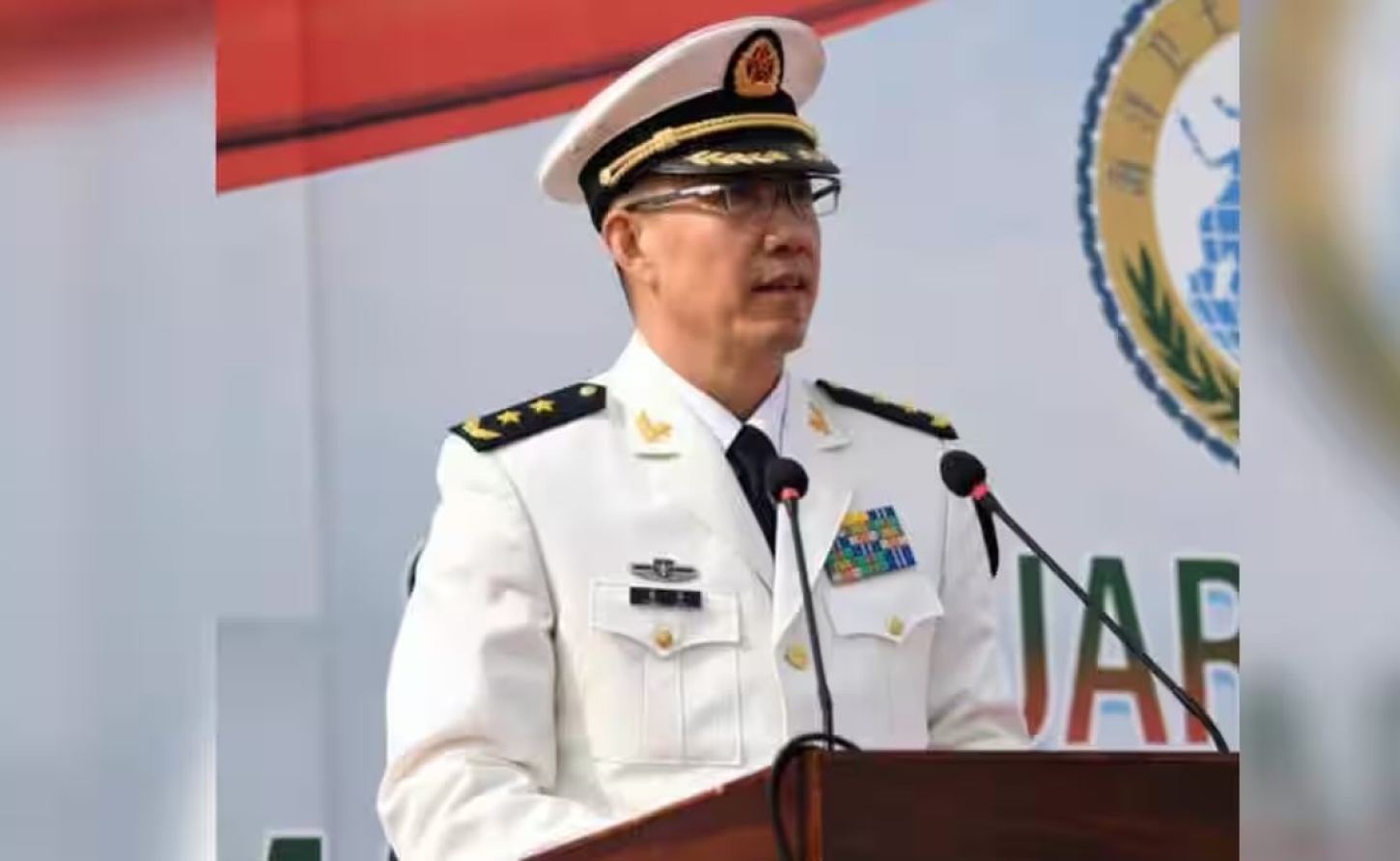
Chinese Defence Minister Dong Jun says bluntly: “We have trade and energy agreements with Iran. We expect others not to interfere in our affairs. The Strait of Hormuz is open to us.”
China Draws a Line at Hormuz: Beijing Warns Washington Its Tankers Will Not Be Stopped
As the US blockade of Iranian ports triggers history’s worst oil supply shock, China’s military and diplomatic machinery is drawing a hard line — and the Caribbean is already bleeding at the pump.
MONTEGO BAY, Jamaica, April 24, 2026| In the most direct military challenge to US naval authority in the Persian Gulf in decades, China has placed Washington on notice: its tankers will continue to move through the Strait of Hormuz, its energy agreements with Iran will be honoured, and any attempt to interfere will be met with force if necessary. The message from Beijing is not a diplomatic suggestion. It is a declaration.
Chinese Defence Minister Dong Jun set the tone bluntly: “We have trade and energy agreements with Iran. We expect others not to interfere in our affairs. The Strait of Hormuz is open to us.” China’s Foreign Ministry followed with a formal condemnation of the US blockade of Iranian ports as “dangerous and irresponsible,” warning that the escalation would only “aggravate confrontation, escalate tension, and undermine the fragile ceasefire.” Foreign Minister Wang Yi, speaking in Beijing during a meeting with UAE officials, was equally unambiguous — the blockade, he said, “does not serve the common interests of the international community.”
The Washington response was as belligerent as the provocation. A White House spokesperson defended the blockade as “securing the Strait of Hormuz to ensure freedom of navigation for all ships traveling to non-Iranian ports,” framing what is in effect a naval siege as a freedom-of-navigation exercise. The irony was apparently lost on those delivering it.
How the World Arrived at This Edge
The roots of this confrontation stretch back to February 28, 2026, when the United States and Israel launched a combined air war against Iran and, in a strike that shook the architecture of Middle Eastern geopolitics, assassinated Supreme Leader Ali Khamenei.
Iran’s response was swift and seismic: it closed the Strait of Hormuz — the narrow waterway between Iran, Oman, and the United Arab Emirates through which roughly a quarter of the world’s seaborne oil trade and twenty percent of its liquefied natural gas normally flow.
The Iranian Revolutionary Guard mined the waterway, boarded merchant vessels, and declared traditional sea lanes unsafe. Shipping firms suspended operations. Global oil markets went into shock.
By March, the International Energy Agency had characterised the crisis as the “largest supply disruption in the history of the global oil market,” with loadings through the Strait collapsing from over twenty million barrels per day to approximately 3.8 million. Global crude inventories fell by eighty-five million barrels in a single month.
Peace talks in Islamabad crumbled over the weekend of April 12. On April 13, Washington escalated: the US Central Command activated a targeted blockade of vessels entering or leaving Iranian ports and coastal areas. The Strait — already critically choked by Iran’s own restrictions — now faces what analysts have termed a “dual blockade.” It is a situation with no modern precedent.
“The Strait of Hormuz is open to us. We have trade and energy agreements with Iran, which we will respect and abide by. We expect others not to interfere in our affairs.”
— Chinese Defence Minister Dong Jun
The Fault Line Beneath the Surface
China’s posture is not merely about oil, though oil sits at the centre of it. Beijing is Iran’s largest crude buyer, and the blockade directly severs that supply line with immediate implications for the Chinese economy. But the confrontation runs deeper than commerce.
What China is defending at Hormuz is a principle: that the United States does not have the unilateral right to dictate the terms of global maritime trade, to impose economic siege through naval power, or to use international waterways as instruments of geopolitical coercion.
In that framing, Beijing’s challenge resonates well beyond the Persian Gulf. Across the Global South — from Latin America to Africa to the Caribbean — Washington’s history of weaponising trade routes, financial systems, and energy supplies against nations it opposes is neither forgotten nor forgiven. China is not simply protecting its tankers. It is contesting the unipolar order that makes such blockades possible.
The Trump administration, for its part, has framed its actions as leverage to force Iran back to negotiations and to prevent Tehran from acquiring nuclear capability. It has also warned that countries supplying Iran with weapons could face tariffs of up to fifty percent — a direct shot across China’s bow, which has denied arming the Islamic Republic. The language of diplomacy is being replaced, steadily, by the language of ultimatum.
The Caribbean in the Crossfire
Caribbean people are not watching this crisis from a safe distance. They are living inside its consequences. The near-total closure of the Strait has triggered what the IEA describes as the worst energy shock in recorded history, driving global oil prices to multi-year highs and provoking emergency measures from governments across the world.
For small island developing states that import nearly all of their fuel — states that have no strategic oil reserves, no domestic production buffer, and no room in already-strained national budgets — every dollar added to the barrel price is a direct assault on economic survival.
The timing is vicious. Jamaica and several CARICOM neighbours are still managing the economic trauma of Hurricane Melissa, attempting to rebuild tourism infrastructure, protect workers already displaced by hotel closures, and maintain social stability in communities stretched thin.
An energy price spike of this magnitude does not merely raise electricity bills. It inflates the cost of food production, ground transport, emergency services, and every sector of the economy that runs on imported fuel — which, in the Caribbean, is essentially all of them.
UNCTAD has flagged severe financial ramifications for developing countries from the Hormuz disruptions. The World Economic Forum has documented cascading impacts beyond oil — methanol, aluminium, fertilisers, and green energy supply chains are all under stress. In a region where food security is already fragile and energy dependency is structural, these are not abstract economic indicators. They are the arithmetic of hardship arriving at kitchen tables.
The Silence That Must End
CARICOM has been conspicuously quiet as this crisis unfolds. The regional body, which last year welcomed Interpol’s Secretary General as a special guest at its 49th Regular Meeting in Montego Bay to celebrate international cooperation, has offered no collective statement on the most consequential disruption to global energy supply in living memory — a disruption with direct and measurable harm to every member state. That silence is itself a political choice, and not a defensible one.
Caribbean nations did not start this war. They have no seat at the table where its terms are being negotiated. They have no vote in the councils of Washington, Beijing, or Tehran. But they bear the costs. That asymmetry — between who holds power and who absorbs consequence — is the defining condition of Caribbean existence in the international order.
The region’s leaders have a responsibility to name it, loudly, and to demand that multilateral institutions create mechanisms that protect small states from the fallout of great-power conflicts they had no hand in creating.
The Stakes
The Strait of Hormuz is not simply a body of water. It is a fulcrum of the global order — a twenty-one-mile-wide chokepoint through which the ambitions, dependencies, and rivalries of the world’s great powers pass daily in the hulls of oil tankers. When the United States parks its navy across that chokepoint and China responds by saying its ships will pass regardless, the world is witnessing not merely an energy dispute but a contest over who gets to write the rules of the international system.
For the Caribbean, the lesson of this crisis must be internalised: energy sovereignty is not a luxury aspiration. It is a survival imperative. Every year that passes without meaningful investment in regional renewable energy capacity, without diversified supply arrangements, without a collective energy security framework, is another year of exposure to exactly this kind of shock — delivered from thousands of miles away, by actors who have no idea what their decisions cost a fisherwoman in Hanover or a schoolteacher in Barbados.
China has drawn its line at Hormuz. The Caribbean must draw its own — not in the waters of the Persian Gulf, but in the boardrooms of regional governance, in the policy chambers of CARICOM, and in the political will to build an energy future that no superpower rivalry can hold hostage.
— 30 —
