
BARBADOS | “What Apology?” — The Bajan Voice Calls Out a 245-Paragraph Sleight of Hand
BARBADOS | “What Apology?” — The Bajan Voice Calls Out a 245-Paragraph Sleight of Hand
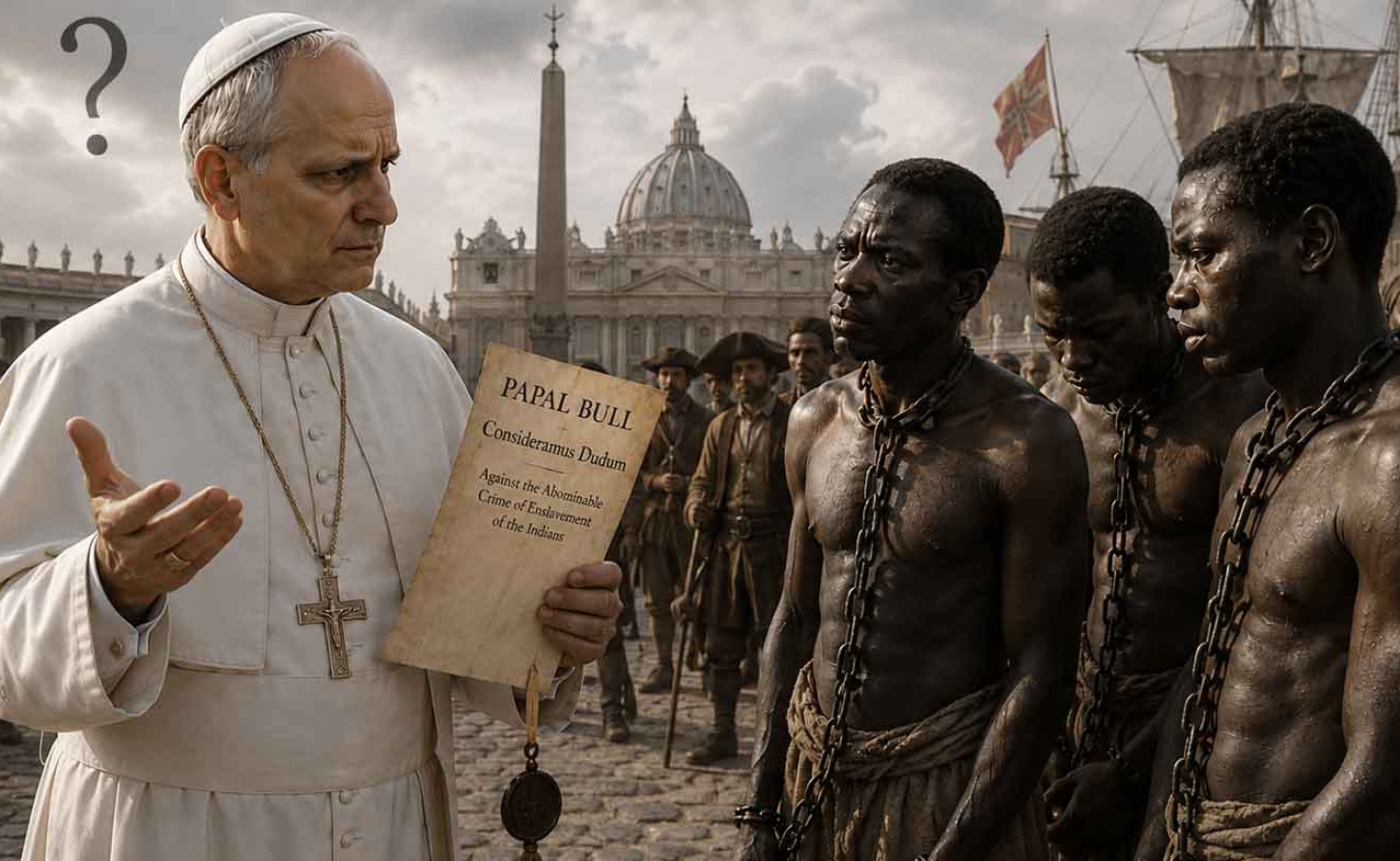
A Caribbean commentator tears apart the claim that Pope Leo XIV apologized to Africans and their descendants — and demands the real thing. Let us be honest about what happened — and what did not.
BRIDGETOWN, Barbados — June 14, 2026 - By The Bajan Voice | Special to WiredJa - On May 26, 2026, Pope Leo XIV signed his name to an encyclical called Magnifica Humanitas — 245 paragraphs devoted, in the main, to the Church’s anxieties about Artificial Intelligence and its threats to human dignity.
Buried within that document — not headlining it, not defining it, not even anchoring a dedicated section — was a single general paragraph in which the pontiff acknowledged that the Holy See had participated in 'slavery' and offered what some quarters have rushed, with unseemly haste, to call an “apology.”
I am compelled to speak plainly. That was not an apology. And our willingness to accept it as one is an insult to every ancestor who died in the hull of a slave ship.
The Anatomy of an Alibi
Read the document carefully. Magnifica Humanitas is, at its core, a papal meditation on the dangers of artificial intelligence — data harvesting, algorithmic exploitation, the concentration of digital power in the hands of a corporate few. It is only within that framework that Leo situates his acknowledgment of slavery.
The logic, as our WiredJa colleagues have noted, is deliberate: the Church, wishing to credibly condemn new forms of exploitation, first confesses its complicity in the original sin of treating human beings as commodities.
Convenient. Clinical. Calculated.
What was done to the Caribbean — to Jamaica, to Barbados, to Haiti, to Trinidad, to Martinique — was authorized by papal bull. Pope Nicholas V’s Dum Diversas in 1452 granted Portugal’s king the explicit right to “invade, conquer, fight and subjugate” Africans and “reduce their persons to perpetual slavery.” Romanus Pontifex followed three years later.
These were not aberrations. They were reaffirmed by Pope Callixtus III, by Sixtus IV, by Leo X. The Spanish crown received equivalent authority for the Americas. Centuries of Caribbean suffering trace a direct legal line back to those Roman offices.
And what does Leo XIV offer in response to this centuries-long, papally sanctioned crime against humanity? One paragraph. In a letter about computers.
“Our pain was specific. Our dispossession was specific. The instruments that authorized it were specific. Any genuine apology must be equally specific.”— THE BAJAN VOICE
What International Law Requires
I am not making this up, and I am not being dramatic. International law — the body of principles governing state and institutional accountability for historic crimes — is precise about what constitutes a proper historical apology. It must be directed specifically to the aggrieved nations and peoples.
It must contain an unambiguous acknowledgment of wrongdoing. It must be accompanied by genuine expressions of remorse. It must address the question of remedy and reparation. And it must be a standalone act — not a footnote tucked inside a document whose primary concern lies elsewhere.
None of those conditions were met in Magnifica Humanitas.
Furthermore, as WiredJa has reported, Pope Francis formally repudiated the Doctrine of Discovery in 2023 — but the Vatican never rescinded the original bulls. Those instruments, Dum Diversas and Romanus Pontifex, remain technically intact. Leo XIV’s encyclical does not rescind them either.
The legal and theological architecture of slavery’s authorization remains standing, even as the current Pope offers what amounts to a general expression of regret — addressed to no one in particular, extracted from no document of moral consequence.
The Dignity We Owe Our Ancestors
I am asking — I am earnestly requesting — my Black and African brothers and sisters to stop spreading the claim that Pope Leo XIV has apologized to Africans and People of African Descent. To characterize that one very general paragraph as an apology for the grave crime against humanity that was racialized chattel slavery is to grossly insult our ancestors.
We owe them more than this. We owe them the refusal to be cheaply satisfied.
This is not cynicism. This is self-respect. A people who have survived the Middle Passage, the plantation, colonialism, and its long economic aftermath do not get to be bought off with a sentence in a document about Netflix algorithms.
Our pain was specific. Our dispossession was specific. The instruments that authorized it were specific. Any genuine apology must be equally specific — directed to us, naming us, addressing what was done and what redress is owed.
“A people who survived the Middle Passage, the plantation, and colonialism do not get to be bought off with a sentence in a document about Netflix algorithms.”— THE BAJAN VOICE
What We Must Demand
Let us now inform the Pope — clearly, collectively, without sentiment — that what is required is a proper historical apology. One that contains all the critical elements that international law stipulates. One directed specifically to the nations and peoples of Africa and the African Diaspora.
One that addresses the still-intact papal bulls that provided the legal foundation for our ancestors’ enslavement. And one that opens a serious institutional conversation about reparative justice — not as charity, but as obligation.
The Caribbean, more than any other region on earth, has a right to make this demand. We absorbed the largest volume of enslaved Africans outside Brazil. Our plantation economies were the laboratories where racialized chattel slavery was refined to its most ruthless industrial form.
Our entire social architecture — our class structures, our colorism, our land distribution, our economic dependency — was engineered by that system, with Rome’s blessing.
One paragraph in an AI encyclical will not settle that account. We are watching, Your Holiness. And we are not impressed.
— 30 —
