
CARIBBEAN | How Trinidad Broke the Caribbean’s Only Leverage
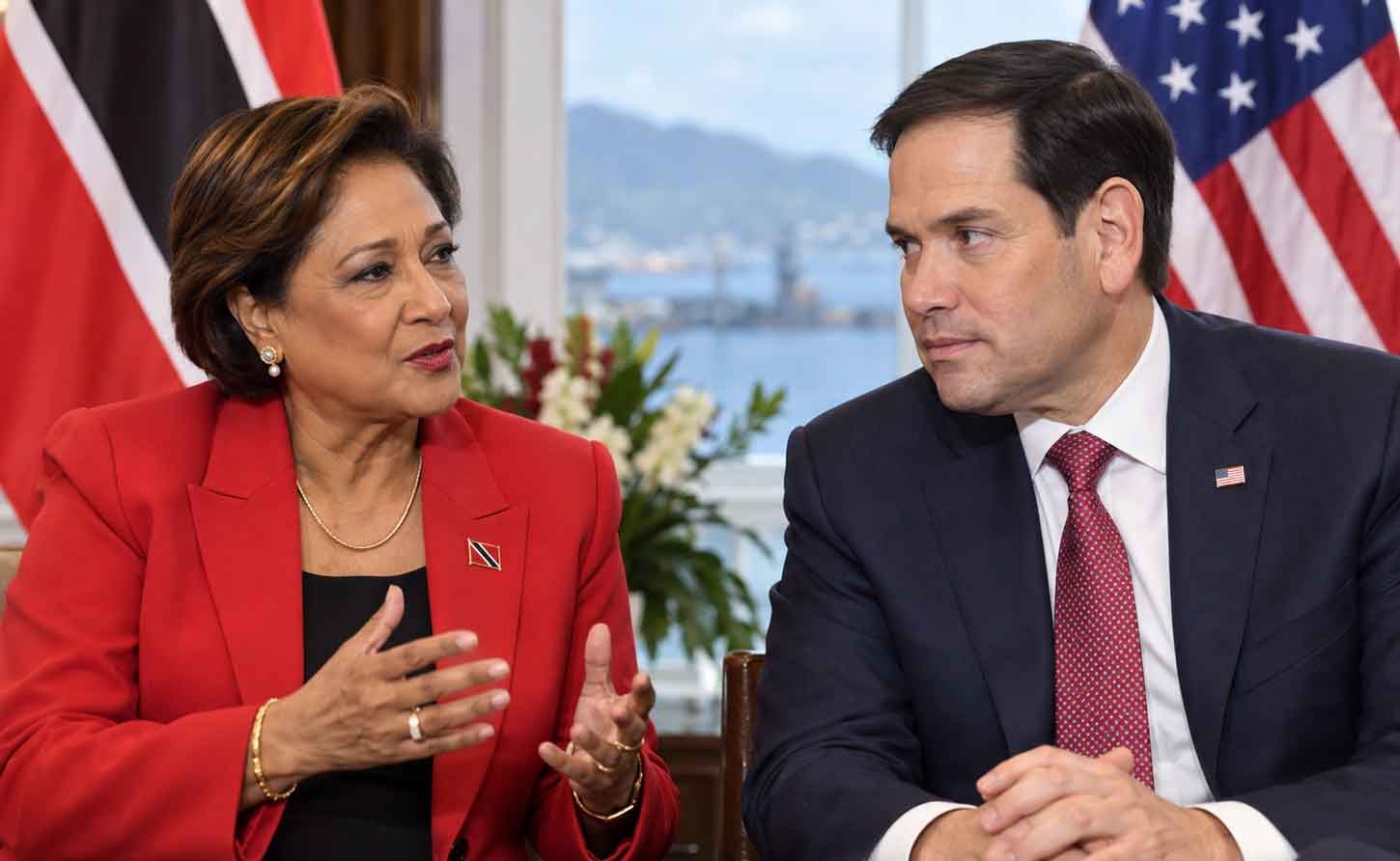
T&T Prime Minister Kamla Persad Bissessar and US Secretary of State Marco Rubio.
Washington is asking fourteen small states to refuse the only lender arriving with concrete. It has not said what replaces it. Trinidad and Tobago stopped waiting for the answer — and took the region’s one shared asset with it.
The photograph at Doral
On 7 March 2026, at a golf resort in Miami, Kamla Persad-Bissessar stood for a photograph beside Donald Trump at a summit convened under the name Shield of the Americas. Eleven days earlier, in Basseterre, she had told her fellow Heads of Government that Trinidad and Tobago would no longer be bound by CARICOM’s political ideologies or its foreign and security policies. Her country, she said, would defend its sovereignty as it saw fit.
Read the two events in sequence and the shape of the year becomes clear. The Caribbean has spent 2026 being asked a question it was never given the standing to negotiate: whose money, and on whose terms. Trinidad answered first, answered alone, and answered unusually well for itself.
The ledger nobody agrees on
Any honest comparison of Chinese and American investment in this region has to begin by admitting that the measurement is rigged in both directions.
China’s footprint is countable because it arrives as contracts. Highway 2000, Jamaica’s largest infrastructure undertaking at roughly US$1.3 billion, drew financing from regional commercial banks, multilateral lenders and the China Development Bank, and its North–South leg was delivered by China Harbour Engineering Company under a fifty-year concession with development land attached.
By 2022, ten Caribbean states had signed Belt and Road memoranda. United States Southern Command has counted some forty Chinese port projects between The Bahamas and the southern tip of the continent.
The ledger is less lurid on inspection. The US$274.5 million Montego Bay Perimeter Road, routinely filed under Chinese influence, was financed by the Jamaican treasury — Andrew Holness made a point of saying the country did not need to borrow for it. CHEC was the contractor, not the creditor.
The Rhodium Group has found that Beijing renegotiates loan terms far more often than it seizes assets; the Hambantota parable travels better than the evidence behind it. And the region’s debt overhang was built, overwhelmingly, inside Western institutions.
A great deal of what Washington counts as its contribution is remittances — money Caribbean people send to themselves.
The American ledger has the opposite problem. It is enormous and almost invisible. Foreign direct investment stock, tourism receipts, preferential market access under the Caribbean Basin arrangements and the correspondent-banking plumbing the whole region depends on dwarf anything Beijing has committed.
Yet a great deal of what Washington counts as its contribution is remittances — money Caribbean people send to themselves. Booking that as American investment is a category error, and everyone in the room knows it.
A warning without a wallet
What the region has received in abundance is advice. Marco Rubio carried it to Jamaica, Guyana and Suriname in March 2025, and to St Kitts and Nevis in February 2026, tying American support to a decisive turn away from Beijing. Panama, under comparable pressure, withdrew from the Belt and Road altogether.
The difficulty is what accompanied the advice. The American assistance architecture was frozen and then dismantled. Senators of both parties wrote to Rubio warning that a blanket hemispheric freeze cut directly against the China-countering objective being invoked to justify it.
A finance minister told to refuse the only bidder at the table, and offered nothing in the same breath, has not been handed a policy. He has been handed a preference and asked to pay for it.
To Washington’s credit, this is changing. In July the administration notified Congress of a programme to replace Caribbean and Central American undersea cable infrastructure with trusted alternatives — hundreds of millions of dollars, and the first serious capital commitment of the period.
That deserves saying plainly, because American policy’s critics in this region rarely do. It is also worth noticing what it funds: telecommunications security, an American strategic interest that happens to sit in Caribbean water. It is not a growth strategy. Nobody in Portmore or Point Fortin gets a job out of a cable.
The Trinidad exception
Persad-Bissessar’s case deserves to be put at its strongest, because it is stronger than her critics allow.
She inherited a gas economy running short of gas, and a murder rate she attributes in significant part to trafficking across the Gulf of Paria. She campaigned against the Dragon project and pronounced it dead on taking office, with some justification: the licence granted in 2023 had already been revoked once, and a decade of People’s National Movement effort had produced no molecules. Consensus diplomacy had delivered her nothing she could bank.
Alignment delivered within months. In February the United States Treasury issued General Licences 49 and 50, naming Shell and BP and reopening Dragon and the Manakin–Cocuina cross-border field.
By August she was standing beside BP executives discussing Calypso, 4.4 trillion cubic feet of it, operatorship consolidated after Woodside sold out. Set against that record, “zone of peace” is an abstraction — and she has called it something harsher than that: fakery.
The rejoinder is not that she was wrong to chase the gas. It is that a licence is a lease. The 2023 authorisation was withdrawn by the same instrument that granted it, and General Licences 49 and 50 can go the same way on an afternoon’s notice. Trinidad has not acquired leverage. It has acquired a landlord.
What broke, and how
The damage is specific, and it is not sentimental.
At the fiftieth Heads of Government meeting, the reappointment of Secretary-General Carla Barnett was settled in a leaders’ retreat rather than in plenary, with Trinidad and Tobago, Antigua and Barbuda and The Bahamas absent from the decision. Port of Spain’s procedural objection was a fair one, and the Community has never adequately answered it.
The bloc’s response was to proceed. Persad-Bissessar’s was to declare CARICOM “not a reliable partner at this time” and demand Barnett’s departure. Both responses cost something. Only one of them was difficult to reverse.
The consequence surfaced on 3 January, when American forces struck Caracas and removed Nicolás Maduro. It was the most significant use of force in this sea in a generation, and the Caribbean Community arrived at it without a collective position, because one of its largest members had spent the preceding months arguing the opposite of the bloc’s stated one.
That is what the leverage was. Not a treaty and not a fund, but a presumption that fourteen governments would answer as one — which made each of them slightly harder to ignore than its population warranted.
The arithmetic that remains
The choice in front of this region was never China or America. Small states have never had capital. What they had was arithmetic. One member, one vote, and one bargain struck on behalf of all — that was the entire proposition of 1973, and it was the only asset the Caribbean owned that Washington and Beijing both had to negotiate around.
Trinidad got its licences. The other thirteen will now discover what their own are worth, negotiated one at a time.
— 30 —
