
CARICOM | Patterson Sounds the Alarm on Caribbean Sovereignty ‘We Are Moving in the Wrong Direction’
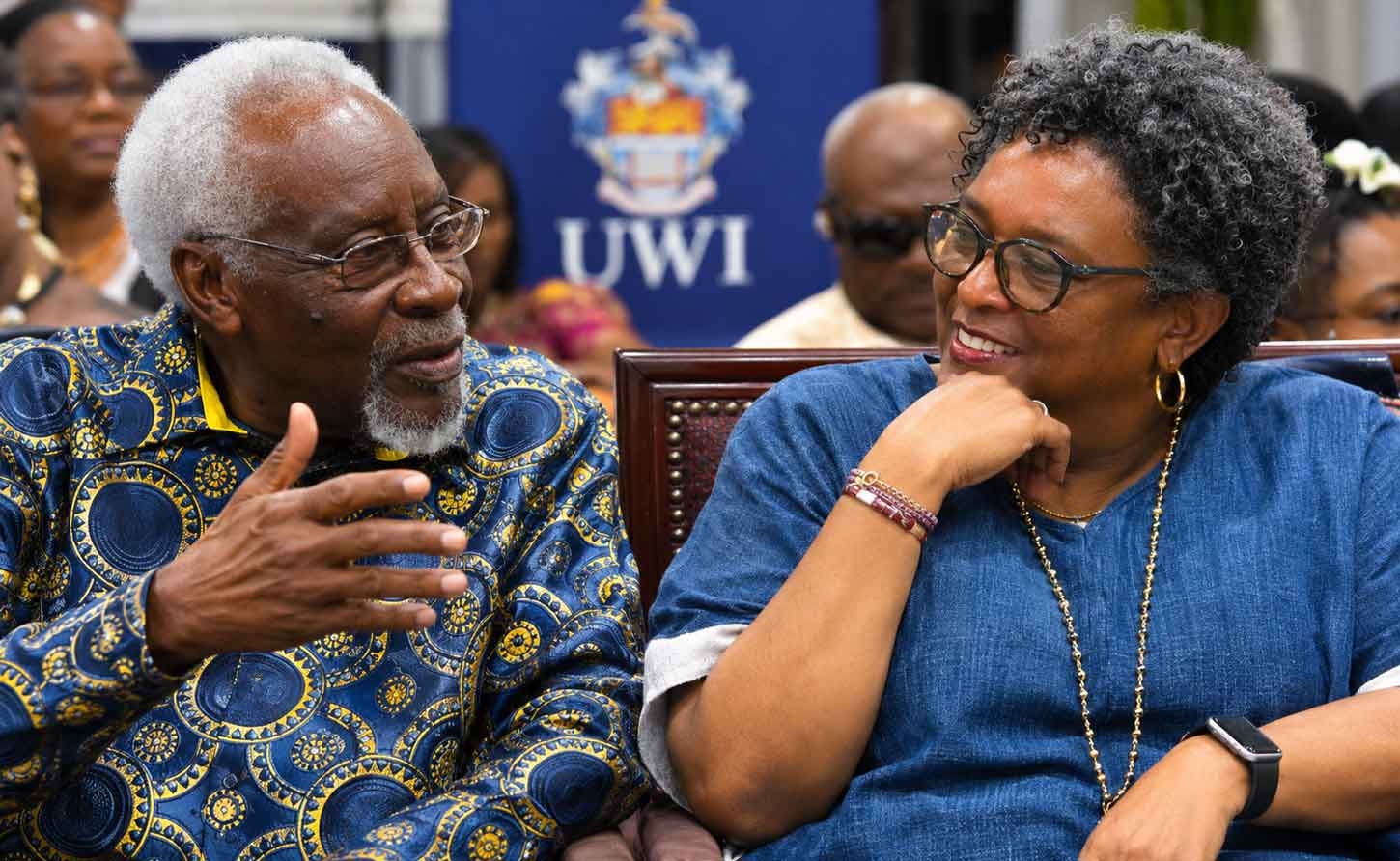
Former Prime Minister P. J. Patterson and Barbados Prime Minister Mia Amor Mottley at the November 15 launch of Caribbean Integration: The Patterson Doctrine — Governance, Transformation and the Future of the Caribbean Community.
At the Mona launch of a book bearing his name, Jamaica’s longest-serving prime minister warns that the four pillars on which Caribbean sovereignty was built are being chipped away — and that no member state has the right to do it.
MONTEGO BAY, Jamaica, November 17, 2026 - Calvin G Brown - “We are moving in the wrong direction.” With those seven words, former Jamaican Prime Minister P.J. Patterson passed judgement on the state of the Caribbean Community — and he did it at the launch of a book that bears his own name.
He did not name names. He did not need to. Standing before a Sunday-evening audience at the University of the West Indies, Mona, Patterson followed that verdict with a sentence that landed like a gavel:“Without casting stones at anyone, I would say no member nation of the Community has the right to whittle away any of those fundamental principles.”
The occasion was the November 15 launch of Caribbean Integration: The Patterson Doctrine — Governance, Transformation and the Future of the Caribbean Community, the 386-page study by former Governor General Professor Sir Kenneth Hall and Myrtle Chuck-A-Sang. Patterson’s brief was modest: a few remarks, then an introduction of the guest speaker, Barbados Prime Minister Mia Mottley. What he delivered, in under half an hour, was a statesman’s warning that the ground on which Caribbean sovereignty stands is being dug out from under it.
Four men, four pillars
Patterson took his audience back to the beginning — to the years when, as a young minister, he helped convert the Caribbean Free Trade Association, CARIFTA, into a common market and then into the Caribbean Community. That project, he reminded them, “was based on the work of four independent national leaders”: Eric Williams of Trinidad and Tobago, Michael Manley of Jamaica, Forbes Burnham of Guyana and Errol Barrow of Barbados — the quartet who, in 1972, defied hemispheric orthodoxy by jointly recognising Cuba, and who signed the Treaty of Chaguaramas the following year.
From them, Patterson said, came four principles. First, that sovereignty meant equality for all, but was most effective when exercised collectively. Second, that the Caribbean was to be a zone of peace. Third, the rule of international law. Fourth, the right to self-determination.
On the zone of peace, he credited Williams with leading the argument, recalling the Trinidadian leader’s observation that European powers had fought more wars in the Caribbean than on the continent of Europe itself. The founders, in short, were finished with the region serving as somebody else’s battlefield.
On international law, Patterson was blunt about why it was never an abstraction for small states: “For those of us who were small and, in terms of military might, weak, we had no other source on which to rely.”
“These are the four fundamental principles enshrined at Chaguaramas, and they are embedded in the DNA of the Caribbean Community.” — P.J. Patterson
‘Seismic convulsions’
Patterson has watched the Community wobble before, and said so. Democracies change governments; ideologies collide; tremors are to be expected. “Grenada, and the invasion of it in 1983, nearly crushed the Community once and for all,” he said. Then came the pivot: “But nothing before has been like the seismic convulsions we are witnessing today.”
He called it “a matter of profound sadness” that the tides now running through the region are pulling it apart rather than drawing it together. That was the judgement behind his seven-word verdict — and he offered it without qualification.
The context he left unspoken is no secret. Since late 2025 the Caribbean has lived with a United States military build-up in its waters, lethal strikes on vessels Washington says were running drugs, and the US assault on Venezuela. Trinidad and Tobago’s Prime Minister, Kamla Persad-Bissessar, has thrown her government’s support behind the American military presence and derided the regional position as “zone of peace fakery.” In January, the Trump regime issued an executive order threatening economic retaliation against any country supplying oil to Cuba.
And at the United Nations last month, more than three decades of solid CARICOM support for the annual resolution against the US embargo of Cuba gave way. Patterson did not let that pass. He saluted what he called “the CARICOM Magnificent Seven that stood firm for the people of Cuba” — and pointedly counted Barbados among them.
The case on the other side
Those who have broken ranks do not accept that they are vandals at the foundation. Persad-Bissessar has argued that CARICOM stayed silent while Venezuela’s government threatened two member states, and that US operations against narco-trafficking are what will make the region a true zone of peace. Jamaica’s Prime Minister, Dr Andrew Holness, speaking as outgoing CARICOM chairman in February, insisted that the Community “is not and has never claimed to be a political union” and that its treaty mandates no single foreign policy.
Patterson’s answer was to separate the negotiable from the non-negotiable. Ideological differences, he allowed, “are bound to arise.” The four principles are a different matter. They are not policy preferences to be traded with each change of administration; they are the terms on which small states agreed to face a large world together.
Exorcising the federal ghost
If the diagnosis was grim, the prescription was unsentimental. “For six decades we have been haunted by the federal ghost,” Patterson said — a reference to the collapse of the West Indies Federation in 1962 and the suspicion of regional authority that has shadowed every integration effort since. It is time, he argued, to exorcise that ghost once and for all, because global turbulence leaves the region no path to salvation except forward, towards what he and the book describe as “a mature, resilient and vibrant regionalism.”
Nor was his impatience confined to history. Noting that Mottley is the most senior member of the CARICOM committee on governance and finance, set up to make the Community fit for purpose, he disclosed what he had just whispered to her: “That committee needs to get to work, and now.”
Across the Atlantic
The sharpest geopolitical note came near the end. Naming Washington’s revived claim to hemispheric dominance — “the ‘Donroe Doctrine’ as it is named” — Patterson said that hegemonic doctrine “compels us to establish meaningful links with global Africa.” He could not resist an aside to the book’s author: “Prof, you see why I don’t like my name associated with doctrines.”
Mottley, he revealed, was leaving Kingston that night not for Bridgetown but for Sierra Leone. And Patterson, speaking “from my vantage point in the pavilion,” said he is working with colleagues on the African continent on the design of a global African coalition — one embracing not only governments but groupings of people across Africa’s six regions and the diaspora in the Americas, the United Kingdom and the Middle East.
A charge to the next generation
He reserved his final challenge for the faculty and students in the room, whose presence he singled out with evident delight. Mona, he said, was conceived as the place where the Caribbean would find its own solutions. He asked them “to be the vanguards of the change we need.”
Then, with a flourish of alliteration, he handed the podium to “the gem from Barbados, the jewel of the Caribbean,” fresh from a third consecutive clean sweep of all 30 seats.
But it is the earlier sentence that will travel. Four leaders of four small, newly independent states chose collective sovereignty, peace, law and self-determination because, lacking armies and empires, they had nothing else to stand on. At 91, the man who was in the room when CARICOM was built has put the region on notice: whittle away the pillars, and do not be surprised when the roof comes down.
— 30 —
